By: Rachel Barry
In an earlier blog post, I shared my want to learn more about my students through writing. I challenged myself to create more opportunities to allow my students to express themselves through writing. After talking to various teachers (of various subjects, I might add), I decided to start journaling with my students. I will be honest, a majority of my ideas for implementation were stole from US History teacher Saarah Mohammed.
The Process
Starting in Quarter 4, a prompt was posted on Schoology each Friday for students to reflect and respond to. Students were given approximately 10 minutes to write, though when needed, students could take more time. I started with prompts that I was curious about "Without monetary constraints, where in the world would you travel to? Why do you want to travel there, and who would you take with you?" Then, by Saarah's recommendation, I started using next years' Common App writing prompts as inspiration. For example, I adapted "Discuss an accomplishment, event, or realization that sparked a period of personal growth and a new understanding of yourself or others." to "What is your proudest accomplishment?"
The Effect
I was amazed at how open my students were in sharing some personal stories and feelings, and I loved the students reactions when they saw that the day's agenda included a journal. I saw my students in a new light, as some who normally struggle in math were thriving in the world of writing, while others were more frustrated that they couldn't just get right to simplifying complex numbers.
I learned so much. I learned about a student who have overcome depression and suicidal thoughts, another who want to study abroad because they have never left Des Plaines or Elk Grove Village, a student who can't wait the fall to be able to go to their farm and help out with the harvest, one who shared being asexual and wants to educate others, a student who is working hard on his Eagle Scout project, another who is struggling to care for her younger sister when the parents are rarely in the picture, and so many students excited about their school activities. I am eternally grateful for my students' willingness to share their stories with me, as I am forever changed by these relationships that I have built.
Next Steps
Now that I have opened this can of worms, I can't close it. I know that I will start the year with my students journaling and continue the process throughout. Starting earlier and building this process, I hope to also incorporate some academic self-reflection questions, such as "What grade have you earned?" (stolen from Mark Heintz), "How can you use the feedback from _ assignment/assessment to improve your learning?", or "Now that you have achieved your goal, what is your new goal?" My goal is to build more metacognition skills as well as break down the barrier that we can only learn math in a mathematics class.
One of the things that surprised me the most was that the students who forgot their iPads and wrote their journals on paper tended to write more. However, I wasn't able to keep a conversation going, as I did with other students in the comments section on Schoology. I have debated the idea of each student having their own journal, though logistically this could be difficult, as I typically read these journals at home over the weekend. If anyone has any insight into trying some of these methods, I would greatly appreciate any imput!
Showing posts with label mathematics. Show all posts
Thursday, May 31, 2018
Tuesday, January 16, 2018
Reading Essays in Math...What?!
By: Rachel Barry
A Math Teacher's Jealousy
I admit it, I'm jealous of English teachers. All of the time. I hear about the moving essays that students write in their English classes, sharing insight into the students' pasts. There is a different, deeper relationship that can be built when you have read someone's words and heard details of their life experiences. When I talk to English teachers, I am amazed by the openness that students are willing to share their personal stories, of which I am then jealous that I am not privy to seeing this side of my students. Also, at a school with students from many different backgrounds, including numerous students who do not call English their first language, these teachers are better able to understand the student's level of English proficiency.
If I ask my students to write an essay outside of class, would they do it? Am I adding to their plate when this is not a skill assessed in either of the courses that I teach? Will they do this if it is not for a grade? After much brainstorming, I came to what I believed was a solid solution. What if I asked students to submit an essay that they have already written? I finally decided that I just needed to find a platform to be able to read my students' writing.
As students were finishing up their finals before Winter Break, I asked them to submit any essay that they have written. For some of my seniors, this could be a college admissions essay, while for my other students, I offered that they submit an essay in which they share insight into who they are as an individual or an essay that they are proud to have written.
This. Was. Awesome.
I learned soooo much. I learned about a student navigating life with immigrant parents, a student who had a parent suffer a life-threatening accident and the journey towards recovery, a student who had been diagnosed at a young age with epilepsy, a student who skipped a grade in elementary school, a student who is a DREAMer, and many students shared their passions for various sports/activities/technologies.
This exercise has not only opened my eyes to future possibilities, but it has also opened the dialogue with other teachers.
Call To Action
Now that I have a much better understanding of students' writing abilities, I want to build more writing in math. I want to focus on building opportunities in my math courses to have students write more in class, to express their mathematical understandings. In a future blog post, I will reflect on the writing about the current mathematical content.
If you have other ideas for interdisciplinary activities that can gain insight into students' writing and/or details of their life, please share by stopping down in the Collab Lab or in the comments section on this blog!
A Math Teacher's Jealousy
I admit it, I'm jealous of English teachers. All of the time. I hear about the moving essays that students write in their English classes, sharing insight into the students' pasts. There is a different, deeper relationship that can be built when you have read someone's words and heard details of their life experiences. When I talk to English teachers, I am amazed by the openness that students are willing to share their personal stories, of which I am then jealous that I am not privy to seeing this side of my students. Also, at a school with students from many different backgrounds, including numerous students who do not call English their first language, these teachers are better able to understand the student's level of English proficiency. If I ask my students to write an essay outside of class, would they do it? Am I adding to their plate when this is not a skill assessed in either of the courses that I teach? Will they do this if it is not for a grade? After much brainstorming, I came to what I believed was a solid solution. What if I asked students to submit an essay that they have already written? I finally decided that I just needed to find a platform to be able to read my students' writing.
As students were finishing up their finals before Winter Break, I asked them to submit any essay that they have written. For some of my seniors, this could be a college admissions essay, while for my other students, I offered that they submit an essay in which they share insight into who they are as an individual or an essay that they are proud to have written.
This. Was. Awesome.
I learned soooo much. I learned about a student navigating life with immigrant parents, a student who had a parent suffer a life-threatening accident and the journey towards recovery, a student who had been diagnosed at a young age with epilepsy, a student who skipped a grade in elementary school, a student who is a DREAMer, and many students shared their passions for various sports/activities/technologies.
This exercise has not only opened my eyes to future possibilities, but it has also opened the dialogue with other teachers.
Call To Action
Now that I have a much better understanding of students' writing abilities, I want to build more writing in math. I want to focus on building opportunities in my math courses to have students write more in class, to express their mathematical understandings. In a future blog post, I will reflect on the writing about the current mathematical content.
If you have other ideas for interdisciplinary activities that can gain insight into students' writing and/or details of their life, please share by stopping down in the Collab Lab or in the comments section on this blog!
Tuesday, September 26, 2017
Student Involvement in Assessment (Part 2)
By: Rachel Barry
This is the second post in a series focusing on involving students in the assessment process. For the first post, click here.

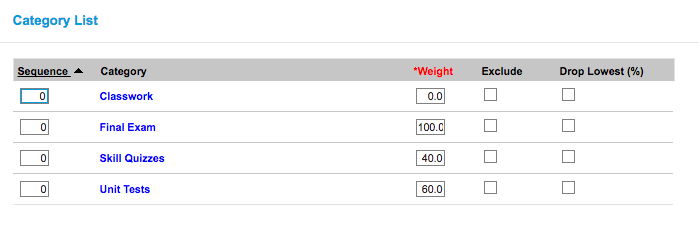
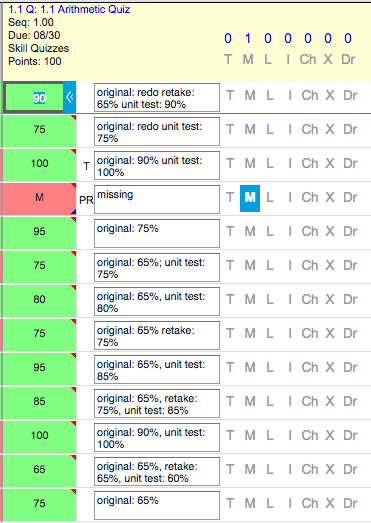
I loved this activity, and I'd rather not call it an assessment. I feel that the students learned so much from being given a "second chance." The struggle that I have is that I am obligated to report something in the gradebook. This year, I am only reporting summative unit test scores towards students grades, so all quizzes are going in the formative assessment category in the gradebook (a 0% category). Because of this, I had some flexibility on how to report this to be as informative as I wanted. For the score, I averaged the two scores, and in the comments section, I reported both the original score and their edited score (as seen to the right). I LOVE the comments section!
This is the second post in a series focusing on involving students in the assessment process. For the first post, click here.
In continuing to include students in the assessment process, I am exploring methods of self-reflection and peer editing, as well as open to suggestions that I hope other educators will share with me. For our second quiz, I had my regular Algebra II students edit their own quizzes. First, I had them take the quiz as they normally would, and I made marks (in blue) only if the problem was incorrect. I gave no scores. Then, the next day I handed back the quizzes, along with a green pen, to each student. Students corrected the problems that they got wrong in the green pen.
The conversations were awesome! The topic is simplifying radicals, so it is common for students to make silly mistakes or make the same mistake throughout all problems. Many students quickly realized what they did incorrectly and were able to make the necessary adjustments to their work. For the students who struggled on this topic more than others, I was able to give them more one-on-one instruction to better understand this topic.

I loved this activity, and I'd rather not call it an assessment. I feel that the students learned so much from being given a "second chance." The struggle that I have is that I am obligated to report something in the gradebook. This year, I am only reporting summative unit test scores towards students grades, so all quizzes are going in the formative assessment category in the gradebook (a 0% category). Because of this, I had some flexibility on how to report this to be as informative as I wanted. For the score, I averaged the two scores, and in the comments section, I reported both the original score and their edited score (as seen to the right). I LOVE the comments section!
I'm continuing to explore new methods to build a positive learning experience and student self-reflection from the assessment process. I would love to hear any ideas that you have as well, so comment here, tweet at me, or stop down in the Collab Lab!
Tuesday, September 5, 2017
Student Involvement in Assessment (Part 1)
By: Rachel Barry
When I was a student, I was the true definition of a rote learner. I also was very involved in extra-curricular activities, so I would do what I needed to in order to obtain the grade I wanted. Now as a teacher, I regret that the school system allowed me to spend so much time focusing on grades, instead of truly learning.
Attitude Towards Grades
I feel that a significant part of this was the assessment process. If I got a poor score on a test, I didn't always go back to learn what I missed. If it was going to be included on another assessment (ie: final exam), I would learn enough to get by, but never go back to fully understand the content and how it related to the course or real life. As a teacher I am now trying to change how I assess (both formatively and summatively) to create learning experiences from these assessments. I had been finding that students who receive an "A" feel that they have learned all that they need to learn, and student who receive an "F" feel that they cannot learn. Therefore, I am working to promote continuous growth through assessments, instead of an assessment being the "final call" of what a student knows.
Getting Students Involved in the Process
Last year, I started incorporating students in the assessment process. For the first quiz of the year, I have students grade their own assessment. I do this by passing back each student's quiz with a colored pen. I show the answer key over Apple TV and talk through how I grade each problem. Finally, I show how I use the grading rubric to assign a grade to the quiz.
Once they have assigned their grade, I have them go through the questions that they got wrong and make corrections.
When I was a student, I was the true definition of a rote learner. I also was very involved in extra-curricular activities, so I would do what I needed to in order to obtain the grade I wanted. Now as a teacher, I regret that the school system allowed me to spend so much time focusing on grades, instead of truly learning.
Attitude Towards Grades
I feel that a significant part of this was the assessment process. If I got a poor score on a test, I didn't always go back to learn what I missed. If it was going to be included on another assessment (ie: final exam), I would learn enough to get by, but never go back to fully understand the content and how it related to the course or real life. As a teacher I am now trying to change how I assess (both formatively and summatively) to create learning experiences from these assessments. I had been finding that students who receive an "A" feel that they have learned all that they need to learn, and student who receive an "F" feel that they cannot learn. Therefore, I am working to promote continuous growth through assessments, instead of an assessment being the "final call" of what a student knows.
Getting Students Involved in the Process
Last year, I started incorporating students in the assessment process. For the first quiz of the year, I have students grade their own assessment. I do this by passing back each student's quiz with a colored pen. I show the answer key over Apple TV and talk through how I grade each problem. Finally, I show how I use the grading rubric to assign a grade to the quiz.
Once they have assigned their grade, I have them go through the questions that they got wrong and make corrections.
As you can see, students are using this assessment as a learning tool, fostering more growth and understanding. These quiz grades go in the gradebook in the formative category, so there isn't a battle over getting "points" back. The conversations with students were focused on the content and application of skills instead of spending time discussing grades. It was awesome!
Personal Reflection
As I continue to grow in my professional development, I am becoming less scared of trying new things. Throughout the year, I hope to keep the assessment conversation going, as well as continuously obtain student input as to assessment methods that continue to motivate them in the learning process. I will continue to think back on the thought of "What would have made me want to learn in class?" instead of my high school mentality of "What do I need to do in order to get the grade that I want?" I will be following up with more posts on student involvement in the assessment process, so stay tuned!
Wednesday, August 23, 2017
Critical Thinking on the First Day of School
By: Rachel Barry
Following up on yesterday's post on the ways teachers build relationships with and among students on the first day of school, I wanted to share a more in-depth look at my first day of classes.
This past spring and summer, numerous math teachers around the district embarked on an opportunity to take a massive open online course (MOOC) from Stanford University called How to Learn Math for Teachers. This course focused on how to change student mindsets towards mathematics, pedagogical strategies to promote active learning, and build critical thinking skills. (Small plug...there were about 80 teachers across the district - math, science, special education - who took this course, and it was AWESOME!). Prior to taking the class, I felt that I had a strong understanding of how to change the focus in class from grades to learning, however, this class gave me numerous more strategies to emphasize this more through how I communicate and how I create effective classroom activities. Here are some activities that I did on the first day of classes to both build relationships as well as challenge students to think critically.
Would You Rather...?
In groups, I had students develop a "Would You Rather...? statement, one per group, and wrote it on their tables (see whiteboard tables here). Then, the students rotated around the groups and voted at each table.
In my AP Statistics class, I took this a step further and had students discuss the expected outcome prior to voting. This is a key concept of statistics, so I loved being able to bring it up on the first day. In this class, we continued the first day by performing a simulation where they worked in groups, getting to know one another, and getting introduced to statistics.
In my regular Algebra classes, I had the students calculate the percentages of tallies for each. It was interesting to see the various methods that students used (proportions, decimals, etc) and whether or not the set up two equations or if they calculated one and then subtracted that from 100 to get the other. We then had a class discussion on how many math problems can be solved using different steps or methods.
This lead perfectly into my next activity...
Number Sense Activity
For this activity, I put this problem on the board and showed students how to solve this using traditional methods. Then I challenged them in their groups to come up with FOUR other ways to solve this problem.
Following up on yesterday's post on the ways teachers build relationships with and among students on the first day of school, I wanted to share a more in-depth look at my first day of classes.
This past spring and summer, numerous math teachers around the district embarked on an opportunity to take a massive open online course (MOOC) from Stanford University called How to Learn Math for Teachers. This course focused on how to change student mindsets towards mathematics, pedagogical strategies to promote active learning, and build critical thinking skills. (Small plug...there were about 80 teachers across the district - math, science, special education - who took this course, and it was AWESOME!). Prior to taking the class, I felt that I had a strong understanding of how to change the focus in class from grades to learning, however, this class gave me numerous more strategies to emphasize this more through how I communicate and how I create effective classroom activities. Here are some activities that I did on the first day of classes to both build relationships as well as challenge students to think critically.
Would You Rather...?
In groups, I had students develop a "Would You Rather...? statement, one per group, and wrote it on their tables (see whiteboard tables here). Then, the students rotated around the groups and voted at each table.
In my AP Statistics class, I took this a step further and had students discuss the expected outcome prior to voting. This is a key concept of statistics, so I loved being able to bring it up on the first day. In this class, we continued the first day by performing a simulation where they worked in groups, getting to know one another, and getting introduced to statistics.
In my regular Algebra classes, I had the students calculate the percentages of tallies for each. It was interesting to see the various methods that students used (proportions, decimals, etc) and whether or not the set up two equations or if they calculated one and then subtracted that from 100 to get the other. We then had a class discussion on how many math problems can be solved using different steps or methods.
This lead perfectly into my next activity...
Number Sense Activity
For this activity, I put this problem on the board and showed students how to solve this using traditional methods. Then I challenged them in their groups to come up with FOUR other ways to solve this problem.
Some students hit the ground running, while others sat back. It was interesting when most groups got two right away (15 + 15 + 15 + 15 and 4 + ... + 4), and then they hit a road block. Some students immediately started drawing (a grid of 15 x 4, four circles with 15 dots in each), and others sat back and observed. Many students also separated or broke down the numbers (10 x 4 = 40, 5 x 4 = 20, 40 + 20 = 60 or 15 x 2 = 30, 15 x 2 = 30, 30 + 30 = 60). The last method, though only two of my three classes saw it, was time.
As groups were finishing up, I was having students share at the front of the board. I have always struggled getting students (probably me coming up with excuses as to why it may not work) to do this regularly in class, so I decided to just start it on the first day, as a class norm.
I repeated this method with 25 x 7, and the students were much quicker, using other groups' methods. Many students then saw the connection to money.
Rectangle Activity
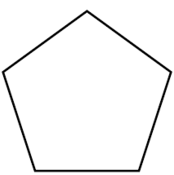
For the next activity, I drew this figure on the board and asked students "How many rectangles are in this figure?"
Now that students were acquainted with one another, the brainstorming started much quicker. In each class, after about a minute or two had passed, a student asked "Is a square a rectangle?" YES! Exactly what I'd hoped! We then had a (short) discussion about the importance of asking questions and challenging me throughout the course by asking "Why?" Then students continued working. It was very cool to see students using colors, breaking down the figure, etc. (If you want to know, there are 18!)
Fractions Activity
The last activity was for me to formatively assess students' prior knowledge of fractions. Our first unit focuses on simplifying exponents and radicals, and if students do not fully understand the basics of fractions, they will struggle when we throw in variables, exponents, and square roots.
I wrote random fractions on a bunch of notecards. Each student was given a notecard and a partner. Each pair was given a die. Students were to roll the die, and if the die landed on an odd number, they added the fractions, while if it landed on an even number, they subtracted the two fractions. Once they solved for the correct answer, one person traded their notecard with one of another group. They repeated the process. Next, they used the same notecards and rolled the die with an odd number meaning that they would multiply the fractions, and an even number would mean dividing the fractions. They switched cards, and repeated.
Survey
Finally, students opened their iPads, logged into Schoology and pulled up a Google Form survey. In this survey, I ask them both routine questions (when is your lunch/study hall, who is your counselor, when is your birthday, etc.) and getting to you know questions (what are your future career goals, is there anything that I should know that would help me better teach you?)
Thursday, March 9, 2017
#214EdPrep: Hannah Shares Her Teaching Experience
By: Hannah Irizarry
This is the fourth in a series of blog posts discussing the collaboration of the Collab Lab and our EG Ed Prep students. Hannah implemented a lesson based on the Spark Session presented by Rachel Barry. Please follow along on our journey using the hashtag #214EdPrep or clicking on the label #214EdPrep in the word cloud!
Last week Ms. Barry showed us different teaching methods that would help students learn. One idea that I really like was Mathketball. I felt like this would be such a fun activity for the 3rd graders that I'm currently working with in my internship. They're currently working on multiplication, division, and fractions. I wrote 5 problems for each section. Once I got to the classroom, I gave them all three sheets of paper and made sure to show them how to fold and rip so they had enough paper for each problem. I made them get into a circle and then I explained how to play this game.
Throughout the whole game the kids were laughing and enjoying the game but also were learning the problems.
When I heard that a student wanted to “skip” a problem I would quiet them down and show them a different method to figure out the problem.
After we were done they all went back to their seats and said that they wanted to play this again. I really enjoyed teaching them this game and watching them get the answers right.
This is the fourth in a series of blog posts discussing the collaboration of the Collab Lab and our EG Ed Prep students. Hannah implemented a lesson based on the Spark Session presented by Rachel Barry. Please follow along on our journey using the hashtag #214EdPrep or clicking on the label #214EdPrep in the word cloud!
Last week Ms. Barry showed us different teaching methods that would help students learn. One idea that I really like was Mathketball. I felt like this would be such a fun activity for the 3rd graders that I'm currently working with in my internship. They're currently working on multiplication, division, and fractions. I wrote 5 problems for each section. Once I got to the classroom, I gave them all three sheets of paper and made sure to show them how to fold and rip so they had enough paper for each problem. I made them get into a circle and then I explained how to play this game.
When I heard that a student wanted to “skip” a problem I would quiet them down and show them a different method to figure out the problem.
Thursday, December 1, 2016
Effective Communication in the Gradebook - Part 1 (Math)
Seventh post in a series from our staff-led Institute Day. This will be a two-part blog post, with the first post reflecting on the math component, while the second post focuses on the science component and the teacher take-aways from the session.
Rachel Barry (Math) and Quinn Loch (Science) presented this session, which focused on these two questions:
1. How can I show formative feedback in the gradebook?
2. How can I communicate progress in the gradebook?
Rachel Barry (Math) and Quinn Loch (Science) presented this session, which focused on these two questions:
1. How can I show formative feedback in the gradebook?
2. How can I communicate progress in the gradebook?
MATH
To begin, it is important to note that these ideas and implementations are constantly evolving. I am constantly discussing alternatives with my colleagues to determine what is the best way of giving feedback and communicating a student's progress. I am in my seventh year of teaching, and I have yet to maintain the same grading system and gradebook set-up in two consecutive years.
- Formative Feedback is reported in the gradebook using a 0% Category.
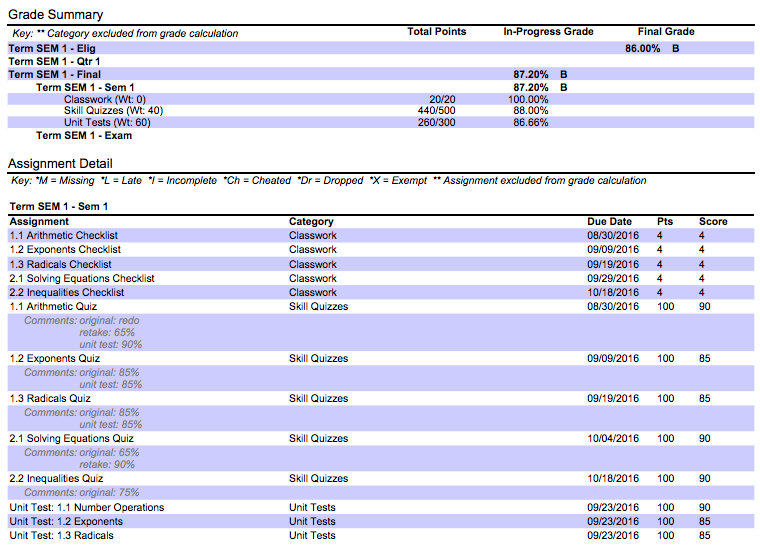
All grades not on a summative quiz or unit test go in the 0% category. This helps students and parents see progress, without affecting a students grade.
- Formative Feedback is reported in the gradebook using a 0% Category.
All grades not on a summative quiz or unit test go in the 0% category. This helps students and parents see progress, without affecting a students grade.
- Use comments in Infinite Campus to display student progress on a math standard.
Shows multiple attempts on same math standard.
Teacher View:
- Students reflect at the end of a unit on their effort and performance.
At the end of each unit, students reflect on their effort and performance using the Reflection document below. The Checklist grades are in the formative category of the gradebook, while the quizzes and unit tests are both summative categories. They log in to Infinite Campus to fill this out themselves. Then, they answer the following two questions on the back:
1. What are you most proud of from this unit?
2. What are you going to change to improve in the next unit?
The purpose of this document is for students to realize that if they complete the work in class (through a Schoology Checklist), they will be successful on the quiz. Also, if they go through the reassessment process, they better their performance on topic. Most of the time, when they have completed a retake, they also score better later on the unit test.
Check in tomorrow for Part 2, focusing in Science!
Tuesday, November 15, 2016
Split View Multi-tasking in Math
By: Rachel Barry
In case you didn't know, the iOS 9 update (from last year) included a new feature called Split View Multi-tasking. If you would like to learn about the process to open both apps, please read this Gadgets360 article here.
This allows you to open up two apps at once, on one screen. When I had first learned of this, I realized how cool it would be for students to be able to have their calculator app open while solving math problems in Notability. Here is what this looks like:
Very cool! Some students like this, while others still prefer having their TI-84 calculator separate. Regardless, a great feature, especially for when a student forgets his/her calculator.
I was really excited the other day, when I was walking by a student and saw them using this feature in a new way. To give you some background first, our curricula includes formative assessments through Schoology quizzes.
Students have a .pdf version of these formative quizzes, so that they can download the document into Notability and have something to write on to solve the problems. They then have to type their answers into Schoology. This can be cumbersome and time-consuming.
Instead of going through this multi-step process, this student decided to be much more efficient. He used the Split View Multi-tasker feature to pull up Notability while working in tandem with the quiz open in Schoology. Saves students so much time (and doesn't get them distracted!)
In case you didn't know, the iOS 9 update (from last year) included a new feature called Split View Multi-tasking. If you would like to learn about the process to open both apps, please read this Gadgets360 article here.
This allows you to open up two apps at once, on one screen. When I had first learned of this, I realized how cool it would be for students to be able to have their calculator app open while solving math problems in Notability. Here is what this looks like:
Very cool! Some students like this, while others still prefer having their TI-84 calculator separate. Regardless, a great feature, especially for when a student forgets his/her calculator.
I was really excited the other day, when I was walking by a student and saw them using this feature in a new way. To give you some background first, our curricula includes formative assessments through Schoology quizzes.
Students have a .pdf version of these formative quizzes, so that they can download the document into Notability and have something to write on to solve the problems. They then have to type their answers into Schoology. This can be cumbersome and time-consuming.
Instead of going through this multi-step process, this student decided to be much more efficient. He used the Split View Multi-tasker feature to pull up Notability while working in tandem with the quiz open in Schoology. Saves students so much time (and doesn't get them distracted!)
Thursday, October 6, 2016
Adjusting Math Standards from ACT to SAT
By: Rachel Barry
For the past seven years, our math department has not used a textbook, but instead has written and edited our own digital course materials. This includes all assessments (both formative and summative), practice worksheets, and supplemental materials. If you are interested, you can learn more about this system in this previous blog post. The important piece to note here, is that this system was developed using the ACT College Readiness Standards. These have been adapted over the years, but the original pillars of our curriculum were based on the following:
- Basic Operations and Applications
- Probability, Statistics, and Data Analysis
- Numbers: Concepts and Properties
- Expressions, Equations, and Inequalities
- Graphical Representations
- Properties of Plane Figures
- Measurement
- Functions
In developing each course Scope & Sequence, we looked vertically through the four-years of a student's math career and took an integrated approach to the CRS skills. Traditionally students learn vertically through the pillars (i.e.: traditional Algebra I, Algebra II, Geometry, and Trigonometry courses). Instead, we decided to approach the content at the students' cognitive ability across the chart horizontally in a more integrated approach to build students critical thinking skills. This has worked well for our students, and we see a significant change in students' retention of skills and global understanding of mathematics.
Then came the state decision to move from the ACT to SAT.
A bunch of questions and concerns became topics of discussion among out department. Do we make a huge change from the standards we were teaching to prepare for the ACT to the standards that will prepare them from the SAT? If we had solid math curricula already, should we make adjustments? What should we do to best prepare the students who have been provided curricula based on the ACT but now will be taking the SAT? Believe me, the list of questions didn't stop here.
Ultimately, as whole department, these were the decisions that were made:
- Include Free Response portions to all Unit Exams
- The SAT has both Multiple Choice and Free Response components.
- Include Non-Calculator portions in the curricula
- The SAT has both Calculator and Non-Calculator tests.
- Integrate more critical thinking and problem solving questions into the curricula
Our regular junior team, took all of these department agreements and have been implementing them this year. We also decided to work with the regular freshman and regular sophomore teams to realign our skills. Therefore, our junior course is slightly more aligned to a traditional Algebra II course. This decision was made because the SAT has a stronger Algebra II component, while the ACT had more of a balance between Algebra and Geometry.
To look at the changes to our Scope and Sequence of skills, you can take a look at our full lists here:
The biggest content additions were:
- A basic arithmetic component (add/subtract/multiply/divide integers, decimals, and fractions without a calculator)
- A graphing unit (linear and quadratic functions both with and without a calculator)
Things taken out of our curriculum were:
- Surface area and volume (formulas are now provided on the SAT)
- Probability, weighted averages, and sequences/series (these are now made extension skills for students who need a challenge)
- Logarithms and complex numbers (these are also now extension skills)
Thursday, September 1, 2016
Building Positive Relationships Early
By: Rachel Barry
This year my focus in the classroom is building positive relationships. I believe that I have always worked on creating a relatively positive environment for students to feel comfortable sharing their thoughts with me, whether these thoughts were personal or academic in nature. The problem with that last sentence is 'with me'. Yes, it is incredibly important for teachers to get to know their students, build a positive rapport, and care about them as an individual. Towards the end of last year, however, I realized that I have never set an expectation for my students to build relationships with one another. I decided to change that going forward.
The first change was in the works during second semester of last year. No more desks! If I expected students to work together by communicating and collaborating with one another, I needed to have a physical environment that would foster this teamwork. I now have whiteboard tables (which are amazing!), and there will be more blog posts about this resource in the future.
To begin cultivating relationships with and among my students, we first needed to begin with some introductions. As the teacher, I need to provide students with opportunities to learn more about one another. Here are some ways that I fostered this communication in the first week of school:
1. Names
Every other day of class, I have had new groups using the Team Shake app. This app randomly seats students into groups or pairs, based on how you designate the randomizer. Then I ask my students to write their name on the whiteboard table and shake hands with the members of their group. Over the period of two days, I am hoping that they are getting to know each new set of students at an introductory level. (Note: This is also helping me to learn their names much quicker because I myself am a visual learner.)
2. All About Me
This year, I created a new All About Me activity using the website Piktochart. More information on how to create or use infographics can be found here.
Students accessed this document electronically via Schoology and annotated using Notability. Then, students were asked to share any one of their 'favorites' with their group. At the end of the first day, they were then asked to share a different 'favorite' with the class.
What I learned about my students through this exercise:
- Who is strong and who is weak with technology (both Schoology and Notability)
- Who is willing to share easily and who needs time to feel comfortable sharing with me
- Who can follow directions and answer questions appropriately
- Who has internet at home (some students didn't finish and expressed that they wouldn't be able to submit this assignment tonight due to not having internet)
3. Numbers of Significance
This idea I received from my colleague Eleanor Pattie. I demonstrated with an example explaining 3 numbers of significance for myself and then had the students write out their 3 examples. Then, they shared one of these examples with the class. Here is a student example:
What I learned about my students through this exercise:
- Some students are incredibly creative (i.e. 10 - age when received the first pair of Air Jordans; 2 - never like to go first; 10.5 - when I was first inspired to draw)
- Some students have had some really cool life experiences (i.e. played in a championship game in Cooperstown)
- Some students are very honest (i.e. number of suspensions; 9/11 - happened a week before I was born)
- Some students shared personal tragedies
- Lastly, I learned about my students' writing capabilities such as their spelling and grammar
4. Academic Goals
In order for me to be an effective teacher, I need to know my students as both an individual and as a student. Before the school year starts, I look up and pull a lot of data from our Infinite Campus information. As much as this is helpful for me to best meet my students' needs, I'll be honest and say that it is also a bit creepy. Therefore, I gave them a Google Form to answer the following questions:
1) What were your grades last year in math?
2) What school did you go to? (for my freshman classes); Who was your math teacher last year? (for my junior classes)
3) What are your plans after high school?
A. Community College (i.e. Harper, etc.)
B. 4-year College/University
C. Trade School (cosmetology program, nursing program, mechanics program, etc.)
D. Military
E. Other: _________
4) What are your future career goals?
5) What are your math goals for this year? (i.e. getting into the Harper College Algebra course, staying eligible every week for a sport, etc.)
6) What are your overall freshman/junior year academic goals? (i.e. getting a passing score on an AP test, getting into the Harper 103 English course, etc.)
I have looked over these replies and will have one on one meetings with each student over the next couple weeks. During these meetings, I am going to have students fill out the following card, which will be stapled to their portfolios. This way, every time we go over assessments, students will be able to look at their goals and reflect on them. I am still brainstorming ideas of how best to document these student refections, so if you have any ideas, please share!
This biggest component of all these activities was that I want students to be comfortable by allowing for student voice in the classroom. They get to determine what they share with me and what they share with the class. For example, I let them choose their 'favorite' with the class. I could've said that everyone needed to share their favorite color, but instead I wanted to see what my students wanted to share about themselves. I will be documenting more of my encouragement of student voice and building relationships throughout this year's blog posts.
This year my focus in the classroom is building positive relationships. I believe that I have always worked on creating a relatively positive environment for students to feel comfortable sharing their thoughts with me, whether these thoughts were personal or academic in nature. The problem with that last sentence is 'with me'. Yes, it is incredibly important for teachers to get to know their students, build a positive rapport, and care about them as an individual. Towards the end of last year, however, I realized that I have never set an expectation for my students to build relationships with one another. I decided to change that going forward.
The first change was in the works during second semester of last year. No more desks! If I expected students to work together by communicating and collaborating with one another, I needed to have a physical environment that would foster this teamwork. I now have whiteboard tables (which are amazing!), and there will be more blog posts about this resource in the future.
To begin cultivating relationships with and among my students, we first needed to begin with some introductions. As the teacher, I need to provide students with opportunities to learn more about one another. Here are some ways that I fostered this communication in the first week of school:
1. Names
Every other day of class, I have had new groups using the Team Shake app. This app randomly seats students into groups or pairs, based on how you designate the randomizer. Then I ask my students to write their name on the whiteboard table and shake hands with the members of their group. Over the period of two days, I am hoping that they are getting to know each new set of students at an introductory level. (Note: This is also helping me to learn their names much quicker because I myself am a visual learner.)
2. All About Me
This year, I created a new All About Me activity using the website Piktochart. More information on how to create or use infographics can be found here.
What I learned about my students through this exercise:
- Who is strong and who is weak with technology (both Schoology and Notability)
- Who is willing to share easily and who needs time to feel comfortable sharing with me
- Who can follow directions and answer questions appropriately
- Who has internet at home (some students didn't finish and expressed that they wouldn't be able to submit this assignment tonight due to not having internet)
3. Numbers of Significance
This idea I received from my colleague Eleanor Pattie. I demonstrated with an example explaining 3 numbers of significance for myself and then had the students write out their 3 examples. Then, they shared one of these examples with the class. Here is a student example:
What I learned about my students through this exercise:
- Some students are incredibly creative (i.e. 10 - age when received the first pair of Air Jordans; 2 - never like to go first; 10.5 - when I was first inspired to draw)
- Some students have had some really cool life experiences (i.e. played in a championship game in Cooperstown)
- Some students are very honest (i.e. number of suspensions; 9/11 - happened a week before I was born)
- Some students shared personal tragedies
- Lastly, I learned about my students' writing capabilities such as their spelling and grammar
4. Academic Goals
In order for me to be an effective teacher, I need to know my students as both an individual and as a student. Before the school year starts, I look up and pull a lot of data from our Infinite Campus information. As much as this is helpful for me to best meet my students' needs, I'll be honest and say that it is also a bit creepy. Therefore, I gave them a Google Form to answer the following questions:
1) What were your grades last year in math?
2) What school did you go to? (for my freshman classes); Who was your math teacher last year? (for my junior classes)
3) What are your plans after high school?
A. Community College (i.e. Harper, etc.)
B. 4-year College/University
C. Trade School (cosmetology program, nursing program, mechanics program, etc.)
D. Military
E. Other: _________
4) What are your future career goals?
5) What are your math goals for this year? (i.e. getting into the Harper College Algebra course, staying eligible every week for a sport, etc.)
6) What are your overall freshman/junior year academic goals? (i.e. getting a passing score on an AP test, getting into the Harper 103 English course, etc.)
I have looked over these replies and will have one on one meetings with each student over the next couple weeks. During these meetings, I am going to have students fill out the following card, which will be stapled to their portfolios. This way, every time we go over assessments, students will be able to look at their goals and reflect on them. I am still brainstorming ideas of how best to document these student refections, so if you have any ideas, please share!
What I learned about my students through this exercise:
- Which students want to get into the Harper College Algebra Course (These students will need additional skills to pass the placement test to get into the course.)
- Which students may need interventions early on (These students should get into good habits early by being encouraged to come in before school, during lunch or visiting the Mastery Lab regularly for help.)
- Which students should be challenged to try to get into the Harper College Algebra course (Maybe they don't realize that it is an option for them.)
- Which students do not have aspirations for schooling following high school (I will need to learn more about these students as to why they do not want to pursue a continued education.)This biggest component of all these activities was that I want students to be comfortable by allowing for student voice in the classroom. They get to determine what they share with me and what they share with the class. For example, I let them choose their 'favorite' with the class. I could've said that everyone needed to share their favorite color, but instead I wanted to see what my students wanted to share about themselves. I will be documenting more of my encouragement of student voice and building relationships throughout this year's blog posts.
Tuesday, March 29, 2016
Editing Lifesaver: Skitch!
By: Rachel Barry
Need to quickly edit a picture or diagram AND want it to look professional? Skitch is your answer! I have used Skitch throughout my entire teaching experience, and I still can't believe how quick and easy it is to create or edit images.
I first started using Skitch when we were creating our own digital curricula in the Math Department six years ago. You can read more about our curricula here. Following our creation, we have been doing a lot of editing of our materials. That problem didn't work out to a "nice" answer? The diagram doesn't provide students with enough information? The picture provides students with too much information to be the level of difficulty for that class? Use Skitch!
Here is an example of how to edit a diagram in Skitch. Let's start with an image of a rectangle and triangle, created from Autoshapes in Microsoft Word.
I also use Skitch to create warm-ups, exit slips, and other supplemental materials for class. This application allows me to create numerous variations of the same diagram, or quickly edit an already existing picture. Here is an example of an edited diagram:


**Throughout my Skitch experience, I have only used the laptop version, however, there is also an iPad version. I played around with it prior to writing this blog post, and I find it to be just as user friendly.
Need to quickly edit a picture or diagram AND want it to look professional? Skitch is your answer! I have used Skitch throughout my entire teaching experience, and I still can't believe how quick and easy it is to create or edit images.
I first started using Skitch when we were creating our own digital curricula in the Math Department six years ago. You can read more about our curricula here. Following our creation, we have been doing a lot of editing of our materials. That problem didn't work out to a "nice" answer? The diagram doesn't provide students with enough information? The picture provides students with too much information to be the level of difficulty for that class? Use Skitch!
Here is an example of how to edit a diagram in Skitch. Let's start with an image of a rectangle and triangle, created from Autoshapes in Microsoft Word.
This video explains some of the features of Skitch:
I also use Skitch to create warm-ups, exit slips, and other supplemental materials for class. This application allows me to create numerous variations of the same diagram, or quickly edit an already existing picture. Here is an example of an edited diagram:


**Throughout my Skitch experience, I have only used the laptop version, however, there is also an iPad version. I played around with it prior to writing this blog post, and I find it to be just as user friendly.
Friday, March 11, 2016
Website Review: IXL
By: Rachel Barry
In our Elk Grove Lead Learners meetings, we have discussed the importance of formative assessments and providing students with immediate feedback. I have been working to incorporate these tools more frequently and through different methods to increase student engagement and learning.
One website that I have begun to use somewhat regularly is https://www.ixl.com/. This website offers both free and paid versions. Everything I will discuss here is using the free version.
IXL offers open answer quiz questions in the areas of Mathematics, Language Arts, Science, and Social Science for grades pre-K all the way through 12th grade. Within each content area, you can search by grade level (though not always based on the order of skills we teach at EG) or use the search feature. It is very easy, and you will find many question sets on the same topic.
Once you choose a topic, you can share the website link with your students. For users of Schoology, it opens it right within the app, so it is a seamless transition.
Students get one question at a time, and all students will be given different questions. For example, here is a sample from the question set of "Surface Area of Cubes and Rectangular Prisms".
In our Elk Grove Lead Learners meetings, we have discussed the importance of formative assessments and providing students with immediate feedback. I have been working to incorporate these tools more frequently and through different methods to increase student engagement and learning.
One website that I have begun to use somewhat regularly is https://www.ixl.com/. This website offers both free and paid versions. Everything I will discuss here is using the free version.
IXL offers open answer quiz questions in the areas of Mathematics, Language Arts, Science, and Social Science for grades pre-K all the way through 12th grade. Within each content area, you can search by grade level (though not always based on the order of skills we teach at EG) or use the search feature. It is very easy, and you will find many question sets on the same topic.
Once you choose a topic, you can share the website link with your students. For users of Schoology, it opens it right within the app, so it is a seamless transition.
Students get one question at a time, and all students will be given different questions. For example, here is a sample from the question set of "Surface Area of Cubes and Rectangular Prisms".
I provide students with scratch paper, to work out their solutions. Then, students will type in their numeric response and receive immediate feedback of whether it was correct or incorrect.
The greatest component is the reflection piece after each incorrect answer. Here is a sample response that the students will see:
This explanation provides students with explicit and individualized information, including visuals, to help each student understand what he/she did incorrectly.
On the side of each question, there is a bar that provides information on the question set including the number of questions answered, the time that the student has spend on the question set, and a Smart Score. On the left is the toolbar that the students see, and then I provided the website's explanation of the SmartScore.
I think that this is a great tool for formative assessment, and I mainly use it as a quick warm-up in class. It is a great way to also spiral old skills or provide additional support for gaps that my students have coming into my class. If you have any other ways that you use IXL for, please feel free to share with the CollabLab!
Subscribe to:
Posts (Atom)