Showing posts with label Authentic Resources. Show all posts

Wednesday, February 21, 2018

A Rewarding and Demanding Lesson

By Kristen Gierman

Historical documents are tricky.  They are full of baggage.  Historical context.  Higher level vocabulary.  Perspective.  Author’s purpose.  You name it, they are HARD to digest.  But that is no reason to shy away from them in the classroom.  In fact, I sit here writing this blog because challenging my students to break down arguably the most difficult document they have seen thus far culminated in one of the most demanding yet rewarding lessons of the school year.


As my world history classes focus on the rise and fall of governments during the time period after World War I, we turned our attention to the Middle East.  What happened to the region after the Ottoman Empire came crashing down?  What role did the League of Nations play? How might this impact the region today?  These are all questions I wanted my students to consider, however, I did not want to simply answer that for them.  Instead, I wanted to release this responsibility of learning to the students.


This took some careful planning and pre-reading strategies to make it all come together.  To start the lesson, students were teamed up and competed in a Quizlet Live that included eight “difficult” terms they might not know or might not have ever seen yet would encounter during the course of the period.  Words like sovereignty, tutelage, and mandate are no walk in the park for any sophomore.  However, allowing students to work together to gain some familiarity with the terms shifted the conversation from “I have no idea what these mean” to eventually building some confidence in what used to be unknown or unrecognizable.  

After creating a historical context for the lesson, the students worked to decipher the potential meaning of the political cartoon seen below.
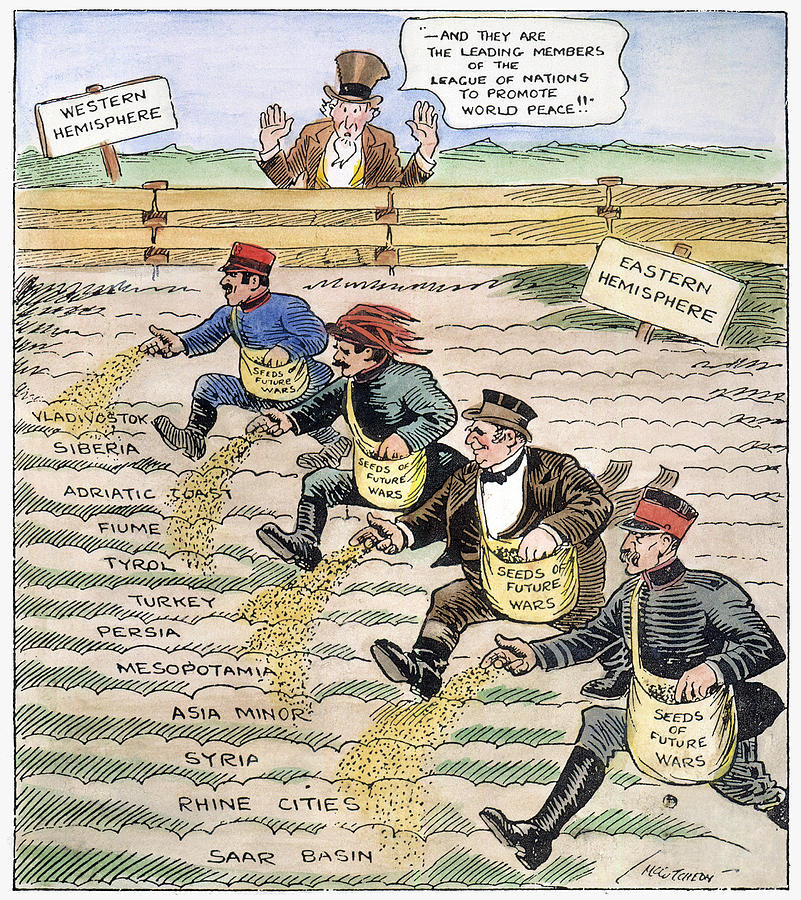


The claims produced by the students echoed the criticisms of the League of Nations’ decisions and ultimately set the stage for the Big Kahuna of this entire lesson...analyzing and understanding the language of Article 22 of the Covenant of the League of Nations.  
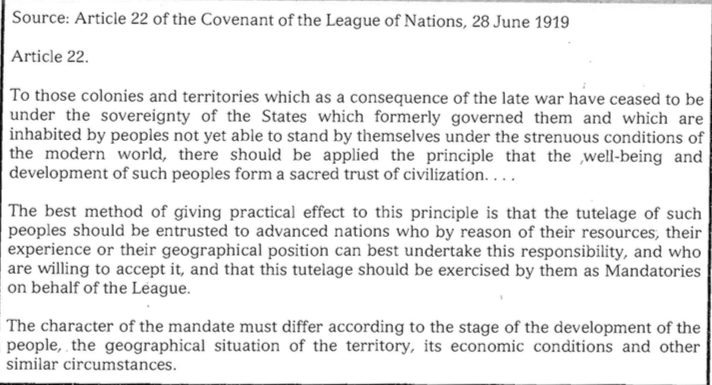


For anyone, this would appear a daunting task but the students got after it!!  After modeling some word substitution thanks to the help of the Quizlet, the students worked with their partners to take each sentence and put it in words they could understand.  Not only did they strive to complete this challenge but I found them more engaged in the process and seeking my feedback to confirm their understanding of the text.  

I even laughed a bit as students, who regularly do not want to do work, busted it to prove to me that they were “Ivy League” material….only to conclude class by announcing their future attendance at Stanford University. :)

All jokes aside, it was rewarding to see the students grapple with their understanding of a document that was arguably “out of their reach.”  I am confident that they can make an argument as to why the mandates were created in the Middle East by the League of Nations and I look forward to the next step of the process where they connect these concepts to the rise of independence movements in the region.

Wednesday, August 30, 2017

Authentically Engaging Students in 1st 5 Days

By Kim Miklusak

In AP Language we decided to do an assignment right off the bat that would not only help us get to know our students and what is important to them, but also help them dive right in to rhetoric and authentic writing.  This year students will be participating in the NY Times Student Editorial Writing Contest.  For this project, students will write an editorial on a topic of their choosing, 450 words, with at least 2 pieces of research.

We reviewed the assignment with students, they read the NYT winners from last year, and compiled a list of skills they noticed made the editorials successful.  We then brainstormed topics we were interested in with the people at our table.  To start narrowing down our topic, we got students up on their feet, doing a "speed dating" activity that I have seen our foreign language teachers do, specifically Linda Ashida.

One side of the room talked about the topic they were interested in; the other side of the room asked questions to help narrow their focus and ultimately reach a call to action.  After every 30 seconds, students would switch and continue to speak about their topic.  They ended the activity by returning to their seats and debriefing with their table.

From their students wrote their first draft of their editorial.  Over the next few days they shared with their peers, receiving preliminary feedback on audience and purpose.  This week students will revise their appeal to strengthen their appeal to ethos, next week pathos, the final week logos--ultimately they will write one final draft in which they find the appropriate balance for their specific call to action.  Our goal is for students to write several drafts over the coming months, incorporating what they are learning in AP Lang, but also using what they are leaning from the writing process and applying it to their classroom reading and writing as well.

Please follow us at the hashtag #1YrInEng to see how we are doing!

Tuesday, January 31, 2017

Blending Reading and Writing to Understand the Content

By Mark Heintz

This semester I put more emphasis on students reading to gain an understanding of the content and writing to prove their understanding of the readings and content.  Throughout the semester, I shifted my teaching style to center on students reading and writing daily.  This shift came my students giving me feedback and their writing and my own reflection on the time it takes to develop the skills of academic writing and understanding of primary and secondary sources.  Since the shift, the amount of daily feedback each student received on their progress towards these skills has increased and their understanding of the content increased.

For the past week lessons, the following were my content objectives:

  • List five ways rulers continued to use religious ideas to legitimize their rule. 
  • List three supporting details that explain how the Spanish, Dutch, French, and British empires rose in both hemispheres.  
  • List supporting details that explain how the Manchu, Mughal, Ottoman, and Russian rose to power.

For the final, the students will be assessed on a stimulus based multiple choice exam and three short answer questions which mirrors the content objectives and the style in which the course is presented.

My students gain background information on the content objectives from a series of videos I made.  You can read about that process here.  The videos have freed time in the classroom to analyze documents and practice the writing. 


The students are reading and unpacking difficult documents like the ones pictured above. Two documents such as these can take entire period to analyze.  Each day they continually work towards mastery on these skills all while reinforcing their understanding of the content.   I am fortunate enough to have white board tables which makes it easy to read student samples and provide feedback. The students are able to ask individual questions about the documents and their writing. Since they write on the tables, I can easily provide feedback related directly their questions.  Furthermore, I can differentiate between poor writing skills or a gaps in their content knowledge.  Since they are writing so frequently, I am understanding their voice ways to fix it for each student.  After each day, I can pause the class to models of student work to emphasize a common mistake or praise progress.

The students are having to master the content knowledge to work through the documents and writing.  As seen in point C in the above sample, the student needs to draw more specific examples to prove their point.  It takes time to develop the ability to make claims about the past and defend them with historical examples that actually support the claim they made.  I am proud of the progress my students have made this semester! 


Tuesday, September 20, 2016

Writing in Science

By Mark Heintz

I have been attempting to visit all the core sophomore courses my students take.  I want to see the purpose of writing and how teachers teach it and then use it in all the core classes.  I had yet to see a chemistry class and was fortunate enough to visit Colin Rice's honors chemistry course.  The two of us share a lot of the same students and I heard they wrote a lot in his course, so I asked if I could visit. He graciously accepted.

In chemistry, the teachers use writing as a summation of labs.  But, it serves a far greater purpose. Prior to the class I visited, the students completed a lab on closed systems.  The students collected data and completed a lab packet. Today, the students wrote about their findings in the lab.

Although all of the students had collected data, some of the students did not complete the lab correctly.  There in lies the genius of the writing. While Colin cared about the lab and the data the students acquired, he cared more about the explanation of the data to prove a concept.

A pair of students did not produce data that would prove the hypothesis.  They knew their data to be incorrect.  Colin told the girls not to worry about the inaccuracies of the data.  Instead, he told the girls to explain what went wrong in their lab. Furthermore, he wanted them to to write why the data they acquired could not be a part of a closed system.  If the students could explain the errors in their writing, they would have to understand the concept in a very in-depth way!  The critical thinking involved was amazing! What is great, is that all the students will have slightly different data and be attacking the writing from different view points.

After talking to Colin, we realized that our thesis/main idea/claims were nearly identical.  We both require students to use very specific evidence to support a thesis.  But, the best part was the reasoning.  We both desire the same critical thinking from the students.  We still have work to do on making the students see the parallels, but it was a great first step!


Wednesday, February 24, 2016

Enhancing Language Learning with 1:1 Technology


Written by Linda Ashida

An invitation to present at the Winter Conference for AATSP (The American Association of Teachers of Spanish and Portuguese) gave my colleagues Carmen Ruiz, Chris Cirrincione, and me a professional learning opportunity to reflect on, and share, ways that we engage students in language learning with 1:1 technology.

In our presentation we shared strategies that impact student learning by:
  • Personalizing instruction
  • Improving feedback
  • Increasing Collaboration
  • Connecting with Authentic Resources
  • Expanding Learning Beyond Classroom Walls 
While our examples related specifically to World Language classes -  developing interpretive, interpersonal and presentational communication skills - the activities can be easily adapted to any content area.

Some examples of strategies we shared:
  • Give all students a voice with backchannel activities using TodaysMeet or Twitter.
Today's meet is quick and easy to set up!  It takes just a minute!


  • Give real time formative feedback with ClassKick or GoFormative .
Embed audio and video links for formative listening practice / feedback

  • Encourage collaboration with Google Docs and Schoology Media Albums.
Crowd source resources and learning collaboratively! Divide class into groups.  Each group becomes an expert on a text, audio or video source and fills in Google Doc with main point, key details and key vocabulary!

Students upload infographics related to AP themes. Practice creating questions for their infographic.  Engage in paired speaking activities.  Share written comments for peer review.

  • Practice listening comprehension skills with Play Post It or EdPuzzle (Shout out to our Prospect High School colleagues Teri Buczinsky, Ryan Schultz, and Mike Aldworth for sharing their example!)
Embed questions in videos for comprehension checks to build listening comprehension of authentic resources!

  •  Engage students with Authentic Resources with SpanishListening.org, AudioLingua and more!
Search for native speaker samples by level,  topic, gender and country!

  • Expand learning beyond classroom walls with Google Earth, Virtual Field Trips and Skype.
 Transport yourself around the world with Google Earth or Virtual Field Trips. Try a Mystery Skype!  Connect with another class and guess where they are from.


To learn more about these and other examples we shared, check out this link to our presentation slides.

Do you have other strategies that work?  Please share!

Would you like to learn more about any of the strategies from our presentation?  Please connect with us in the Collab Lab!  
ing Beyond the Classroom walls