Showing posts with label collaboration. mastery. Show all posts

Tuesday, May 8, 2018

Learning at Elk Grove: Intro to Engineering

By Patrick McGing, Merlyn Manoj, Kaelyn Rittle, and Mark Heintz


I was fortunate to visit Pat McGing's Intro to Engineering course a few weeks ago.  I asked him and a few of his students to document the learning that took place that lesson and what they hoped to learn in future ones.  From my outsider's perspective, there was a high level of student agency present.  The students were focused and working with purpose.  They rarely deviated from the task at hand and that was evident by the amount of time student spent on the task at hand.  

More importantly, the teacher and the students were all learners.  The teacher was learning right alongside the students.  Because the student projects were so different, it was impossible for the teacher to know the answers to all of their questions.  Rather than giving the students the answers or saying he did not know it, he worked with the students to come up with the solutions.  The equity in the partnership between students and the teachers reminds me that everyone is a learner and together we grow so much more than by ourselves.  Watch the short clip of student focus and the partnership between student and teacher.  Aftwerwards, be sure to read the reflections that follow.  


Teacher Perspective: Patrick McGing

What did learning look like in the lesson?

Learning looked like collaboration.

Students in this Introduction to Engineering Design section are at many different points in a project. Many students were working with their peers to solve problems, demonstrate, or just assist in a minor way to help a peer along. I could look around the classroom and see multiple students leaning over to their neighbor or getting out of their seat to assist a classmate. Therefore, the teaching did not come from me but from students peers.

  • Learning looked like students building skills in smaller areas of Autodesk Inventor with 3D modeling or 3D assemblies.
  • Learning looked like students building communication skills.
  • Learning looked like students building time management skills.
  • Learning looked like students recalling previous knowledge to aide in their current project.


What do you hope to do for the next time?

I hope for students to have a better grasp and understanding of assembling parts in Autodesk Inventor. Many of the students helping each other during the lesson were helping students assemble parts. Something I have tried in one of my other courses is having students develop a step by step “protocol” for troubleshooting specific problems. This helped students actually attempt troubleshooting a problem with already brainstormed solutions and gave them better success in solving a problem on their own. I would like to try this in my introductory course so that students could better persevere through problems.


Student: Merlyn Manoj

What did you learn this lesson?

During this project, I learned how to use my manage my time since we worked on our project independently. It was a bit hard though because if you were falling behind you would have to go to the lab outside of class to catch up with your peers. This project also gave me a lot of freedom since we had to create our own parts, and even though it was frustrating at times because you can’t just follow a plan right in front of you when things are going wrong, it was fun having that creative aspect in our project.

What do you hope to learn for the next time?

I want to learn more about Inventor rather than the basics of it. I think learning how to figure out a solution to a problem rather than just asking a friend or a teacher right away would be a great skill to have.


Student: Kaelyn Rittle 

What did you learn this lesson?

I’m not sure I can say I learned anything new from this unit because most of what we did included skills I learned in the past. However, this unit granted a lot of freedom as to what we were allowed to create, and I would say the design process was the most challenging for me. My project is slightly different in that I have two cranks whereas pretty much everyone else has only one which makes spacing everything just a little harder. I have 5 parts - three in the back and two in the front and measuring everything out so that they wouldn’t hit each other involved a lot of trial and error. This was difficult because whenever I’ve worked on Inventor in the past, I was either following a sheet with the dimensions given to me or I was physically measuring parts as I went along.

What do you hope to learn for the next time?

I think it would be fun to work with other features on Inventor that I haven’t used before. As far as I know, I’ve only used the very basics of it, and maybe exploring it more will help me further understand the program in case I were to ever use it in the future.

Wednesday, February 21, 2018

A Rewarding and Demanding Lesson

By Kristen Gierman

Historical documents are tricky.  They are full of baggage.  Historical context.  Higher level vocabulary.  Perspective.  Author’s purpose.  You name it, they are HARD to digest.  But that is no reason to shy away from them in the classroom.  In fact, I sit here writing this blog because challenging my students to break down arguably the most difficult document they have seen thus far culminated in one of the most demanding yet rewarding lessons of the school year.


As my world history classes focus on the rise and fall of governments during the time period after World War I, we turned our attention to the Middle East.  What happened to the region after the Ottoman Empire came crashing down?  What role did the League of Nations play? How might this impact the region today?  These are all questions I wanted my students to consider, however, I did not want to simply answer that for them.  Instead, I wanted to release this responsibility of learning to the students.


This took some careful planning and pre-reading strategies to make it all come together.  To start the lesson, students were teamed up and competed in a Quizlet Live that included eight “difficult” terms they might not know or might not have ever seen yet would encounter during the course of the period.  Words like sovereignty, tutelage, and mandate are no walk in the park for any sophomore.  However, allowing students to work together to gain some familiarity with the terms shifted the conversation from “I have no idea what these mean” to eventually building some confidence in what used to be unknown or unrecognizable.  

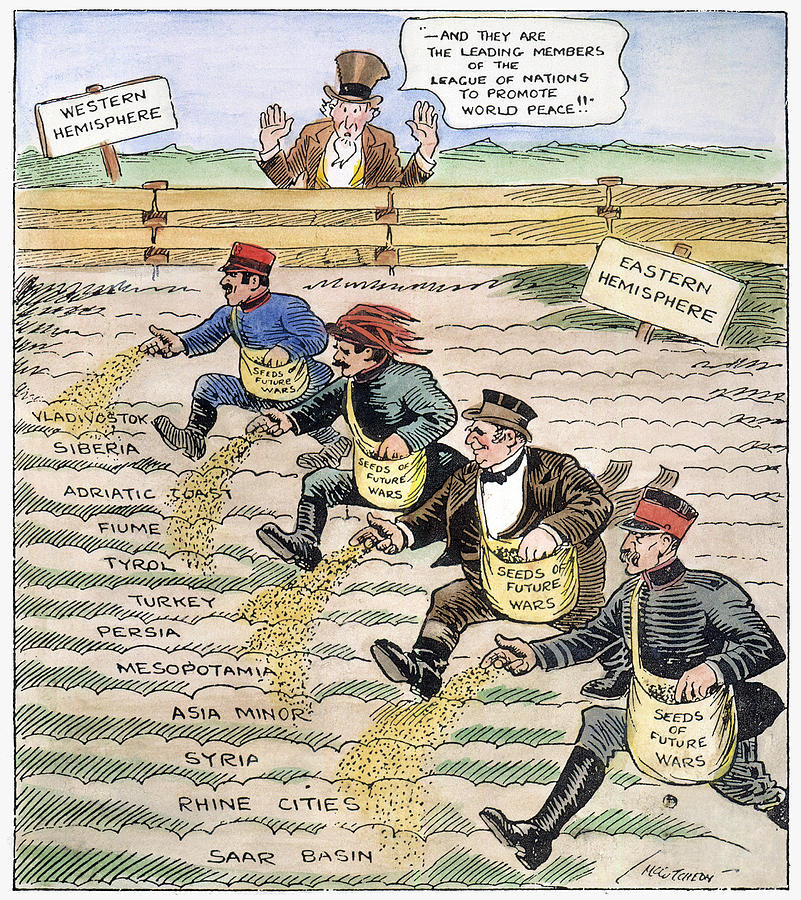
After creating a historical context for the lesson, the students worked to decipher the potential meaning of the political cartoon seen below.


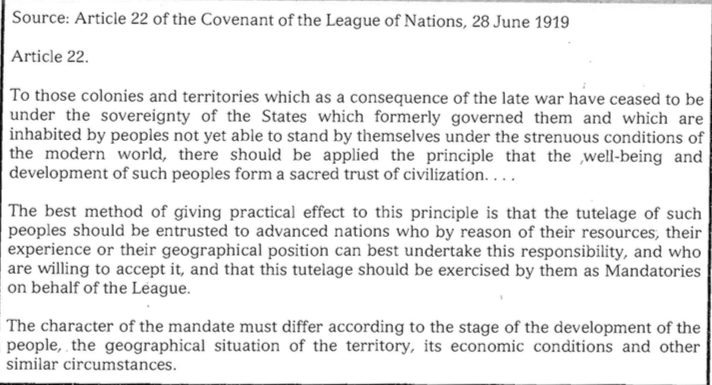
The claims produced by the students echoed the criticisms of the League of Nations’ decisions and ultimately set the stage for the Big Kahuna of this entire lesson...analyzing and understanding the language of Article 22 of the Covenant of the League of Nations.  


For anyone, this would appear a daunting task but the students got after it!!  After modeling some word substitution thanks to the help of the Quizlet, the students worked with their partners to take each sentence and put it in words they could understand.  Not only did they strive to complete this challenge but I found them more engaged in the process and seeking my feedback to confirm their understanding of the text.  

I even laughed a bit as students, who regularly do not want to do work, busted it to prove to me that they were “Ivy League” material….only to conclude class by announcing their future attendance at Stanford University. :)

All jokes aside, it was rewarding to see the students grapple with their understanding of a document that was arguably “out of their reach.”  I am confident that they can make an argument as to why the mandates were created in the Middle East by the League of Nations and I look forward to the next step of the process where they connect these concepts to the rise of independence movements in the region.

Wednesday, November 1, 2017

Engaging the Unengaged

By Linda Ashida


For the tenth in our 2017-18 series of Teaming On Tuesdays, Sean Mulcrone facilitated a follow-up session from the workshop he led for our October 16th Institute Day.

Sean facilitated a conversation that engaged the 17 staff who attended––including teachers, students services staff and instructional aides––in a rich conversation to share challenges, solutions and resources to help us foster a culture of learning to engage all of our students. Specifically, we focused on strategies to engage our most un-engaged students.


Check out the photos below to see all the ideas we brainstormed on the Collab Lab Whiteboard wall:


Many of the ideas we shared align with our school goals of creating a culture of learning and mastery, and building relationships with our students.  That is, we talked about how important it is to reflect on and communicate explicitly the "Why?" ––The purpose–– for the activity or lesson we are teaching, and how it connects to the broader learning of the unit, and real-world skills when possible. We also talked about the importance of building relationships and connections with students to better understand the root cause of the challenging behaviors or lack of engagement.

To curate all of the ideas shown in the photos above, and to facilitate our ongoing conversation––and to share our learning more broadly with those who were unable to attend––we created a Google Doc (of course, we did! :-)

Check it out here: http://tinyurl.com/EngageAllStudents

The doc is editable so please feel free to add your own ideas, resources, and questions!


It was great to bring staff together who don't otherwise have this opportunity during the school day to connect with colleagues across departments and roles.  It was also really great to get to know each other better and I believe we all left with new insights; everyone concurred that we should keep the conversation going and meet again.

So, stay tuned for news of future Teaming on Tuesdays when we will continue the conversation, including dates when we will invite students to join us as we have so much to learn from their perspective and insights!

We can't end this post without a S/O to Sean! We're grateful for his willingness to facilitate professional learning experiences for our Institute Days, Teaming on Tuesdays and the days in-between!