Showing posts with label documenting learning. Show all posts

Tuesday, January 15, 2019

How does your school define learning?

By Mark Heintz

While a school uses the word learning on a daily basis, does everyone in the community have the same meanings and beliefs about the world?  To get everyone to have that same understanding, I gathered a group of teachers last May to define learning at Elk Grove High School. I wanted to have a common definition of learning across the school. This post is a check-in to see what progress has been made.

Process

Just a reminder to everyone reading that this group of teachers from all over the building with different levels of experience who have all come together with a common purpose (some arm pulling was required).  Along the way, each of us reflected alongside each other and our students.  We don’t claim to have any answers, just the desire to share what we are doing and come together to do it.  That experience is a major success.

Throughout the first semester, I visited each teacher’s classroom in the group two times and discussed the visit afterward. Everyone wrote a reflection of the lesson and personally defined learning. After the first quarter, I added a person to add a larger perspective (art - I’m sorry I didn’t include you in the first place).  As the semester ended and everyone defined learning, I compiled everyone’s definition and gathered the group again.  When we met, we read through everyone’s definitions, found commonalities and trends, and then started to define learning as a group.

Difficulties

I thought coming up with a common definition would be easier.  I think everyone in the group thought it would be easier.  Most of us struggled to define learning when it was just ourselves let alone when all of the definitions were next to each other.  The words mattered more when the same word was used in different contexts.  As the group met in December, we spent an entire hour choosing our words and coming up with the definition.  While tedious, we did come up with a working definition!

Results

We ended up with a three-parts to the definition, because just having the definition wasn’t enough.  The group decided we needed statements to reflect what the learning process is and what the product of learning is.  Without further ado...

Learning is the integration of values, or importance to the individual, and beliefs with new and relevant information, skills, and/or abilities for long-term application in life outside of the immediate task.   
The process of learning is an evolving journey that includes engaging tasks and processes, emphasizes voice and shapes meaning and authenticity. 
The product of all of this is an ever-evolving worldview, the development of skills and awareness to continually evaluate and reflect upon themselves and the world around them.  

Next Steps

Next semester, each person in the group is committed to living the definition.  It’s one thing to come up with a statement, it’s completely another to have the classroom experience live up to the definition.  I will be going back into their classrooms and following up with a conversation.  As I go into their classrooms they are committed to having the lesson reflect their beliefs on learning. Cross your fingers and I will hopefully be sharing further progress of our journey.

Tuesday, April 3, 2018

Learning Moment at Elk Grove

By Mark Heintz

How do we define learning at Elk Grove? 

Schools are centers of learning.  Each day, the people who walk through the halls of Elk Grove learn, connect with others, and share.  However, much of the learning that takes places goes undocumented; it is not document or shared.  As a community, let us take a moment and connect with one such learning moment in hopes to share a common vision of learning and grow together.  


If you have a learning moment you would like to share with the larger community at Elk Grove, email your request to Mark.Heintz@d214.org  

Wednesday, February 21, 2018

A Rewarding and Demanding Lesson

By Kristen Gierman

Historical documents are tricky.  They are full of baggage.  Historical context.  Higher level vocabulary.  Perspective.  Author’s purpose.  You name it, they are HARD to digest.  But that is no reason to shy away from them in the classroom.  In fact, I sit here writing this blog because challenging my students to break down arguably the most difficult document they have seen thus far culminated in one of the most demanding yet rewarding lessons of the school year.


As my world history classes focus on the rise and fall of governments during the time period after World War I, we turned our attention to the Middle East.  What happened to the region after the Ottoman Empire came crashing down?  What role did the League of Nations play? How might this impact the region today?  These are all questions I wanted my students to consider, however, I did not want to simply answer that for them.  Instead, I wanted to release this responsibility of learning to the students.


This took some careful planning and pre-reading strategies to make it all come together.  To start the lesson, students were teamed up and competed in a Quizlet Live that included eight “difficult” terms they might not know or might not have ever seen yet would encounter during the course of the period.  Words like sovereignty, tutelage, and mandate are no walk in the park for any sophomore.  However, allowing students to work together to gain some familiarity with the terms shifted the conversation from “I have no idea what these mean” to eventually building some confidence in what used to be unknown or unrecognizable.  

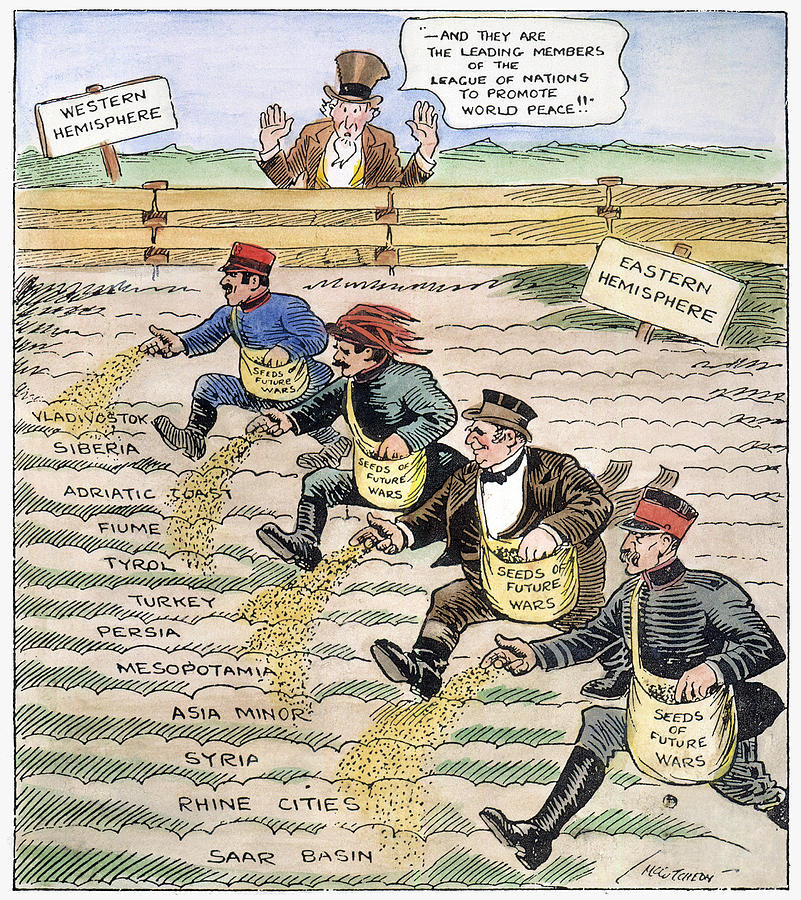
After creating a historical context for the lesson, the students worked to decipher the potential meaning of the political cartoon seen below.


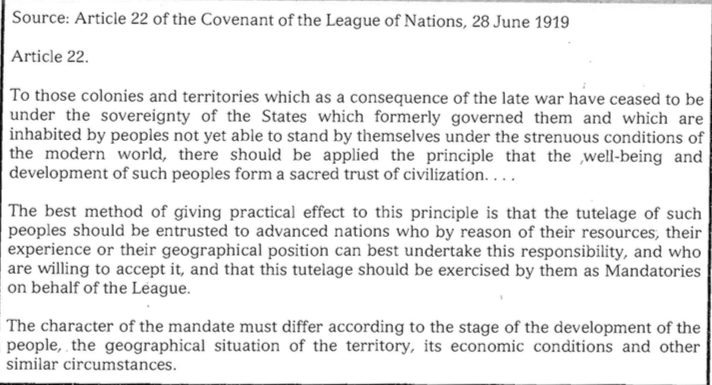
The claims produced by the students echoed the criticisms of the League of Nations’ decisions and ultimately set the stage for the Big Kahuna of this entire lesson...analyzing and understanding the language of Article 22 of the Covenant of the League of Nations.  


For anyone, this would appear a daunting task but the students got after it!!  After modeling some word substitution thanks to the help of the Quizlet, the students worked with their partners to take each sentence and put it in words they could understand.  Not only did they strive to complete this challenge but I found them more engaged in the process and seeking my feedback to confirm their understanding of the text.  

I even laughed a bit as students, who regularly do not want to do work, busted it to prove to me that they were “Ivy League” material….only to conclude class by announcing their future attendance at Stanford University. :)

All jokes aside, it was rewarding to see the students grapple with their understanding of a document that was arguably “out of their reach.”  I am confident that they can make an argument as to why the mandates were created in the Middle East by the League of Nations and I look forward to the next step of the process where they connect these concepts to the rise of independence movements in the region.

Wednesday, February 22, 2017

Sharing Learning Targets with Students

By Melissa Curtis

We’ve been hearing a lot about clear learning targets and meaningful feedback the last couple of years.  Many teachers I know have been using learning targets in their curriculum for years, but maybe not explicitly sharing them with their students or getting any feedback.  I have been using a simple yet effective way to use daily goals or learning targets in my classes that might be helpful to other teachers.


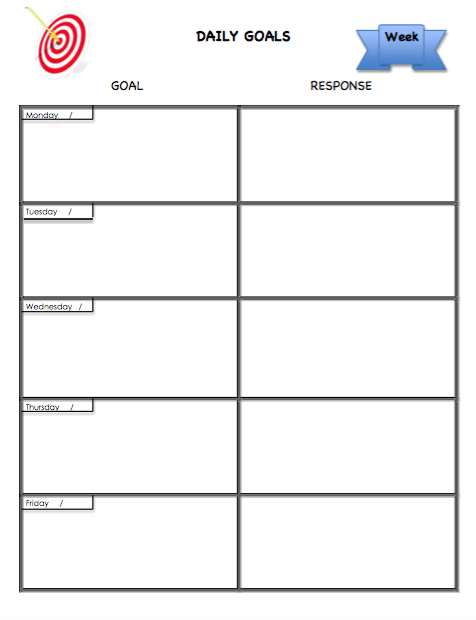
First, I have created a document called Daily Goals that I post in Schoology.
Screen Shot 2017-02-21 at 11.41.24 AM.png
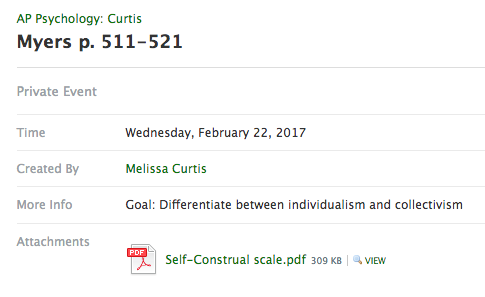
Students open this document in Notability every week.  They can reuse the same one from week to week and just erase last week’s info.  Some choose to upload it from Schoology each week and “add to existing note” so they have one long note instead of 36 different ones throughout the school year.  Each day when they come into class, I have the daily goal projected on the screen for them to write down in the left-hand column.  I post these in my calendar in Schoology so even when students are absent, they can see the daily goal and any handouts/links we used that day.  Here is an example:


Screen Shot 2017-02-21 at 12.44.10 PM.png
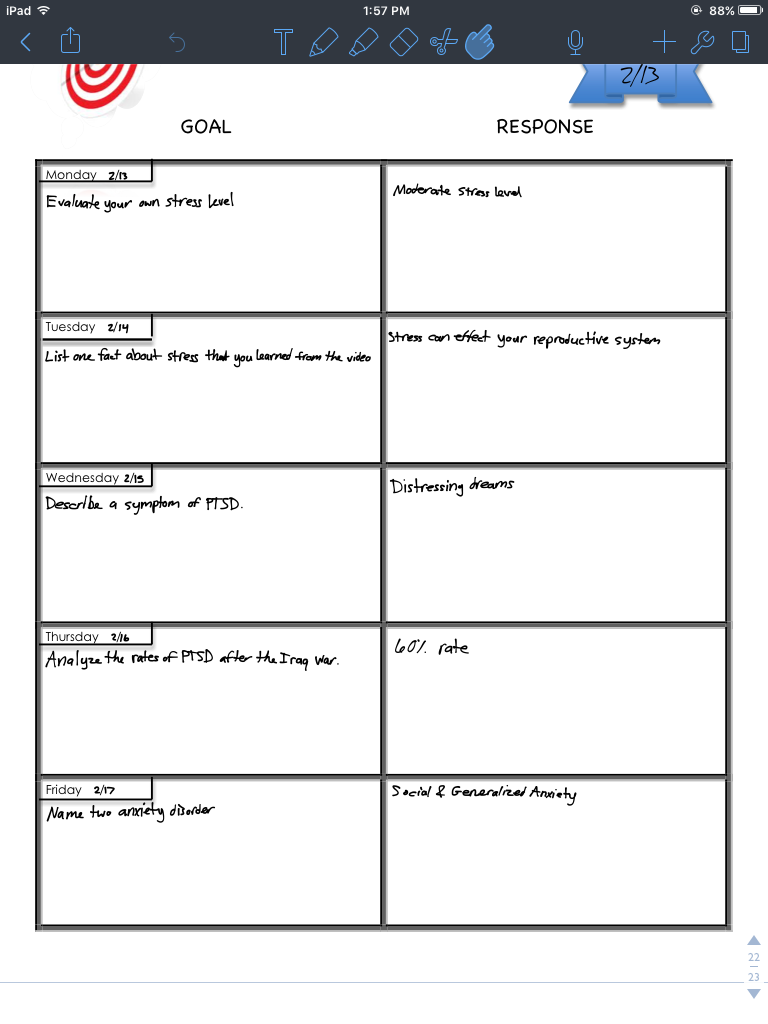
At the end of class, I ask students to write a response to the daily goal.  This should be a thoughtful comment about what we learned that day in class.  It guides students and myself to focus on the clear purpose of the lesson.  By Friday, their daily goals document should look like this:

IMG_1464.PNG


Every Monday, or first day of the week, I walk around the room and check their goals from the prior week.  I give students a small homework grade of 5 points for this.  The real value though is in getting a snapshot of what students learned that week.  In their own words, they are narrowing down my curriculum into the simplest forms.  I usually spot check one or two days for each student and I can comment on any mistakes they have made.  I can also get a sense of the whole class and clear up any misconceptions as a group.  


In my experience, students like the structure and routine of a class.  They know when they come in to take out their iPads and start writing down the daily goal.  At the end of class, it provides closure for the lesson and I can call on random students to help answer it for the whole class.  When students are absent, it provides a quick answer to “What did I miss yesterday?”.  It has become an expectation that most students buy into pretty quickly.  Yes, there are some who don’t do it or copy it from a friend, but you can monitor those individual cases pretty easily.  I have been doing this for years and like the simplicity and accountability of the daily goals.  Now, I will start calling them Learning Targets :)

Feel free to use or modify anything you see here!  

Wednesday, May 18, 2016

Self-Assessment and Science Skill Tracking

written by Quinn Loch

A few days ago, Kim Miklusak provoked some great conversations in the Collab Lab about how we have students self-assess and how we can get students to better understand their current skill set. You can read her previous blog post about cognitive bias and how people can incorrectly evaluate themselves when it comes to knowledge or skills.

Mark Heintz recently shared his approach with self-assessment and skills tracking using Schoology's many features. The goal is to have students assess themselves and allow them to compare their assessment to the teacher's assessment. This can help close the cognitive bias gap that students often have and it can give students a better understanding of what skills they might need more attention on, even if they didn't realize it.

I have this same goal when it comes to self-assessment of science skills, however I plan to implement this strategy on paper throughout the year. In biology, we typically have a lab for each unit that gives a chance to provide formative feedback, and we have lab practicals that act as a more formal summative assessment of lab skills that we have been developing. To help track progress, I drafted a skills tracker that I will have my students will use.
Students will assess themselves only on the skills that we have been developing with a rubric that helps guide them. This rubric will be attached to the lab that they turn in.
After a student submits their lab, I will use the same rubric with a different color pen so students can see their assessment next to mine along with any comments I may have left. This information will then be logged in their tracker. By the time a lab practical comes around, students will have feedback from previous labs and can help focus their energy and attention on certain skills that they maybe didn't realize they struggled with.

I'm hoping that these tools will guide students into a better understanding of their own learning and progress. Along with getting a better sense of where they stand, it should also help students target the specific skills that they need to continue to develop.

Thursday, March 31, 2016

Relative Deprivation: Student Examples

By Mark Heintz

Over the summer, I read David and Goliath: Underdogs, Misfits, and the Art of Battling Giants by Malcolm Gladwell. One of the things that struck me was the concept of relative deprivation. Relative deprivation is when people compare themselves to others and feel they are inferior based on other's ability. I see this clearly in coaching running. Many students will not even come out to the sport because they can very visibly compare their mile time to other students. They do not see they can improve and therefore, do not come out for the sport.
 
I then read an article about using student work and examples to help students achieve.  You can read the overview of the article here.  The article contends that using only exemplary student examples can lead to very negative consequences.  I believe the student examples I have used led to negative consequences.  At first, I felt I was a good teacher because I used students examples.  I showed low, mid, and high examples.  However, I spent most of the time on the best examples.  I feel and students love to see what a 100% looks like.
  
The problem with the A, the best, and the 100%, is it is unrealistic.  One of the classes I teach is AP World.  The highest score a student can get on an essay is a nine.  I have been to the AP reading and I graded somewhere around one-thousand essays.  I graded only one nine. One nine out of a thousand.  Furthermore, a student can get a five out of nine on the essays and still be on their way to getting the highest score on the AP exam.  

It is hard to be perfect.  I think it is harder to show kids an essay at their ability that is below the best and be okay with it. Sometimes it feels we are lowering the bar.  Last year in AP, I showed more of the five out of nine essays and my scores went up.  Kids were not confused or looking at an unobtainable writing sample.  

One of the best changes the Human Geography PLT made this semester was norming the average writing.  It took time and discussions about what we thought the average student's writing should be. We started with the average and worked up.  The result is being able to show more student samples at the average level. The process helped me guide students to better writing and meet them where they are. 


Tuesday, March 8, 2016

Reflection on Periscope

By Kim Miklusak

Last week I helped Rita Sayre Periscope her Science of Cancer forum.  While I had played around with the app a little bit before the forum, I definitely learned a lot from doing the event itself. 

It's very simple to set up.  Once you connect it to your Twitter account, it can send an alert to your twitter feed to let your followers know that you are broadcasting an event.  From the main screen you can also choose to watch events on different topics or presentations in your area. 

When you're ready to broadcast, you type in the title of your event.  There are a number of settings to allow people to connect with you and comment as you broadcast.  It also allows you to limit who sees your event.  I didn't use either of these functions, however.  When you're done, the link is live for 24 hours.  You can also save the entire presentation to your camera roll.

From a broadcast perspective, I can definitely see some limitations.  In the theater where Rita presented, it was hard to control the lighting, and the camera doesn't let you light balance like you would on the camera app.  It does zoom in and out, but again--maybe due to the lighting--the camera had a hard time focusing when she changed slides.  This also caused a problem when panning to follow her as she moved across the front of the room.

Overall, however, I think the possibilities for using Periscope in an educational setting are endless.  Immediately I could see using it for forum presentations, professional development days, assemblies, theater and music productions, sporting events, etc.  I know some teachers use it to broadcast their classroom as well, so that would be an interesting experience.

Please share with us in the comments any ideas you have for using Periscope in your classrooms and school as well!

Monday, January 11, 2016

Worth the Time

By Mark Heintz

The more I teach, the longer it takes me to get through the material.  In my first few years of teaching, I focused on completing activities. Let me emphasize the past sentence, I focused on completing activities.  I would lead the classroom and just get through the material.  If I was writing things on the board and students were packing up with a minute to go, I would still teach. Furthermore, I would continue to write down things for the students to complete a worksheet if the bell was about to ring.  I taught bell to bell.  I was a good teacher.  


An activity that used to take ten minutes, might take an entire period now. This is mainly because I actually teach the concept and/or skill.  I spend more time building or activating background knowledge, movement activities, writing, reading, allowing all students a voice, and ensuring all students have an understanding.  It takes more time because I am not as concerned about the teaching as I am the student learning that takes place. 


For example, look at the image below. For the activity below, I would model the first one with whole class instruction. Then I would have the class try the second one.  Finally, I would walk around the room and help students with the rest. If they didn't finish them, I would just tell them the answer at the end.  To get through ten statements, it would take about ten minutes.  


Now it takes me the whole period. I mostly do the same process.  But instead of me leading the completed task, I have students AirPlay their attempts and defend it. I still walk around and help students as they attempt it. But I am also looking for students responses that will help guide the class. As I talk to students and help them, I look for misconceptions and understanding that will benefit the whole class.  As they AirPlay, I make them defend their answer to the whole class. This a time-consuming process, but it allows the students to really show the understanding.  Although we might not get through as much in a day, what we do get through is incredibly powerful.


Monday, November 9, 2015

Pre-Reading

By Mark Heintz

In human geography the students are learning about population density and distribution. After going through several days of effects of populations density, the students did an in-depth look at Bangladesh and the effects of population density.  The lesson included an article on the effects of population density on Bangladesh.  Almost all of my students have never heard of Bangladesh. The make the article more approachable, I inundated them with images, maps, videos, and discussions that built their background knowledge.

I first gave them the location of Bangladesh and its relative size to the USA.

Then, I gave them a map of Bangladesh. The class discussed the impact of the water on the population.  

After looking at the maps, the students watched a three minute video clip on the population growth and water problems associated with the rapid population increase. Finally, the students looked at several images of Dhaka. Again, the class discussed the visuals.  


The process took thirty minutes.  The students read and annotated the article.   It was great! The students were engaged the entire time they read. The post reading discussion was high level and their comprehension was fantastic! It just shows the power of building their understanding before they read. 


Wednesday, October 7, 2015

The Collab Lab Resource Hub

Written by Linda Ashida

The Collab Lab Resource Hub is the website that serves to document the myriad professional learning experiences at Elk Grove High School, and to curate resources to facilitate future learning.


We invite you to explore check out the Resource Hub.  Among other things you will find: 
Information about our Teacher-led Institute Days.
•Resources to impact learning in 1:1 classrooms.  Under the "Resources" tab you will find helpful links on Notability, Schoology, and more! Many of the resources have been contributed by staff at EG or other District 214 Schools.
Information about our Elk Grove Lead Learners Team 
Information about our Peer Observation Groups

The Collab Lab Resource Hub is a work in progress, so some pages are more developed than others, but they still serve to as one important way, in addition to using social media (this blog and Twitter) to document and share our professional learning journey and curate resources to multiply our learning.

How do you document and curate resources from your own or your school's professional learning? Please share your examples!

We always look forward to receiving feedback, suggestions, or resources you have to share.

Leave us a comment or come see us in the Collab Lab!


Friday, October 2, 2015

What Did You Do Today?

Guest Blogger: Colleen Mullaney

“What did you do at school today?” was a common question that I got when I went home from school while sitting at the dinner table.  My response was simple: “math, science, lunch, recess, and reading,” never actually answering the question of what I did in school. 

Now as a teacher, on the other side of things, naturally I see it a little differently.  The checklists that a number of EG’s math teachers have created, adjusted, and refined over the last couple years, have caused students to become machine like.  They crank out the work, going from video notes, to practice, to exit quiz and then move to the next level, only to repeat the process throughout the week.  So how do you help them to slow down, think about the work they did that day, and monitor their progress? It started with moving a magnet from one box to the next on a chalk board when a student would finish a level.  But what about the in between work, the little accomplishments, the small victories? Then it hit me! Let’s utilize those 5 minutes at the end of class that students use to pack up their stuff instead of finishing some work.  I would like to say it was simple and came to me easily, but what you see below is version 5 of this reflection.


At the end of the period, with about 4 minutes left, students are given group folders that contain their reflections for each skill.  All I ask them to do from day to day is check off what they did from Day 1 to Day 5 and at what level.  The key at the top explains the abbreviations in each square. 

Now here is where the true reflection starts.  Typically our students are taking an objective quiz every 5 days or so.  Once they receive those quizzes back, they answer the following questions on the back of their “work trackers.”
 
After showing students examples of what good reflections and poor reflections look like, it’s their turn.  They begin look over their quizzes and record their grades.  I also have them look up their overall grades too and then answer the questions.  As they do so we look at how long they are spending on each level, what day they get to level 3, if they were absent during the week, etc.


So what do I do with the reflections after the quiz? On one hand, it is used to monitor student progress and hold them accountable for the work they did that day.  On the other hand it is a conversation piece too.  If a student wants or needs to retake the quiz they will come in to make corrections on their quiz.  Before we even begin to look through the quiz and start corrections we have a one on one conversation about their work throughout the week and how it has reflected in their grades. I start with the front with all the check boxes and talk about pacing, length of time spent on each level etc.  And that usually gets them to understand why they earned the grade they did.  The level of understanding they have gotten through throughout the week usually matched the level of understanding they show on their quiz.

I was really excited about doing this reflection for all the reasons above, but there was one hidden perk that I wasn’t really expecting.  Students are not looking at their score and putting it in the retake or no retake piles I have in my room.  They are taking the time to look through their mistakes and look at the questions they got wrong.  Especially for the students who get through a majority of the checklist and don’t earn the grades they want or demonstrate the knowledge they think have of the topic.  They are looking for the ways they can improve and why they got the questions wrong.  They see and realize how easy of an improvement it could be.  They will retake their quiz and demonstrate they really do know this topic at a higher level. 

Over all, I have really enjoyed watching the students complete these reflections and it has given me more opportunities for discussions than I ever imagined. The reflections stay in their folder until the unit test, so it helps them to narrow their focus on the objectives to study before the test.  I have kept the ones they have completed so far, unsure of what to do with them yet.  But considering this reflection is already on version 5, I can only assume there will be more versions to come!

Tuesday, September 29, 2015

Peer Observation Day at Elk Grove High School!

Written collaboratively by the ITF / DTC Team:  Linda Ashida, Rachel Barry, Mark Heintz, Kirsten Fletcher, Quinn Loch, Kim Miklusak and Katie Winstead

Today the Collab Lab hosted a new variation on the Elk Grove High School tradition of peer observing, that started five years ago. (To learn more about the history of Peer Observation Groups at EG, check out this Google slide presentation.) On this  Peer Observation Day we offered opportunities to visit classes every period of the day. Though the format has changed this year, the goal is the same: To provide ongoing, collaborative, and personalized professional learning opportunities to colleagues from across disciplines.


To inform staff about this professional learning opportunity, we messaged them the week before via Twitter and email using the infographic above. Without the need to RSVP, interested staff were invited to meet in the Collab Lab, during any period they had Conference or time free. Each period we went as a group to visit two different classrooms for about ten minutes.

Following the class visits, the groups returned to the Collab Lab to share applications, ideas, questions, and next steps related to our own work with students.  We wrote notes on the Collab Lab white board wall to hold our thinking. It was great to see how the ideas grew as the day progressed. And even the notes themselves, not just the observations, sparked new ideas, as teachers could see what people had written from the periods before them.  One of the DTCs who came in to the Collab Lab at the end of the day said, "Oh my gosh! There are so many great ideas on the wall since I left 5th period!"


The observations sparked many great conversations about connections across disciplines and applications to our own classes.  The class visits even inspired same-day applications of ideas! For example, Kristen Guth was inspired 2nd hour by observing Mark Heintz' use of Google Docs to have groups of students collaborate to analyze sources related to the learning goals (Each student group worked on a on a single class-shared Google Doc, so after the activity, each group could see the work of the other groups).  By the end of third hour, Kristen dropped by the Collab Lab to share how she had already adapted Mark's idea to use in her English classes 4th hour!


An important point that came up in conversation each period was the need to remember that our focus is always on learning, and implementing technology according the student learning goals and our readiness for next steps. That is, just because we are a 1:1 school doesn't mean our lessons should be driven by technology.  Some lessons we saw today would be considered "low-tech" and yet they were engaging, sometimes "hands-on," offering students time to think aloud, process learning with peers, make their learning visible and get immediate feedback. For example,  in one lesson students collaborated and used string and paper labels to represent the great lakes and sustainability.


At the same time, we need to recognize and be open to learning about the ways that technology can, indeed, transform learning; learning experiences that couldn't be accomplished without technology. For example, today we say lessons that included: targeted and immediate feedback with Schoology Rubrics; collaboration, peer-feedback, and differentiated learning with Google Docs and BaiBoard; and, messaging authors via Social Media, in hopes of getting feedback directly from the source!

Another point that came up in our post-observation conversations was that with all the sparks of ideas we shared today, we should not put pressure on ourselves to do too much.  It is important to strike balance, with an open mind to see and hear new ideas, and be inspired by them, and at then filter out the the next steps that make sense for each of us and our students.  Furthermore, as several teachers mentioned, there is so much value in simply getting to know the work or our peers and our students -- what learning looks like -- in other classes.  Even students throughout the day commented how interesting it was to see teachers learning together in their classes.  Both staff and students were very open to having the peer observers wander around their classes and talk to the students about their work. We have so much to learn from the students too!


In addition to documenting our learning on the Collab Lab white board walls, the ITF / DTC team also created a shared Google Doc to take notes each period. The doc includes a chart with the names of teachers who have Conference each period (so we would could anticipate who might join us, and to follow-up to share our ideas). The chart also contains links to a note doc for each period which will also facilitate our future connections and next steps for learning.


Several teachers identified next steps they planned to take and they made arrangements to meet with DTCs in the Collab Lab. For example, one teacher plans to explore ways to engage students with Notability. He'll meet with a DTC tomorrow, try the ideas out in his classes, and then report back to us in the Collab Lab to let us know how it worked, and to share his example with others.  This is just one example of the many ways that professional learning multiplies through our peer collaboration in the Collab Lab.

Today's observations inspired some good suggestions from teachers related to next steps for Collab Lab support of our professional learning. For example, one suggestion was to have themed Learning Labs, like "Notability Day" or "Baiboard Day," where any period of the day teachers could drop by the Collab Lab to explore ways to engage students, build collaboration, increase peer-feedback and student-ownership of learning, and give immediate and targeted feedback with one specific app.  Staff could share examples with each other and have time to "play."

As one of our DTCs tweeted at the end of the day, it was a very informative --and FUN! -- day of learning together. To get more of an idea of what our day "looked like," check out tweets at #214Learns and #EG1to1.   For some highlights of the days Tweets, check out this Storify.

We would like to give a big shout out to staff who welcomed colleagues to their classes:

1st Period: K. Fletcher - AP French, K. Miklusak - AP English Language
2nd Period: M. Heintz - Human Geography, K. Miklusak - AP English Language
3rd Period: Q. Loch - AP Environmental Science, B. Kale - Written & Oral Communication
4th Period: R. Barry - Honors Geometry, D. Saken - AP Psychology
5th Period: Q. Loch - AP Environmental Science, K. Fletcher - French 4
6th Period: M. Heintz - World History, T. Boczar - Physics
7th Period: M. Heintz - World History, C. Mullaney - Advanced Algebra
8th Period: B. Kale - Written & Oral Communication, C. Cirrincione - Human Geography

Also, a big thank you to all the staff who joined us on these class visits.  We had from one to seven peer observers each period! We are looking forward to ongoing collaboration -- continued ways we will Connect - Learn - Share -- to strengthen our interdisciplinary professional learning networks even more, with our colleagues at Elk Grove High School, and in District 214 and beyond!