Showing posts with label essay. Show all posts

Tuesday, September 6, 2016

Author's Purpose and Thesis Development

By Kim Miklusak and Mark Heintz

Bonnie Kale invited us in to see her sophomores analyze each other's work after the three of us had been talking this year about the purpose of our courses.  We quickly realized each of our classes has been getting students to create arguments and defend them with specific pieces of evidence.  Another point of our courses to have students know that authors use different approaches to getting their arguments across to the reader.  So traditionally we rely on the 5-paragraph paper format because it's easy to teach at younger grades, but we realize it's so limiting as students progress.  Bonnie's class was working on getting students to see these patterns and reflect on their own reading and writing.

Prior to the class we saw, the students read a short story and created an outline for their literary analysis.  The students were tasked with two things in their literary analysis. For the first task, the students attempted to identify the author's main idea. For the second task, the students attempted to identify the organizational approach used by the author.

The students had to include both tasks in their thesis for their literary analysis. For the lesson, Mrs. Kale wanted students to identify if students completed both tasks.  She was not having the students provide feedback to other students.  She wanted to see if students could tell when other students completed the task and their effectiveness in the task.  The students walked around the room and attempted to see if other students completed the task using a graphic organizer on their iPads.


Before allowing students to move on to the actual writing of the literary analysis, Mrs. Kale ensured students knew when they were writing to the task at hand.  There has been so much overlap in the skill, the students are seeing that they are writing to a specific audience and for a specific purpose.  Moreover, they are seeing that authors are writing to a specific audience and for a specific purpose in all disciplines.  Some authors are more effective in their argument than others. That same day, all three of us inadvertently focused on the same skill!

Hopefully as this year's sophomores move into juniors, they will have more background in the foundational and cross-disciplinary approach to crafting arguments and supporting those arguments with specific pieces of evidence.  

Monday, May 16, 2016

Peer Editing: When You Don't Know What You Don't Know


A few weeks ago, as my students were heavily working on sample analysis, writing, and peer analysis in preparation for our AP English exam, I was listening to an episode of This American Life.  The topic was “In Defense of Ignorance."  One of the acts focused on what is called the Dunning-Kruger Effect, a cognitive bias that says that someone with low skills frequently mistakenly over-evaluates themselves in certain areas (which is basically all of us at some time).  Conversely, people with high skills frequently under-evaluate themselves because they assume they can't be that much stronger than everyone else.

This made me think about how my students were doing in their peer- and self-evaluations.  Peer editing circles, for example, are sometimes only as effective as the peers’ ability to provide reliable, valuable, specific, skills-based feedback.  Each year my students focus on using rubric skills to give this feedback to their peers.  As the year comes to a close and we look at more AP holistic scoring guide anchor papers, I ask them to put a 1-9 score on the top of the peer’s page, so each student will have 3 scores.  I then ask them to score their own paper: either by circling the score they agree with or by disagreeing with their peers and writing their own scores.  I also ask them to resolve among their group any essay for which a score differs by more than 2 points, asking them to return to the anchor papers as their guide.

But that got me thinking: there will always be those of us who don’t know what we don’t know.  In this setting, in addition to what we already do, how can we refine our instruction or provide different experiences to help all students more accurately self-assess and then take clear steps to improve, reflecting upon how and why they did so, so they can write a better paper next time.  I know, million dollar teacher question, right?

As it turns out, when you’re in the CollabLab, these are things your peers either jump in to help discuss with you, or, in this case, were already working through as well!  In the next couple of days we share Quinn’s pen-and-paper take on it in Biology and Mark Heintz’s digital ideas via Schoology

Please share any ideas you have in how to have students be better at self-assessing their skill ability level!

Monday, April 11, 2016

Writing Workshops with AP samples

By Kim Miklusak

As we approach AP testing, I wanted to do one last series of activities with my students to bring together all of the individual skills we have been practicing.  Because we have three different essay types--argumentative, analytical, and synthesis--I planned out 3-day sequences once a week that dig into the details of each type of prompt.

My goals were many, but the main ones included
1.  To have students analyze and plan additional examples of AP prompts for each type
2.  To have students read, analyze, and score AP-provided and peer samples of essays types
3.  To have groups analyze documents and planning in a small, like-group settling in order to facilitate additional ways to think about planning and answer more questions

On the first day of the sequence, students read, annotated, and planned an AP sample on their own.  They then discussed their thinking with a small group and planned out their thesis, main ideas, and evidence.  They reviewed the three AP samples in small groups and scored them using the 1-9 holistic scoring guide.  We finally came together as a large group to discuss why each was scored the way it was and to work through any confusion if their scores were more than one point off.

On the second day they started class by writing on a giant sticky note on the front of the board: "What do I need to do to be successful on this essay type?"  We discussed the key points to focus on meta cognition and goal setting and to clear up any last minute misunderstandings.  For example, one thing I've really been working on with them this year is to do the best essay they can do in 40 minutes.  Too often I think they focus on wanting to do the best essay they can possibly do and either don't finish in time or over-think, causing a sort of brain-lock.

Using holistic scoring guide to peer- and self-assess
On the third day students returned to their groups.  They reviewed and analyzed the AP samples to set anchor papers followed by three of their peers' essays, providing a 1-9 score and rationale.  Again, if any paper was scored more than 1 point off from the others, they were asked to discuss and come to an agreed upon score.  Finally, the students re-read their own paper, making notes, and determining if they believed they got a 6 or above, in which case I should review it, or if they wanted an additional--third unseen prompt--that they can return to me by next week.  Although this doesn't have the benefit of a timed setting (I certainly encouraged them to do so), it does provide them with a third and final samples in addition to a set of anchor papers to continue to receive feedback on their work.

Thursday, March 31, 2016

Relative Deprivation: Student Examples

By Mark Heintz

Over the summer, I read David and Goliath: Underdogs, Misfits, and the Art of Battling Giants by Malcolm Gladwell. One of the things that struck me was the concept of relative deprivation. Relative deprivation is when people compare themselves to others and feel they are inferior based on other's ability. I see this clearly in coaching running. Many students will not even come out to the sport because they can very visibly compare their mile time to other students. They do not see they can improve and therefore, do not come out for the sport.
 
I then read an article about using student work and examples to help students achieve.  You can read the overview of the article here.  The article contends that using only exemplary student examples can lead to very negative consequences.  I believe the student examples I have used led to negative consequences.  At first, I felt I was a good teacher because I used students examples.  I showed low, mid, and high examples.  However, I spent most of the time on the best examples.  I feel and students love to see what a 100% looks like.
  
The problem with the A, the best, and the 100%, is it is unrealistic.  One of the classes I teach is AP World.  The highest score a student can get on an essay is a nine.  I have been to the AP reading and I graded somewhere around one-thousand essays.  I graded only one nine. One nine out of a thousand.  Furthermore, a student can get a five out of nine on the essays and still be on their way to getting the highest score on the AP exam.  

It is hard to be perfect.  I think it is harder to show kids an essay at their ability that is below the best and be okay with it. Sometimes it feels we are lowering the bar.  Last year in AP, I showed more of the five out of nine essays and my scores went up.  Kids were not confused or looking at an unobtainable writing sample.  

One of the best changes the Human Geography PLT made this semester was norming the average writing.  It took time and discussions about what we thought the average student's writing should be. We started with the average and worked up.  The result is being able to show more student samples at the average level. The process helped me guide students to better writing and meet them where they are. 


Tuesday, November 3, 2015

ThinkCERCA


This past Thursday, several teachers from our special education department sat in a ThinkCERCA training to learn ways to incorporate explicit instruction in writing in a variety of class: both Strategies for Learning, English and content area classes.

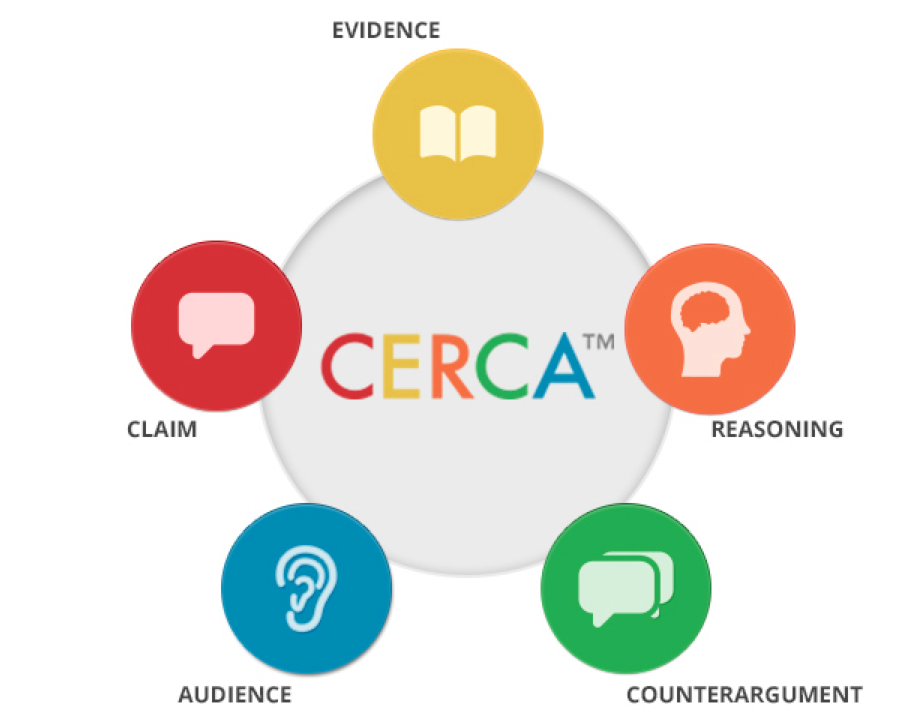
I had the privilege to work with ThinkCERCA last year in my Strategies for Learning class. Using ThinkCERCA, I was able to break down the writing process and help students have an organized argument. What does ThinkCERCA stand for?


Our class did a pre-assessment writing about the following prompt:
What type of learner are you? Use evidence from the text to support your claim about why this learning style is best for you.
After reading an article, I asked the students to write a paragraph-long argument. This is what I got from one student after prompting her to go back and look in the article for examples, etc:
I'm a visual learner. I agree with those things about how I like to read.
We spent about two weeks going over the process of ThinkCERCA and how we can build strong arguments. We spent a day on claims: we looked at claims, analyzed claims, wrote claims and then looked at each other's claims. After going through each part, I had them go back to the original prompt.

This is what I got after two weeks of using ThinkCERCA:
I learn best by visualizing my school work because if I see examples on what I have to do I get it right away by examples and visuals.  The article states "if your a visual learner, you take in informations best by reading." In school I learned vocabulary words by studying. The article also states a true fact, "you get impatient when listening to someone giving an explanation. You just want to read it yourself." When my teachers use to help me with work and they explain it in a difficult way when I can't understand, I want to try and learn it myself. The author says, "kinetic learners might enjoy measuring and mixing." It doesn't apply me because I don't understand how to do it. In conclusion, I am a visual learner.
I went through a training last year, and then another one today. I was pleasantly surprised to see that ThinkCERCA had a bunch of improvements! Some of the highlights:

  • Scaffolded Text: In every part of ThinkCERCA there are mini-lessons and texts available for all grade levels 3-12. No more digging through the internet to find articles that connect to differentiate for the diverse learners in your classroom!
  • CERCA Starters: An easy way to start the learning process of ThinkCERCA. These are the starting points to teach all of the important skills: Why We Make Arguments, Summary, Claim, Evidence, Reasoning, Counterargument, Audience. Each CERCA Starter comes with a mini-lesson and a corresponding QuickCERCA (article and multiple-choice questions) to get a baseline on how much the student understands that concept.
  • More CERCA Sets with Thematic Unit PlanningCERCA Sets have an entire unit planned out for you: you have an overarching question, suggested mini-lesson, and applied lessons (which are articles/writing at various grade levels 3-12).
  • Assign by Reading Level: When you create your class, you assign students a reading level. When you assign an applied lesson, you can have it automatically assign the article that corresponds to their reading needs! This makes differentiating a breeze.
  • QuickCERCAs Guide Lessons: When students read an article and answer the 5 comprehension questions, the data is directly linked to each part of CERCA. A quick 20minute QuickCERCA can then guide you as to which part of CERCA you need to go over.


For more information, check out the ThinkCERCA Blog.

Tuesday, October 20, 2015

Increasing Engagement & Feedback with TurnItIn.Com

By Jackie Randall and Kristen Guth

World Literature and Composition utilizes Turnitin.com more than simply an authenticity resource.  The sophomore English teachers take advantage of the site’s ability to prevent plagiarism, engage students, manage assignments and collaboration, and deliver rich feedback.  For the recent Memoir assignment, students submitted their first drafts to Turnitin.com.  With this submission, students received almost instant grammar corrections.  In addition, the sophomore team created comments that directly correlated with the rubric for the assignment.  By sharing both the comments and rubric within the team, all students receive consistent feedback across the grade level.  Each comment can be tied to the customizable rubric allowing for students to check the mastery of skills during the drafting process.


In the student example above, the purple bubbles are grammatical errors. The blue bubbles are the teacher comments, both canned comments (saved in the comment library on the right of the screen) and original comments found in the blue speech bubbles.
When the student hovers over the comment, the explanation or rule appears.  This is also where the evaluator can connect the comment to a criterion on the rubric.


Students have access to the complete rubric and how their comments correlate to the criterion. 

Through this process, students can receive rich feedback specific to their paper and assignment while in the drafting process.  Teachers can take advantage of utilizing canned comments (seriously, how many times do you write the same thing on every student’s draft?!) and grading through the website or iPad instead of hauling home piles of students’ drafts.  PLTs can share comments and rubrics to make team wide grading efficient and consistent. I’d say that’s a win-win-win! #turnitinforwhat

Friday, September 25, 2015

Schoology Checklists as Formative Assessment

By Kim Miklusak

Schoology checklists are not new on this blog: you can read more on how different subjects have used them here!  This year, Matt Snow & I are using them to differentiate instruction and provide immediate feedback for students at the AP level.

The sequence goes like this: Students take a pre-reading quiz on vocabulary from the text, using context clues and roots to determine the meaning of 5 words.  They have 3 opportunities to take the quiz in order to get 100.  This will then unlock the text, which students will annotate and submit, receiving quick feedback on a 4-point scale.  They then take a 10-question comprehension quiz, participate in a discussion in which they write a sample thesis (again using a 4-point scale).  Finally they are able to unlock the AP writing/analysis assignment, which targets individual writing skills.  None of these steps is graded!  They are the foundational skills required to reach higher level understanding, so students receive self-, peer-, and teacher-provided formative feedback before moving on. 
This example is not set up as a checklist because we are modelling it for students first.
The next assignment will be a linear checklist feature.
We have multiple goals for this set-up: 1) we hope to catch each student where s/he needs the most support, 2) we hope to provide immediate feedback on targeted skills, and 3) we hope to allow students who do not need as much support the opportunity to push themselves farther than they may have been able to in a traditional classroom set-up.

In pre-1:1 years, I had students fill out an excel print out, noting what score they received on the 4-point scale for each writing skill [more information on that can be found here].  But now with Schoology, if I can mark assignments as "graded" even if they are formative, I am able to see a running tally of how each student scored on each individual writing skill.  Now not only do students get quicker, targeted feedback on individual skills, but they can see their own development over time, thus making revisions and conferencing more effective and efficient.

This screen shot is set to display our "writing" rubrics/skills.
I can also change the view to "reading" or grammar rubrics/skills
You'll see in the sample above that there are some things I need to work out: for example, how to label each assignment.  Nevertheless, I'm excited to work with these features for this upcoming year!

Wednesday, September 9, 2015

Establishing Mastery Culture

By Kim Miklusak

This year the English Department has rolled out common expectations for all grades and levels.  We hope that these agreed upon norms will create consistency in mastery and rigor for all students.

1.  Common Weights & Categories:  30% Writing, 30% Reading, 30% Grammar, 10% Habits of Work (sophomores and juniors; freshmen and seniors have adjusted percentages for an "oral communications" category).  This shifts the focus to a more standards-based learning approach.  Teachers and students will be cognizant of what category or categories each assignment goes into.  For example, if a writing assignment is scored in writing and grammar, the students should be aware in advance of how and why the assignment is being scored in each area.  This reporting will also allow parents, students, and teachers to be able to clearly identify areas of strength and weakness.  Previously categories were designated as "major assignments" or "writing" but the effect was that it muddled together skills that did not accurately report out in grade form.

2.   Revisions: Every major essay requires two revisions for the first semester.  This will instill in students, again, the continuing importance of multiple drafts as well as mastery culture.  The first grade will be a completion grade and will be reviewed by a peer, a tutor, the author, or a teacher--at the discretion of the teacher.  The students should then ideally write a brief reflection, summarizing what and how they will revise, thus requiring students to be conscious of their writing.  By the second semester, the requirements change where students who receive a D or F are required to revise, but students who receive A, B, or C have an option to do so.  This focus shifts in order to aid the students in AP who will now be required to write a timed, graded essay on the AP exam in May.

3.  Habits of Work: This is a debated topic; however, the consensus was to remove "on time" points from major assignment grades. Again, this practice muddled what the grades meant and how parents and students understood them.  Now, for example, it's clear that a student can write a quality essay but struggles with completing work on time.  Additionally, the habits of work points serve as a placeholder to demonstrate that a student has completed a first draft even if a second draft is still pending.

Wednesday, May 6, 2015

Active Learners

By Mark Heintz

I create a lot of materials for my students to learn such as lecture notes, examples, PowerPoints, quizzes, review materials, videos and a number of other items.  I learn a lot in process of creating these materials, in fact, way more than my students, because I create and they do not.

In my first few years of teaching, I was the sage on the stage.  I lectured and created materials all towards the purpose of students understanding the content.  However, I found that I spent an exuberant amount of time going back over material that I already covered, because the students had poor retention rates of the material.  Even more revealing, the review day had more of an impact on students test grades than the learning that occurred over the entire unit.  The review day put material in their short term memory that was useful on the test the next day.

After reflecting, I found that most of the student learning was passive.  So, I present the Cone of Learning! When students are active in the process, their retention rates increase.


Now, I want my students to be an active participant in the learning process.   The picture below shows one of the learning goals for the first unit our Human Geography class.   Also, it states the skills students will develop in that unit.  The marriage of these two, content and skills, is crucial to learning. It forces the learning process to be based on reading, writing, interpreting, and mainly doing the work. 


After the purpose has been set, the students will manipulate images to one of the categories of the five themes.  Then, the students will write why they think the image belongs in that category.  I should preface this learning progression by stating this will be the students first exposure to the five themes of geography.  I want the students to build their background knowledge through interpreting images and writing out their understanding of that interpretation.  Then, the students will discuss their interpretations in a small group setting, and finally report out as a class.

Normally, I would have lectured to the students on the five themes to first give the students background knowledge.  I would have found images to give the students specific examples and guided them through the themes from my direct instruction.   Now, I love the students being an active participant in their learning.    


All of this background building will lead to the students writing in response to a document based question on the five themes of geography. Along the way, students will have practiced the skills and been given feedback as they learn.  They will write to learn and learn to write at the same time, all while being active participants in the learning process.  

Friday, March 20, 2015

Student Interviews as Assessment

By Kim Miklusak

This week I performed interviews as part of an ELL grad project in assessment to discover how students brainstorm for an AP English Language prompt.  I selected two students who are second language learners and who have struggled in different ways during the year.  I cannot overstate how useful I found these interviews!  Many teachers instruct and model brainstorming.  Some require that students to demonstrate planning for X minutes before they can write.  What I think these interviews made clear to me, however, was where specifically in the planning process students struggle.  This information will provide teachers and students with clear steps to possible solutions.

For example, my first student is a native Urdu speaker and speaks Urdu as her home language.  She exited ELL during 3rd grade.  Listening to her speak through her planning, we could pinpoint two main concerns: defining terms in the quotation and how to move from brainstorming evidence to outlining a main idea based on the prompt.  I am going to provide her with some graphic organizers to help scaffold the process better for her.

My second student is a native Spanish speaker and speaks Spanish as her home language.  She was in bilingual education through 3rd grade.  When planning, this student skipped the unknown vocabulary in the quotation and jumped right into prompt.  Once we talked through how to use context clues to define terms, the prompt became much easier.  Because she has not internalized steps to understand unknown words, she relies on "what it sounds like" and then moves on to working through the prompt.  I was able to provide her with other ways to figure out unknown words such as using her Spanish cognates.

I realize that interviews are incredibly time consuming: each of these took 10-15 minutes and could easily have run longer.  It would be impossible to do with every struggling student.  However, I highly recommend using this form of assessment for a few of your students in any subject area and grade or possibly using the iPad to require students to verbally explain their whole planning or problem solving before they write an essay or complete a math or science task in order to go back and review with them after they if need be.  The information gained was invaluable!

Friday, March 6, 2015

Adding Tech to Writing Assignments

By Kim Miklusak

Last week I attended the CASE Conference (Council for American Studies Education).  The topic this year was storytelling, specifically how do we tell the stories of others and how do we honor the voices in our classroom.  You can check out the conference program here, but one session jumped out at me as a technology coach.

Klein & Bachman, American Studies teachers from New Trier, presented on how they combined a traditional research paper with iBooks.  What an interesting blend of technology to enhance learning!  The students went through all of the traditional steps of preparing for and writing a research paper.  When they finished, they imported their work into an iBook and added videos, photos, links, and quizzes to visually reference what they discussed in their paper.

For example, one student analyzed Disney princesses over time and their effects on women's roles in society.  After importing and formatting the research paper into iBooks, the student added photographs of Disney princesses with pop-up boxes of additional descriptions of the characters, video clips from Snow White demonstrating how subservient she was around the dwarfs' house, and even photographs of the author as a child dressed up in princess outfits!

While this project was done with a more extensive writing assignment, it seems that if a school had easy access to technology, this would be an interesting idea to enhance almost any writing assignment!

Wednesday, February 25, 2015

Schoology Checklists to Teach Writing

By Mark Heintz

A few weeks ago @MsRachelBarry posted how to create a Schoology checklist.  If you want to learn how to create a checklist or don't know what they are, you should read her post by clicking here.  The checklist feature is great for materials that students can easily self-assess or can be automatically graded with an assessment, such as a multiple choice, matching, ordering of events, or true false questions.  You can mandate students post assignments, view links, or take assessments in the order you want them to.  I have used checklists in varying ways, but recently I created a Schoology checklist to help teach writing.

I teach a comparative essay in world history.  It is a very specific essay that addresses students ability to compare two concepts or processes using historical content.  Students struggle with writing and struggle more with writing in an academic sense.  Furthermore, teaching writing often comes with varying skill levels and the checklist allows for more individualized learning to take place.   Here is the prompt I used for this checklist:


For the first step, I had the students sort historical terms into either the Haitian, French, or Latin American Revolution.


When finished, the students submit their worksheet to Schoology. After submitting the worksheet, a quiz comprised of a matching question assessed the same information on the worksheet.  This is learning that the students could assess on their own through the quiz.  Here is a sample of the quiz:  

After students pass the quiz, they move on to grouping the information into either a method or an outcome of the revolutionary process.  The first two steps can sometimes be accomplished without my help.  Some of the higher skilled students can move onto to the harder concepts and work on the skills they need to at their own pace.  At the same time, I can have students who do not understand the content, stay at the own level and get the help they need. Furthermore, students cannot move on to higher level skills without laying the ground work needed to be a good writer.  It is a failsafe way to ensure students can be successful.  When students know the content and do the first steps, it helps students become successful.  Here is a sample of the grouping worksheet and quiz.  


After they pass the quiz, students have to check in with me, the teacher, before they can move on to the next step.  The next step is when students come up with possible groupings for methods and outcomes.  There is not one correct answer, therefore it cannot easily be assessed with a multiple choice assessment.  So, I have the students write their possible groupings in a short essay question in Schoology.  I check the students' work and approve of it before they can move.

Students move on to evaluating and writing of the essay.  I have the students read through several thesis statements to see if they contain all of the components needed to be considered a good thesis.  I then have the students submit their work and take a matching quiz in Schoology to assess their evaluative skills.  
Worksheet
Schoology Thesis Quiz
The last stage in the process is writing comparative statements.   Students will evaluate pre-generated comparative statements.  After reading the statement, they will fix the statement by rewriting it in the correct manner.  They will post their statements in Schoology for me to evaluate.  At the end of the lesson, the students will have a portfolio of student work and samples to look back upon for future essays.  

When completed, the students will be able to write the essay on their own.  This is in the early stages of the essay writing process.  The students will have seen several parts of the essay and have done the planning stages of the essay.  If everything goes well, the students will be successful when they write the essay.