Showing posts with label social studies. Show all posts

Tuesday, January 31, 2017

Blending Reading and Writing to Understand the Content

By Mark Heintz

This semester I put more emphasis on students reading to gain an understanding of the content and writing to prove their understanding of the readings and content.  Throughout the semester, I shifted my teaching style to center on students reading and writing daily.  This shift came my students giving me feedback and their writing and my own reflection on the time it takes to develop the skills of academic writing and understanding of primary and secondary sources.  Since the shift, the amount of daily feedback each student received on their progress towards these skills has increased and their understanding of the content increased.

For the past week lessons, the following were my content objectives:

  • List five ways rulers continued to use religious ideas to legitimize their rule. 
  • List three supporting details that explain how the Spanish, Dutch, French, and British empires rose in both hemispheres.  
  • List supporting details that explain how the Manchu, Mughal, Ottoman, and Russian rose to power.

For the final, the students will be assessed on a stimulus based multiple choice exam and three short answer questions which mirrors the content objectives and the style in which the course is presented.

My students gain background information on the content objectives from a series of videos I made.  You can read about that process here.  The videos have freed time in the classroom to analyze documents and practice the writing. 


The students are reading and unpacking difficult documents like the ones pictured above. Two documents such as these can take entire period to analyze.  Each day they continually work towards mastery on these skills all while reinforcing their understanding of the content.   I am fortunate enough to have white board tables which makes it easy to read student samples and provide feedback. The students are able to ask individual questions about the documents and their writing. Since they write on the tables, I can easily provide feedback related directly their questions.  Furthermore, I can differentiate between poor writing skills or a gaps in their content knowledge.  Since they are writing so frequently, I am understanding their voice ways to fix it for each student.  After each day, I can pause the class to models of student work to emphasize a common mistake or praise progress.

The students are having to master the content knowledge to work through the documents and writing.  As seen in point C in the above sample, the student needs to draw more specific examples to prove their point.  It takes time to develop the ability to make claims about the past and defend them with historical examples that actually support the claim they made.  I am proud of the progress my students have made this semester! 


Monday, June 6, 2016

Keeping Students Engaged After the AP Test

By: Dan Saken

There is such a feeling of finality once students take the AP test in a given class, for both students and teachers.  So how do you convince students to stay bought in and engaged for the month or so left of school that follows AP testing?  MOVIES!!!!.....just kidding (mostly).  Showing movies are great to allow students to decompress from the work that went into preparing for the test (I showed 2 of them in class).  But I noticed that most students were looking at their phone screens more than the movie screen by Movie #2.   While the students may say all they want to do is watch movies, it seemed that my students secretly were yearning for something that required them to do more than just have a pulse. 

My experience and what worked in my class is probably quite different than other classes because:
     a)    AP Psych has a majority of seniors, which is a different kind of beast (battling senioritis, students absent for other AP tests or activities, etc.)
     b)   Our AP test is the first day of AP week, so we have more time following the test than others may


I did a few other things in the first couple of weeks after the test with surveys, reflections, letters, etc., but I took the second-to-last week for seniors and decided to make it an “Activity Week.”  Besides the obvious idea of having fun, it was also important to me that the activities still connected to Psychology in some way.  It was also important that each activity be something that could be done in one day; a “quick-hitter” that held their attention just long enough before the interest wore off.  Here is what the week looked like (and I’ll attempt to hold back on the Psych jargon):

MondayThe Depth Perception Experiment
We do a unit on Sensation & Perception that includes how we perceive our world using depth perception from both eyes or just one eye, so this fit perfectly.  The great thing about this activity was the weather cooperated and we could do the experiment outside.  Students got in teams of 3-4 to conduct an experiment on a person’s ability to catch a tennis ball with one hand (Thanks PE department!)  They were thrown the ball 10 times with both eyes open, then 10 times with only one eye open and were asked to record the data.  The students were very competitive, wanting to do well and genuinely seemed to enjoy the process.  In our debriefing once everyone was done, we were able to calculate the mean, median, and mode, discuss the independent and dependent variables, brainstorm possible confounding variables, and more ideas that directly pertain to the Psych material we learned.  And they definitely learned that it is much easier to catch a ball coming at you with both eyes tracking the ball.

Tuesday – The Quotes Project
We once again took advantage of the weather outside because the project could be done from anywhere that had Wi-Fi.  Each student chose a famous psychologist we covered in class to create a single slide/poster with a picture, dates of life, perspective in psychology, and a quote from him or her.  I did make it worth points, though not enough to make much difference on their grade and said they would present it to the class on Thursday.  I attempted to motivate them even more by saying if their slide was excellent, I planned on making a poster from it to hang in my room next year and I’d place their name under it. Presentations on Thursday!


Wednesday – The Marshmallow Challenge
Students were placed in teams of 4-5 people to compete in a teambuilding activity that focused on their ability to be creative and use divergent thinking.  They were given spaghetti, tape, string, a marshmallow and 18 minutes to build the tallest structure possible that could stand on its own with the marshmallow on top (and create a team name).  Once again, I found the students incredibly engaged and working together to find solutions to this admittedly silly challenge while still being able to connect the lessons from the activity to psychological concepts.


Thursday – Quotes Project Presentations
Students were given the floor to project their slide up on the screen for the class to see and present their psychologist and his or her quote.  I obtained some phenomenal, poster-worthy material that I will definitely be putting up in my room and every student in class got their moment in the spotlight (whether they wanted it or not), receiving a one-clap from the class for their efforts.  Only 3-4 did not complete it out of my 70 students, which I was incredibly pleased with….and I got some new classroom decorations in the process!


Friday – Senior “Absentee” Day
I didn’t have an activity planned for this day….for obvious reasons :).

The feedback I got from students when I asked them about the week was overwhelmingly positive, with most students saying they were open to doing more.  One thing that I strongly believe helped in the success of the activities was that each activity was really a One-Day thing.  If I tried to do an extended assignment of some kind, I don’t think it would have been nearly as successful in keeping the students engaged throughout.  I already have more ideas for next year, but I also hope I can incorporate some of these types of activities into the regular curriculum as a change of pace and opportunity for application of what they’ve learned.  Because in case you didn’t know, “Psych is Life.”

Tuesday, November 3, 2015

ThinkCERCA


This past Thursday, several teachers from our special education department sat in a ThinkCERCA training to learn ways to incorporate explicit instruction in writing in a variety of class: both Strategies for Learning, English and content area classes.

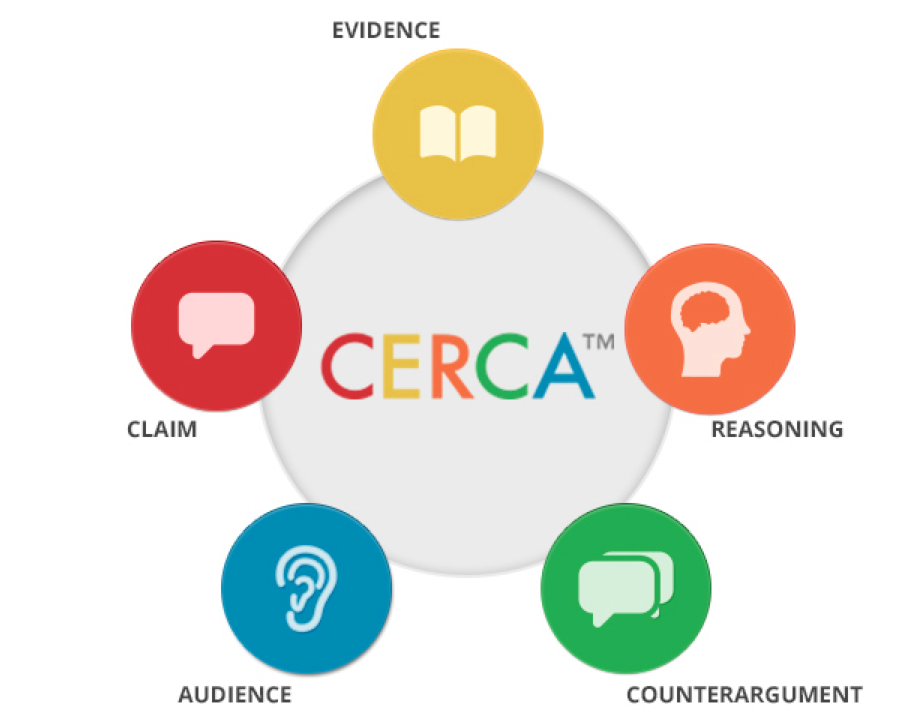
I had the privilege to work with ThinkCERCA last year in my Strategies for Learning class. Using ThinkCERCA, I was able to break down the writing process and help students have an organized argument. What does ThinkCERCA stand for?


Our class did a pre-assessment writing about the following prompt:
What type of learner are you? Use evidence from the text to support your claim about why this learning style is best for you.
After reading an article, I asked the students to write a paragraph-long argument. This is what I got from one student after prompting her to go back and look in the article for examples, etc:
I'm a visual learner. I agree with those things about how I like to read.
We spent about two weeks going over the process of ThinkCERCA and how we can build strong arguments. We spent a day on claims: we looked at claims, analyzed claims, wrote claims and then looked at each other's claims. After going through each part, I had them go back to the original prompt.

This is what I got after two weeks of using ThinkCERCA:
I learn best by visualizing my school work because if I see examples on what I have to do I get it right away by examples and visuals.  The article states "if your a visual learner, you take in informations best by reading." In school I learned vocabulary words by studying. The article also states a true fact, "you get impatient when listening to someone giving an explanation. You just want to read it yourself." When my teachers use to help me with work and they explain it in a difficult way when I can't understand, I want to try and learn it myself. The author says, "kinetic learners might enjoy measuring and mixing." It doesn't apply me because I don't understand how to do it. In conclusion, I am a visual learner.
I went through a training last year, and then another one today. I was pleasantly surprised to see that ThinkCERCA had a bunch of improvements! Some of the highlights:

  • Scaffolded Text: In every part of ThinkCERCA there are mini-lessons and texts available for all grade levels 3-12. No more digging through the internet to find articles that connect to differentiate for the diverse learners in your classroom!
  • CERCA Starters: An easy way to start the learning process of ThinkCERCA. These are the starting points to teach all of the important skills: Why We Make Arguments, Summary, Claim, Evidence, Reasoning, Counterargument, Audience. Each CERCA Starter comes with a mini-lesson and a corresponding QuickCERCA (article and multiple-choice questions) to get a baseline on how much the student understands that concept.
  • More CERCA Sets with Thematic Unit PlanningCERCA Sets have an entire unit planned out for you: you have an overarching question, suggested mini-lesson, and applied lessons (which are articles/writing at various grade levels 3-12).
  • Assign by Reading Level: When you create your class, you assign students a reading level. When you assign an applied lesson, you can have it automatically assign the article that corresponds to their reading needs! This makes differentiating a breeze.
  • QuickCERCAs Guide Lessons: When students read an article and answer the 5 comprehension questions, the data is directly linked to each part of CERCA. A quick 20minute QuickCERCA can then guide you as to which part of CERCA you need to go over.


For more information, check out the ThinkCERCA Blog.

Thursday, May 14, 2015

Exit Slips and Higher Level Thinking

By Mark Heintz

Higher level thinking in May? You bet! At the end of my lesson on Monday, students wrote four impacts of the Neolithic Revolution.  We did one as a class, then they attempted three in their groups. As an exit slip, students submitted what they thought was their best to an open ended essay question in Schoology.


As I read through them, I found that some students grasped the goal of the lesson and used the document as evidence, while others...needed more time. There was such a wide range of sentences submitted and some students did not submit.  As I was reading, I realized I wanted all students to see the range of writing.   Furthermore, I wanted students to evaluate the writing and rank it as either high, middle, and low quality.


I took student exemplars and I typed them in a note in Notability, then attached the note it to Schoology.  This enabled the students to simply drag or edit the statements.  

The students ranked the statements from high to low and it was great! The students saw student examples from the day before.  They ranked the statements simply by clicking on the statements and moving them to the top if they were the best and the bottom if they were the worst.  As a class we discussed the why they ranked them they way they did.  The students were providing great reasons and rationales for their rankings.  The students who did not submit their statement the previous day were exposed to different quality of statements.  The students received timely feedback that improved their writing.  At the end of the day, the students were asked to complete a similar task with the Second Agricultural Revolution and the statements were significantly stronger.  

Wednesday, April 22, 2015

Student Feedback and Notability

By Mark Heintz

A few weeks ago, Linda Ashida posted on Katie Owen's innovative idea of sharing Notability notes to students.  You can read her post here.  Lately, I have been using this practice to increase student engagement and feedback.   Also, as the school rapidly comes to a end, time is precious.  Using shared notes increases classroom time because students are not spending time copying information from one place to another.  Therefore, more time is spend in the analysis of student work and providing feedback.

I recently used this strategy through a list of topics/terms on the USSR and CCP.  I shared the note with the students, and I asked them to move the information to either category.  They could copy the terms to place under both groupings.  When they finished, students shared their work via AppleTV. This practice enabled the class to go through the answers and provide feedback on their selections.  The entire task took only a few minutes to create and a few minutes for the students to attempt.  The discussion that followed the assignment was rich. Since the activity only took a few minutes, there was time that allowed for students to ask questions on why a term was in a specific category.  At the end, some students had a list of terms they needed to look up for further review.  Next time I do this activity, I will ask the students to use the words to draw comparisons.


Another example of this practice comes from a first year teacher, Kristen Gierman.  To help students writing, Kristen created a note that contained elements of a paragraph.  She wrote one main idea statement that the students located and move to the top of the page.  Then, the students went through all of the other statements to determine which were the best support of the main idea.  The students simply erased the ones that were off topic and moved the ones in support to the order they belonged in the paragraph.


The students shared theirs versions of the paragraph and defended the placement of the statements to the class. It was great to see the students evaluating work and seeing their rationale. Many of the students understood the necessity for clarity in their writing and often cited that as a reason to exclude some pieces of evidence. At the conclusion of the activity, the students wrote their own paragraph.  The writings were some of the strongest I have seen students create in my nine years as a teacher.  It was great to see the students use the structure, clarity, and use of strong evidence from the example in their own writing.   


Wednesday, April 15, 2015

Historical Twitter Handles?

By Mark Heintz

The strategy below is a post reading strategy that is easy to implement and gets a lot out of the students.  I have posted about how my history classes usually begin with some sort of warm up relating to documents.  Sometimes they are pictures, but usually they are a reading.  You can read more about them here.

Recently, my students read a few short paragraphs on the British East India Company. I wanted to see how much my students understood from the reading.  At the end of the reading they were asked to create a twitter handle about the document and a tweet that showcased their understanding of the passage.  This was the first time I used this strategy and I wasn't sure how it would go.  But it turned out to be pretty great. Some of the examples were pretty hilarious or very informative.
 The great thing about this strategy was the effort and thought the students put into the task.  They were reading the passage over and over again to come up with something good.  As I walked around the class, I saw students go through several drafts to get to one that was worth sharing!  Several drafts! It was suppose to be a simple post reading exercise, but ended up being an exercise in mental gymnastic that students really cared about.  At the end, some examples were shared over AppleTV.   Give it a try yourself, and let me know how it goes!

Wednesday, March 4, 2015

Easy Exit Slip

By Mark Heintz

Over the past week I have been teaching my students the Atlantic Revolutions.  I thought they were understanding most of the content.  Since they were going to be writing an essay on the revolutions, I wanted to ensure they understood everything before they began writing.  At this point in their learning, the students had completed an online vocabulary quiz, been lectured to, completed an anticipatory reading guide, read a textbook chapter, read several primary and secondary documents, and completed some comparative activities all on the Atlantic Revolutions.  From all of these activities, I thought they were pretty good on the content. During their learning,  I listened to the conversations, answered questions, and reviewed the activities. Then I gave them an exit slip.


I asked the students to do three things:  one thing they didn't understand, two questions they still had, and three things they learned today.  It took less then five minutes for the students to write down their information, and it really gave me and them an insight into what they did and didn't understand. I really like using three things they learned today so they end on a positive note.

The information they provided helped guide the lesson for the next day.  I took all of their questions and found the common misinformation and went back over the material.  The students who seemed really lost, I was able to pull aside and redirect their learning.

The great thing about the use of this exit slip is that it can be used on the spur of the moment.  You can just have the students pull out a quarter sheet of paper and answer the questions.  Another way to do it is through a discussion post in Schoology.  The benefit to doing it online is you can have students start the next day by answering their own questions, respond to each others posts, or you as the teacher can respond to each one if you are really motivated.  A bonus to using Schoology is that you can hide all of the student responses from students until they respond.  So, you can force the students to post before just taking other students' answers.


Wednesday, February 25, 2015

Schoology Checklists to Teach Writing

By Mark Heintz

A few weeks ago @MsRachelBarry posted how to create a Schoology checklist.  If you want to learn how to create a checklist or don't know what they are, you should read her post by clicking here.  The checklist feature is great for materials that students can easily self-assess or can be automatically graded with an assessment, such as a multiple choice, matching, ordering of events, or true false questions.  You can mandate students post assignments, view links, or take assessments in the order you want them to.  I have used checklists in varying ways, but recently I created a Schoology checklist to help teach writing.

I teach a comparative essay in world history.  It is a very specific essay that addresses students ability to compare two concepts or processes using historical content.  Students struggle with writing and struggle more with writing in an academic sense.  Furthermore, teaching writing often comes with varying skill levels and the checklist allows for more individualized learning to take place.   Here is the prompt I used for this checklist:


For the first step, I had the students sort historical terms into either the Haitian, French, or Latin American Revolution.


When finished, the students submit their worksheet to Schoology. After submitting the worksheet, a quiz comprised of a matching question assessed the same information on the worksheet.  This is learning that the students could assess on their own through the quiz.  Here is a sample of the quiz:  

After students pass the quiz, they move on to grouping the information into either a method or an outcome of the revolutionary process.  The first two steps can sometimes be accomplished without my help.  Some of the higher skilled students can move onto to the harder concepts and work on the skills they need to at their own pace.  At the same time, I can have students who do not understand the content, stay at the own level and get the help they need. Furthermore, students cannot move on to higher level skills without laying the ground work needed to be a good writer.  It is a failsafe way to ensure students can be successful.  When students know the content and do the first steps, it helps students become successful.  Here is a sample of the grouping worksheet and quiz.  


After they pass the quiz, students have to check in with me, the teacher, before they can move on to the next step.  The next step is when students come up with possible groupings for methods and outcomes.  There is not one correct answer, therefore it cannot easily be assessed with a multiple choice assessment.  So, I have the students write their possible groupings in a short essay question in Schoology.  I check the students' work and approve of it before they can move.

Students move on to evaluating and writing of the essay.  I have the students read through several thesis statements to see if they contain all of the components needed to be considered a good thesis.  I then have the students submit their work and take a matching quiz in Schoology to assess their evaluative skills.  
Worksheet
Schoology Thesis Quiz
The last stage in the process is writing comparative statements.   Students will evaluate pre-generated comparative statements.  After reading the statement, they will fix the statement by rewriting it in the correct manner.  They will post their statements in Schoology for me to evaluate.  At the end of the lesson, the students will have a portfolio of student work and samples to look back upon for future essays.  

When completed, the students will be able to write the essay on their own.  This is in the early stages of the essay writing process.  The students will have seen several parts of the essay and have done the planning stages of the essay.  If everything goes well, the students will be successful when they write the essay. 

Wednesday, February 11, 2015

Activate Prior Knowledge or Build Background Knowledge


By Mark Heintz

In history, students typically do not have a lot of direct background knowledge on a subject.  One way to build background knowledge or activate any prior knowledge in a quick in easy way is through picture.  I try to put more pictures into the curriculum because they make students think.  Anytime I can do that, I put one in the win category.  For this picture analysis, I used two different forms of art, Ottoman miniatures, and Aztec codices.  These two forms of art are on the AP World curriculum framework.  I mean…I did my dissertation on the cultural comparisons between Aztec codices and Ottoman miniatures. 


Anyway, I have students list everything they see in the pictures.  It really is that easy.  Also, it is a great starting point for picture analysis. The students come up with great observations simply by looking at the photos.  From the pictures below, the one on the left, the students saw soldiers with guns.  Which is great, because they either made the connection to prior learning about Janissaries or they then have that image in their mind when they read about Janissaries later in the period.


The pictures were a pre reading strategy.  The pictures gave students an image in their mind when they read about Aztecs and the Ottomans of which they typically have little prior knowledge.  These images were a great reference point when details come up in the reading.

The student listed what they saw under the picture and then listed what the whole class listed on the right hand side of the picture.  In this case, the iPad was a great medium for the students because they can see the pictures in color and can zoom in on specific parts of the images.


Wednesday, February 4, 2015

Determining Main Ideas in a Reading Passage

I start my AP World History class almost every day with a warm up.  I like the routine of starting off class with the students diving right into content and thinking.  Also, they know what to do at the beginning of class, which helps them start right away.  Before every student had an iPad, I left the warm ups at the door.  Each student picked the paper up as they entered the room, and the instructions were always on the sheet.  Now that each student has an iPad, they download it through the LMS I use, Schoology. 
Most of the time the warm up is a reading that builds background knowledge or addresses an AP theme that is, for a lack of better way to say it, random.  The warm ups are always short, something they can read or complete in less than a few minutes.  Then they can share with another student.  Finally, we report out as a class and then I answer any questions the students might have. The whole process takes from five to ten minutes.
I have a variety of strategies I use depending on what skill I would like to focus on that day.  Also, the variety helps keep the students interested in doing them almost every day. In this case, I used the deletion summary reading strategy.  I used this strategy because students often have a trouble determining what is important or not.  This is crucial when reading non-fiction material.  Furthermore, students will need this skill in any profession, as they will need to be able to sift through material quickly and efficiently in almost any profession.   
 I always give the students a clearly defined purpose when they read.  When using the deletion summary strategy, students cross out everything that does not answer the question or is aligned to the purpose. At the end, I have the students summarize the remaining information. 
Seeing what students delete or keep is very revealing. At first, they either delete or keep everything.  It takes several attempts for students to understand what is important. It takes time to develop that skill when reading unfamiliar non-fiction material.  To help the students, I walk through the process with the class.  After reading each line, I ask what part of the line is essential or directly related to the objective.  Then, we cross out everything we did not say.  As we do this more frequently, I will have several students share over AppleTV their attempts.