Showing posts with label professional development. Show all posts

Tuesday, February 27, 2018

6-Step Process to Designing Curriculum: Evaluation (Part 6 of 6)

From Kern et al

By Kim Miklusak


Last semester I took a Foundations of Curriculum and Instruction course at UIC. Our textbook, while a medical curriculum textbook, reminds us that curriculum design crosses education fields and that what we are doing in our classes every year has its grounding in research.  Kern, Thomas, and Hughes in their book provide a 6-step approach to curriculum development.  My goal is to share the theory behind our current practices to serve as a guide as design and redesign our courses.  Earlier steps can be found here.


Step 6: Evaluation & Feedback--the final step!

According to Kern (et al), feedback "closes the loop in the curriculum development cycle" (122).  Gathering evaluative data and feedback from participants helps determine the success of the curriculum and bolster support for it moving forward.  Ultimately the question is: did the design of your curriculum meet your intended goals and resolve concerns brought up in Step 1 of the General and Targeted Needs Assessment?

Benefits & drawbacks of various feedback
The feedback could be formative and ongoing, or summative and final.  It could be based on individual participants or the program as a whole.  It could be qualitative or quantitative.  It could be about the students or from your peers.  However, when it comes down to it, the feedback should be accurate.  So the questions become how do we best gather the information?  Are the questions clear?  Are the results useful?  Are they are on some sort of scale?  Are the questions asked in a fair manner?  Are they replicable?  Are they surveys?  Interviews?  Focus groups?

In Practice:

I know many teachers have developed opportunities for feedback through their year and at the end of their year--especially with increased access to tools such as Google Forms or Schoology polls.  For example, in the past I have asked students before and after our AP exam to rate themselves in various skill and habits of work areas as well as to rank the usefulness of activities I have done throughout the year.  I have used this information to guide planning for the following year.  I know other peers at EG and on Twitter give students more open-ended surveys, allowing broader feedback, as well as specific in-the-moment questions at the start of class or at the end of a unit.  A few years ago we even pulled together a focus group of students to discuss the purpose of school!  You can see their insightful comments in our blog post here!  This was probably one of my favorite moments of the past few years.

Yet as we develop and re-develop our courses every year or every few years I wonder if we truly gather the data we need to consider the effectiveness of our courses.  We can use AP and SAT data, grades, test results, etc.  Does that data help us?  Do we use it to guide our instruction and assessment?  Furthermore, do we ask the students?  I recognize that sometimes they aren't aware in the moment of the usefulness of some things we do, so in some cases their feedback isn't quite as valid as we'd like.  But in those moments I wonder if we've done enough to explain to them why we're doing what we're doing, which is feedback in and of itself!  

In the end I encourage everyone to ask their students for feedback at the end of the year and to analyze data as an individual, as a team, and as a subject if possible.  What you ask and how you ask it should be in whatever manner is most comfortable to you.  But you may be surprised at how useful what the data and students have to say is when it comes to redesigning your course!

Please feel free to share other insights and ideas based on your experiences in the comments below!

Friday, February 2, 2018

6-Step Process to Designing Curriculum: Implementation (Part 5)


By Kim Miklusak

Last semester I took a Foundations of Curriculum and Instruction course at UIC. Our textbook, while a medical curriculum textbook, reminds us that curriculum design crosses education fields and that what we are doing in our classes every year has its grounding in research.  Kern, Thomas, and Hughes in their book provide a 6-step approach to curriculum development.  My goal is to share the theory behind our current practices to serve as a guide as design and redesign our courses.  Earlier steps can be found here.


Step 5: Implementation

Effective implementation of your curricular design, according to Thomas (et al), would include addressing all of the elements on this checklist displayed in the image below.  The checklist is broken down into several categories with specific considerations below each.
  
The checklist asks, for example, do we the appropriate
 faculty available for this course?  Do we have time, finances, and facilities to train them?  Do we have internal support from administration and external support, if it applies?  Do we have appropriate communication in place to facilitate between all personnel and operational support to distribute the materials needed?  Do we anticipate barriers and address them before they affect the curricular design?  And, finally, how do we roll out the curriculum and monitor it for adjustment?  Do we pilot a course, phase it in, or fully implement it?  Ideally, all of these steps would be addressed as we plan through our stages.  Considering them in advance would also help facilitate development and lead to smoother implementation--especially when partnered with a smooth first four steps of this design process.

In practice:

On the ground, on a daily basis, I wonder how many of these elements of the checklist are addressed as we plan.  Is it feasible for a classroom teacher to address any or all of them?  Is it the role of the PLC leader--if that structure even exists at your school?  Is it a department/division chair--is that person an administrator or a teacher-leader with possible release time?  Does that person have the ability to make these decisions, or are they more suggestions?


Please feel free to share other insights and ideas based on your experiences in the comments below!

Monday, December 18, 2017

6-Step Process to Designing Curriculum: Educational Strategies (Part 4)


By Kim Miklusak

I am currently taking a Foundations of Curriculum and Instruction course at UIC.  Our textbook, while a medical curriculum textbook, reminds us that curriculum design crosses education fields and that what we are doing in our classes every year has its grounding in research.  Kern, Thomas, and Hughes in their book provide a 6-step approach to curriculum development.  My goal is to share the theory behind our current practices to serve as a guide as design and redesign our courses.  Earlier steps can be found here.


Step 4: Educational Strategies

In the previous posts, after determining our targeted needs assessment and stating our goals and objectives, we now need to select our content.  For some subjects, the content and objectives overlap.  For others, the content may be more arbitrary.  Regardless of what content is decided upon, it always must build from the objectives and goals.  As stated in Kern, "transformative learning occurs when learners change in meaningful ways" (67). 

The final step in this part of the process is selecting the best educational methods for your content.  The selection must match with goals, yet at the same time be varied to meet the needs of the students, environment, and content.  Additionally, it must adjust to students' learning styles and preferences.  For higher-level, complex skills, oftentimes balancing a few methods works best over the course of a unit or a year.


In practice:

I find this element of curricular design the most interesting as a teacher.  It is true: we all have the methods that we feel most comfortable with day-to-day, and we all have the ones we feel most comfortable using in our content.  However, as Kern's chart shows, not all methods are best depending on our goals and objectives--or our students. 

Are students experiencing trouble reaching their goals?  Are we having classroom management issues?  Perhaps then there are times in our curriculum when we truly want to practice affective/attitudinal goals and could select the appropriate methods to do so.

However, this often requires us to step outside of our comfort zones--especially when coupled with new technology in the classroom or releasing control of our lessons to our students.  One of the ways I have helped work around this in my own teaching is by observing teachers across content areas.  I have learned so much by working with our Collab Lab team as well as learning with and from our peers in learning groups and lesson demos.

Please feel free to share other insights and ideas based on your experiences in the comments below!

Tuesday, December 12, 2017

6-Step Process to Designing Curriculum (Part 3)


From Kern, Thomas, and Hughes. See link above.
I am currently taking a Foundations of Curriculum and Instruction course at UIC.  Our textbook, while a medical curriculum textbook, reminds us that curriculum design crosses education fields and that what we are doing in our classes every year has its grounding in research.  Kern, Thomas, and Hughes in their book provide a 6-step approach to curriculum development.  My goal is to share the theory behind our current practices to serve as a guide as design and redesign our courses.  Steps 1 and 2 can be found here.

Step 3: Goals and Objectives


Once we have identified the needs of our learners, we need to clarify our goals and objectives.  While there may be some differences in how these terms are used in our various institutions, on the broader level, goals are the overall purposeful outcomes while objectives are measurable elements.  

When we state our goals, they help us to define and clarify our content, priorities, learning methods, and evaluation/assessment outcomes.  These are not only important for ourselves as we re/design our courses, but they are also important to communicate clearly to all stakeholders--peers, parents, students, administrators, etc.


According to Kern et al. there are five elements to keep in mind when writing a clear and measure objective: who will do how much (or how well) of what by when?  A key here is to use descriptors that are less open to interpretation.  For example, how can we measure the verb "know" as opposed to "identify, list, recite, define, etc."  


In practice:


For this step I wonder a few things, but many depend on the situations at our individual institutions.  For example, do we know the overall purpose of our course?  If there is not a clear "out" such as an AP exam or placement test, why do we cover the content and skills that we do?  Do we consider the general and targeted needs assessments as described in the previous blog posts?

Furthermore, does our course align to and build upon the goals of the courses before/after it in the sequence?  Does it need to?  If we are unable to articulate these goals and objectives, then we often end up duplicating assessments if not content and essential questions.  

Additionally, we may end up over-emphasizing a specific assessment-type when it doesn't really measure the outcome we are looking for.  For example, is the focus of my English class to read a novel or is the focus to practice skills via the novel?  If we are not clear in the focus of materials versus objectives, we may over-assess in some areas (for example plot of a text) when our main goal is something more sophisticated.  We also may misrepresent the total number and weight of questions that are not the focus of our stated objectives.  If we want students to practice more higher-level skills, more of our assessments should be weighted this way.

This further leads to a question of assessing Socio-Emotional skills and other subjective measures.  If we assess objectives like "paying attention," are those elements we instruct and model?  Are they truly the objectives we want to assess in our course?  If they are, we should be clear about how they are instructed and assessed.  If they are not, we should realign our focus to the objectives we do want to measure.

Once these goals and objectives are established, we are then able to move on to Step 4: Instructional Strategies, which I will discuss in the next blog post.

Wednesday, November 8, 2017

6-Step Process to Designing Curriculum (Part 2)

From Kern, Thomas, and Hughes. See link above.

I am currently taking a Foundations of Curriculum and Instruction course at UIC.  Our textbook, while a medical curriculum textbook, reminds us that curriculum design crosses education fields and that what we are doing in our classes every year has its grounding in research.  Kern, Thomas, and Hughes in their book provide a 6-step approach to curriculum development.  My goal is to share the theory behind our current practices to serve as a guide as design and redesign our courses.  Step 1, the General Needs Assessment, can be found here.

Step 2: Targeted Needs Assessment.
With the information gathered from the general needs assessment, the curriculum developer will now address their specific learners and learning environment.  This step allows developers to clarify what is already being taught and how it is being taught, including a focus on unmotivated learner.  Furthermore, the developer can set goals for future planning using information gathered.

There are two areas of focus in this stage: 
  • The learner: what are the expectations on knowledge and skills?  What previous education do they have?  What characteristics do they have?  What are the perceived deficiencies and attitudes?  What are their preferences to learning strategies?
  • The environment: What other curricula exist?  Who are other stakeholders affected?  What resources are available?  What barriers and reinforcing conditions exist that affect the learners (positively and negatively)

From this, the developer needs to consider by what means they will gather this information.  Each method has its own benefits and drawbacks related to resources, time, reliability, and so on.  For example, will the developer use surveys, interviews, questionnaires, tests, observation, etc.?  Will the results be quantitative or qualitative?  Would results be consistent across all developers?  Are the questions geared toward the targeted goals?


In Practice:
For this step I wonder how often we gather information from our learners when we re/design our curricula beyond looking at grades or testing data.  On Twitter I have seen an increasing number of teachers using surveys and questionnaires to gather feedback from students about things such as various attitudes, prior knowledge, or feedback on lessons.  We have tried this with our Senior English course this year, and from the information gathered, we decided we needed a SEL focus built into our course.  However, these methods are, as mentioned above, time consuming and not always accurate.  What would it look like to have one-on-one or small group interviews?  What qualities would we look for if we were observing a course in order to redesign it?  How do we ask the right questions in order to get the information we need?

Additionally, I wonder to what extent we consider the environment when redesigning our curriculum.  Do we consider barriers students have to success?  Do we consider reinforcing conditions that encourage them to succeed or not succeed?  In fact, do we survey our students who are unmotivated or unsuccessful to see how we can better adjust our curriculum to meet their needs--what would that method of information gathering look like? 

If you have samples of ways you have surveyed your learners in order to redesign your curricula, please share examples below!  Thanks!

In the next blog post I will discuss Step 3 where we analyze our goals and objectives.

Friday, October 13, 2017

Using Google Slides Q&A Interactive Feature

By Kim Miklusak

I had a presentation in my grad school class last night, and while preparing for it, I actually Googled "How to make Google Slides more interesting"...and that's how I got here.  Did you know that you can turn on an interactive Q&A option when you're presenting in Google Slides?

Here's are quick steps:
Step 1: The option to turn it on is found in 2 places: either under "present" or when you're already presenting, in the toolbar screen on the bottom.
Step 1, Option 1
Step 1, Option 2


Step 2
Step 2: a small box will pop up on your screen.  From there you will see "audience tool" and "speaker notes" in addition to the running timer, a pause option, and a of your slides.  From this screen you will press "start new" OR, and this is really cool, if you've presented before, it will show you the option to click on the notes from other recent times you've given this presentation.  This is a nice feature because it will allow you to address any questions ahead of time if you feel you need to.


Step 3
Step 3: You will now have the option to select the audience.  Mine defaulted to our district; however, you can turn on so that anyone with the URL can respond.  This is a nice feature because you can choose to toggle this off or own depending on your presentation and what you need.  Once you press this button, the screen will remain like this unless you have audience members writing questions or making comments.  If this happens, a notification will pop up on "audience tools."  Otherwise, you can remain on "speaker notes," if you have them, to continue your presentation.


Step 4
Step 4: One of the nice features about this is that the audience is able to see each other's comments (anonymously or by name).  Therefore, people have the ability to "like" a comment, allowing the presenter to see a popular question.  Additionally, the presenter can click on the "present" button under a comment.  This results in the comment overriding the presentation slide and showing up as its own slide.  This way the presenter can show the comment/question to the whole audience and address it.

HOW this went in my class: My screen in class wasn't letting me show only the "presenter view," so my whole class was able to see my notes.  This wasn't a problem in the setting I was in, but it would have been a problem if I were given a formal presentation.  I would expand the usage with this from just Q&A and also allow for comments.  I can see many uses for this--especially in classes that are lecture-heavy.

Leave us a comment below if you have other suggestions, uses, or experiences in your class!


Wednesday, October 11, 2017

6-Step Process to Designing Curriculum (Part 1)

By Kim Miklusak
From Kern, Thomas, and Hughes. See link above.

I am currently taking a Foundations of Curriculum and Instruction course at UIC.  Our textbook, while a medical curriculum textbook, reminds us that curriculum design crosses education fields and that what we are doing in our classes every year has its grounding in research.  Kern, Thomas, and Hughes in their book provide a 6-step approach to curriculum development.  I will cover the first step in the first installment.  My goal is to share the theory behind our current practices to serve as a guide as design and redesign our courses.

Step 1: General Needs Assessment
In the general needs assessment you will identify the problem: something simple like "how do we do a better job of teaching X, Y, Z" or a more complex question like "why are students not able to get through the entire curriculum?"  For instance, how do we improve writing of a research paper?  Or how do we engage students in metacognitive reading practice?  The problem may not deal with content at all and instead focus on areas like teacher qualities or student attitudes.  You will analyze whom the problem affects, what it affects, and the quantitative/qualitative importance of these effects.

In the end, you need to consider the current approach as compared to the ideal approach.  That gap between current vs. ideal is your needs assessment and should be investigated from the angle of all stakeholders--teachers, students, administrators, etc.

In Practice:
What does this mean for our day-to-day lives in curriculum design?  First, I wonder when we sit down to redesign our curriculum, if we start with identifying problems.  If there isn't an identifiable problem, why are we redesigning?  Do we have metrics to show something is missing or not working effectively?  Or do we focus on "I'd like to..." or "wouldn't it be fun if..." thoughts, which have their place, but may not be a priority.

I also wonder in our curriculum designs if we take into account teacher qualities or student attitudes.  Do we consider what other factors may be limiting success in our curriculum such as stakeholders' prior knowledge and attitudes, personal skills and environmental forces, and current rewards/punishments?  Some of this is out of our control, but these are areas we should at least investigate as we reflect upon potential problems to address.

In the next blog post I will discuss Step 2--the targeted needs assessments--where we engage other stakeholders in redesigning the curriculum process.

Thursday, May 19, 2016

Inter-District Collaboration

By The Collab Lab Team:

Yesterday a team from Bremen HS came to visit the Collab Lab after participating in our webinar on "Collaborating to Learn" hosted by the Illinois Principals Association and EdLeaders Network last month.  This team of administrators and teachers is looking to expand their peer observation, professional development, and teacher leader opportunities and were interested in asking questions about how Elk Grove's Collab Lab formed and evolved.

We are thankful for the Bremen team for coming to visit us, and we look forward to the opportunity to continue to work with, visit them, and learn from them across districts as well!


Wednesday, April 27, 2016

Collaborating to Learn! Our webinar for the Illinois Principals Association and EdLeaders Network

By The CollabLab Team

Today the CollabLab team had the opportunity to present a webinar to the Illinois Principals Association / Ed Leaders Network: The Collab Lab at Elk Grove High School: Responsive and Sustained Teacher-Led Professional Learning.


Our purpose was to share with the participants how they can support sustained and responsive teacher-led professional learning in their buildings.  We did this by sharing how we started in peer observation groups and how we continue to evolve in the CollabLab today, centering our conversation around our motto of "Connect, Learn, Share."

Alongside us, our principal, Paul Kelly, supported us and collaborated with us on this presentation.  His focus was to help participants reflect upon professional learning in their own building and help guide them in creating possible action plans.  You can access a copy of this document here.


Throughout the webinar we connected with participants through the hashtag #elnpln.  Check out our conversations and connect with others.  You can access our PowerPoint here.  It contains links to all of the resources supported by the CollabLab.  Please let us know if you'd like to share your ideas or talk to us about professional learning in your school or ours!

Thursday, March 17, 2016

Collaboration and Professional Learning Between Districts

By Anna Izzo

Earlier this year I attended the annual Midwest AATI (American Association of Teachers of Italian) conference at Ridgewood High School in Norridge.  Italian teachers aren’t too common, so after five years I’ve gotten to know just about everyone in the area.  This year, however, I met Allyson Feierberg who started the Italian program on her own at Glenbard North two years ago.  While she was born in Chicago, her mom grew up in Milan and spoke solely Italian at home.  We immediately clicked at the conference; we had a lot in common and had a blast discussing our favorite Italianisms.  We kept in touch as the year went on through email and text asking each other’s advice on a lesson or sharing new materials.  We met after school at Elios Pizzeria in Addison several times for some authentic pizza Napolitana- sacrifices, right?

Last Friday Glenbard North had an institute day, so we wrote up a brief itinerary of what we’d like to accomplish for a professional day.  Both schools fully supported our collaboration despite different districts.  Finding relatable materials and new resources is half the battle, and I’ve always struggled being a one-person team at EG. 

Next year will be Allyson’s first year teaching Italian 3, so we decided to start our day working on that curriculum.  I encouraged her to incorporate a Pinocchio unit, which we then created reading guides for the first four chapters.  I have found making the time for a reader or two, such as Pinocchio, has helped students piece together the foundation of the language they have been learning the past couple years, and allows them to see everything in context.  Typically after Pinocchio, I can really see how well the students can comprehend and use the language up to this point in their studies.


The rest of the day at Glenbard was spent finding and even writing reading samples with comprehension questions, and searching for new listening practice.  We also shared some cultural activities we had both made.  Both Allyson and I were so relieved to have had an entire day to collaborate with someone and to accomplish so much. 

Wednesday, February 24, 2016

Devoting time to our own skills can benefit our students

by Kirsten Fletcher

As teachers, we have a tendency to devote all our energy to planning lessons, meeting with students, grading, etc. and not take time for our own professional growth.  For example, I teach French and I often feel like my language skills are slipping. I can no longer keep up the pace of a conversation the way I used to, and I just can't find the time to maintain the level I would like to have. Yet if I want my students to devote time to improving their language skills outside the classroom, I need to work on my own as well. The broader my vocabulary, the more likely I am to expose them to idiomatic expressions and advanced structures.

One way that I can work on my own skills and still encourage my students is through field trips. Every year, we offer students an opportunity to leave English (and technology) behind for a weekend and immerse themselves in French with Aventure Française. Students spend the weekend participating in trust walks, nature hikes, broom ball, tug-of-war, singing and skits... all while remaining in the target language! It is truly marvelous to observe.
214 students work together in French to accomplish a task


214 students use compasses, identify landmarks,
participate in trust walk in the woods while using French


Teachers refresh their skills as well


While it is always rewarding to see the progress that students make and the confidence they gain in such a short period of time, I also have a selfish reason for going. This weekend forces me to speak French as well. Even better, it gives me the opportunity to not be the expert in the room. I interact all weekend with my peers and I regain some of my fluency of expression. I return to the classroom energized and armed with new ideas.

The same can be said about honing our teaching skills. It is important to take time out to develop ourselves professionally. This may mean doing pull-out days with our PLC, participating in workshops, or attending conferences. While these experiences frequently mean extra work in the form of planning and sub plans, the payoff is worth it. For more reflection on the benefits of attending professional conferences, see this blog post by Kim Miklusak.


On a smaller scale, the Collab Lab at EGHS offers a variety of professional learning opportunities. Without having to get a sub or take time out for conferences, teachers can join our Teaming on Tuesdays workshops for one period (or even part of a period) to learn through observation and discussion with colleagues and students. Many teachers also just stop in to chat, get feedback, or exchange ideas.

In fact, stop by the Collab Lab during any period on a normal day and you can hear teachers challenging one another and having professional discussions about how our goals align to our assessments or how to best reach struggling students. I sometimes walk out overwhelmed, but more often I leave with new ideas that energize me and encourage me to improve my instruction. I acknowledge that it is hard to take time away from my ever-growing to-do list to engage in meaningful conversation about pedagogy - especially when I really just need to get things graded. However, I truly believe that devoting this time to improving myself and my instruction will benefit my students in the end.

Friday, February 19, 2016

Instructional Goals vs. Learning Targets

By Kim Miklusak

In our last Lead Learners meeting we spent time analyzing the differences between instructional objectives vs. learning targets.  Specifically one of the documents we were reviewing was this one: Knowing Your Learning Target

I remember being told in my first year of teaching: always put your objective on your board.  So I would put something like "Complete questions at end of passage" or something similarly vague, but it felt like an objective because we completed it at the end of the period, and the students knew what task we had to accomplish.  But that's just it, it was a task with no connection to why students were doing it.  They wouldn't have been able to articulate the relevance of the task and maybe at times I couldn't as well!

However, as I've taught for longer and worked more on revising various courses, I understand better now why I sequence units together and what my skills and summative goals are for each unit, each lesson, each task (I'm not there yet, obviously, but it's a clear path I'm on). 

This has brought up a few questions:
1.  Do each of us on our PLTs understand clearly why we do each unit, each assessment, each task?
2.  Do I communicate clearly enough to students why we are doing our lessons each day?  Do I spend the right amount of time reviewing the objective?  Would students be able to articulate it and connect it to the broader instructional objective for the unit?
3.  If I were to word the objective in a way that focused on instructional objectives and used academic language, would students understand it?  Would student-friendly language lose the instructional focus?
4.  If I have multiple tasks in one day, do I only write the objective that I am assessing immediately as opposed to the ultimate one that we will be assessing in a few days?  For example my students were writing an argumentative practice paragraph on a specific text we had just covered.  What I wanted to see was the evidence they selected from the text, but they demonstrated that skill through a paragraph, which prepares them for a full essay they will be writing next week.  Does my objective focus on "evidence selection" or is it "comprehension of a text" or is it "preparing skills to create an argumentative essay later"?  I realize any of these is valid, but my ultimate goal for them to demonstrate these skills is the essay; these other skills are mini-lessons assessed on the way.

More on this later in the year as we continue to work in EGLLT, to revise our courses, and to continue to talk on our teams.

Thursday, December 10, 2015

Standards-Based Grading takeaways


By The DTC Team,

Today the DTC instructional team attended the second in a series of in-person workshops focusing on Standards-based grading as presented by Lee Ann Jung and Thomas Guskey and hosted by IL ASCD and District 214.

This is a brief summary of some of the topics covered:
  • Inclusive Grading:
    • We explored the differences between accommodations and modifications for assessments.  While many can be sorted into either category, ultimately the questions to ask are what are your standards and and what are you truly assessing?
    • If something that you’re not measuring impacts what you do measure, you no longer have a valid measurement of student learning.
    • The students who need the most feedback about their learning are frequently the ones who receive the least: Artificially inflating grading demotivates students. 
    • Modifications should not be permanent--they may change at any point. 
    • Can you say that a grade is based on modified expectations? Office of Civil Rights: Response Here.
  • Standards and scales:
    • Limit the number of standards students are expected to master.  When determining what to assess, consider what is necessary, fundamental and urgent?
    • Adding a number does not necessarily make a goal measurable. For example, 80% does not necessarily equal mastery. Instead consider a skill along the lines of "student can identify all site words within 2 seconds each."
    •  Intervention planning should be targeted, consistent, regular, and shared by multiple parties who are invested in the student's life.
    •  Teams should identify skills, determining the setting(s), and describe how they will be measured.

More information and resources can be found at standardsbasedgrading.org.

Wednesday, December 9, 2015

Why Should We Attend Conferences?

By Kim Miklusak

I am thankful in our district that we have the opportunity to be reimbursed for most--if not all--of the cost of attending some conferences both locally and nationally.  At the end of November I had the opportunity to attend #NCTE15, the Annual Convention for the National Council of Teachers of English.  It was the first time I had attended this conference since I was in college!  Last summer, some of our instructional tech teachers had the opportunity to attend ISTE. Right now, Linda Ashida is attending and presenting at the Learn Forward Conference with Lori Abbott.  These are just a few examples of the many opportunities our teachers have had recently (please share more!).

One thing that struck me most about attending NCTE was the open collaboration and sharing between not only presenters and audiences, but also between people in the audience; connections made between elementary, high school, and university staff; and the people connected on Twitter through the hashtag.  I was able to attend session strands in rhetoric, writing, and social justice--three topics I have been focusing on in my own professional development this year.  Currently I am working on a blog series to summarize and share what I have learned.

Ultimately the goal of attending these conferences doesn't end just at personal professional development, but it then continues to also multiply the learning back at our own school.  I was able to bring materials back to my team and to suggest other ideas for our curriculum and instruction.  I think so often teachers get bogged down with the day-to-day and year-to-year demands of the classroom and lives.  It's vital, I believe, for each of us to--as often as we can--get out, share our ideas, feel affirmation for what we are doing, be challenged by new ideas, and learn in order to grow.

Friday, September 18, 2015

Multiplying Learning


Yesterday we had a very special opportunity to do some cool things at Elk Grove High School. Normally on Thursday mornings, educators have time between 7:40-9:00am to meet with PLTs. Yesterday, as Linda described in her previous blog post, we had a "Late, Late Start" which allowed us to have an extra hour of time to learn together!

With this extra time, we decided to get everyone together from some staff-led professional development. The morning started off with a wide variety of Spark Sessions - from mastery learning and peer tutoring, to modeling and scaffolding for learners of all types in a variety of settings. We learned about how these ideas impacted learning and, in some cases, the technology used to make the impact even greater. Each Spark Session was 3-5 minutes - and one session was even live on Periscope!


From there, staff members had the opportunity to learn more about the different Spark Sessions by meeting the presenter and colleagues in different rooms for an informal Learning Lab. It was great to see all the ideas being passed around. The presenters did a great job sparking interest (which then inspired everyone to join a room of their choosing) and then the entire staff was able to talk about different ways to implement the ideas and further ways to improve them.

Colleagues gathering to talk about Visible Learning.
One session I went to was with Adam Clayton, who talked about how important it is to increase language skills in math classes. He wanted to make learning visible by having students talk about their reasoning while solving math problems. To do this, he used Schoology to push out example problems that students opened in Notability. Once in Notability, students then recorded themselves talking about the problems while they solved them (see image below). These recording and notes can then be turned back into Schoology by sharing it as a note (a strategy I thought of last year - to find out more click here).


The most amazing thing about the session was that one teacher posed a question:
If I wanted to respond and write back to the student, could I then send the note to them with my voice and notes added?
Nobody really knew.. I suggested possibly sending it back in an email, but a second later Kim told us that you can drop back assignments to students in Schoology, so why not a note? Next thing you know everyone is playing around in Notability and sure enough - it worked! We practiced adding on additional audio recordings in Notability while drawing - that worked as well! It was amazing to see everyone working together to come up with a great new idea and multiplying learning. I learned something great that I would never have known if we hadn't had all those resources in one room together. So thank you to all my amazing colleagues for the great learning opportunity!

We would love to hear about your experiences with Spark Sessions, the Learning Labs, or any cool professional development opportunities you have been a part of and why they were so enjoyable =)

Wednesday, September 16, 2015

Cognitive Coaching®


This year I got two new roles as part of my job: Division Technology Coach and Mentor. Both roles allow me to get to know new people, learn from my peers, and use my time to help  staff members here at EG move down the path of new learning.

As part of these new roles, I took a workshop this summer that involved Cognitive Coaching®. The idea behind coaching is that when someone comes to you with stress, problem, or something they are working on - our initial thought is to help them out and give them possible solutions. Studies have actually shown that when you give someone solutions, they only use them about 5% of the time.

If, however, you use Cognitive Coaching® to help guide them towards their own solutions, they are more likely to feel better about the problem and know how to get there.

I am definitely no expert yet, but it has been a lot of fun coaching my colleagues this year instead of always trying to pull something out of my bag of tricks. Oh - there are times people ask me how to do X, Y and Z on Schoology or Notability. For those times, I just sit down with them and play around in the programs. When they come to me with lessons that did not go perfectly or students they are struggling to differentiate for, however, I am trying to spend my time listening and asking questions to really see what they need and where they struggle before helping to guide them to their own answer that will improve everyone's learning.

It's amazing what people will talk to you about and the remarkable ideas they will come up with when you listen =)


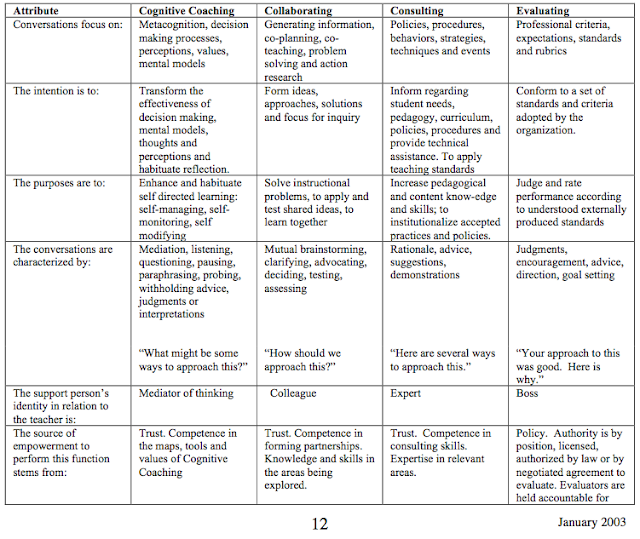
To learn more about Cognitive Coaching®, head over to the website where they have many resources. A great example of the work we did is this chart describing the differences between Cognitive Coaching®, Collaborating, Consulting and Evaluating found in the article "Cognitive Coaching® in Retrospect - Why It Persists."

http://www.thinkingcollaborative.com/wp-content/uploads/2012/08/CC-in-Retrospect-Why-Persists.pdf