Showing posts with label instructional coaching. Show all posts

Tuesday, October 24, 2017

The Collab Lab Team Connects, Learns and Shares at #ICIC17

By Linda Ashida


The Collab Lab Team enjoyed a great day of learning and networking at the Illinois Council of Instructional Coaching's Third Annual Conference: Student Centered Coaching, featuring Diane Sweeney. The ICIC is a group of educators dedicated to building the art of coaching to impact learning for both teachers and students of all ages. The conference brought together 800 educators from the across the state of Illinois and beyond.


The day kicked off with a morning keynote session led by Diane Sweeney. Her presentation on Student-Centered Coaching gave the Collab Lab Team new inspiration to inform the planning of our future professional learning experiences.

In the afternoon, in addition to attending workshops, we were happy to have the opportunity to present and share the professional learning journey of the Collab Lab. Our presentation focused on our mission to build a community of learning at Elk Grove High School and beyond, sharing multiple examples of how our collaborative learning is inspired by our motto: Connect-Learn-Share.


To connect to the presentation, click here: https://tinyurl.com/EGCollabPresentation

To get an idea of what the day of learning and networking at the conference looked like, check out this Storify of tweets.


.

Friday, February 24, 2017

Student Voice: Questioning and Student Feedback

By Mark Heintz


I have been going around school stopping students at random to hear what they feel teacher's do that impacts their learning.  It is so important to continually ask the population we serve to get their feedback on what helps them master the content and skills we are trying to teach.  The responses have been so insightful into what works for each of the unique learners that enter our classroom and can continue to drive the methods we use to instruct them.  Once I captured the student's voice, I tracked down the teacher to share and get their input on the practice that was highlighted. 

The student I asked in the video highlights the way Mrs. Perkins questions at the beginning and the end of each class and allows time for students to process the material from the day before.


Here is Mrs. Perkins explaining how and why she uses the questioning strategy at the beginning and end of class. 


Wednesday, April 27, 2016

Collaborating to Learn! Our webinar for the Illinois Principals Association and EdLeaders Network

By The CollabLab Team

Today the CollabLab team had the opportunity to present a webinar to the Illinois Principals Association / Ed Leaders Network: The Collab Lab at Elk Grove High School: Responsive and Sustained Teacher-Led Professional Learning.


Our purpose was to share with the participants how they can support sustained and responsive teacher-led professional learning in their buildings.  We did this by sharing how we started in peer observation groups and how we continue to evolve in the CollabLab today, centering our conversation around our motto of "Connect, Learn, Share."

Alongside us, our principal, Paul Kelly, supported us and collaborated with us on this presentation.  His focus was to help participants reflect upon professional learning in their own building and help guide them in creating possible action plans.  You can access a copy of this document here.


Throughout the webinar we connected with participants through the hashtag #elnpln.  Check out our conversations and connect with others.  You can access our PowerPoint here.  It contains links to all of the resources supported by the CollabLab.  Please let us know if you'd like to share your ideas or talk to us about professional learning in your school or ours!

Tuesday, April 12, 2016

Matching Assessment Methods: Lead Learners #6

By The CollabLab Team

Yesterday's focus in Lead Learners was based on these two essential questions:


1.  How do we create conditions that maximize mastery of learning?
2.  How do we maximize student learning through sound assessment design?

The majority of our time was spent discussing the concept that assessment methods are not interchangeable.  Thus, we talked about the most relevant assessment method to be used for the type of learning target being assessed.  This helps to ensure accurate assessment results.  The four assessment methods are 1) selected response, 2) written response, 3) performance assessment, and 4) personal communication.

In groups, we did an activity where we were to match the strength of each of these assessment methods for the four types of learning targets.  See the grid below:

Many of us were surprised with the research-based results (provided below).  This spurred very interesting dialogue, especially when looking at different content areas!


Following this dynamic discussion, we had four groups of teachers share lesson demos. The first was our Bio team of Quinn Loch and Krista Glosson who discussed how they restructured their standards to increase a focus on key domains.  They also shared how they report grades both formatively and summatively in a non-standards-based online gradebook to communicate the most accurate information on achievement to students and parents.

Our second lesson demo was by Kim Miklusak, discussing the evolution of changes in the AP English Language grading rubrics from 4-degrees to 3 in order to clarify definitions of mastery and proficiency.  This rubric also mirrors the biology rubric to help increase cohesiveness of skills between content areas. 


Next, Bonnie Kale shared the idea of having one essential question in Honors Written and Oral Communications for a unit.  This unifying element allows for students and teachers to synthesize information and skills in order to maintain a focus throughout an entire novel.  This also allows the team to reloop through writing and reading skills all centered around one theme.


Finally, Sandra Lee and Katie Winstead shared how they differentiate formative feedback in Prep World LiteratureThey build in elements of a pre- and post-test as well as clear learning targets in order to allow them to modify instruction to meet the needs of a wide range of student ability levels.  Regardless of grammar ability, all students learn the same materials at a different pace and with targeted teacher support.


Thank you to everyone who presented and participated yesterday!  We are looking forward to more conversations in upcoming PLTs and at next month's presentation!  To learn more, follow the #EGLLT hashtag on Twitter or stop into the CollabLab for more conversations!

Tuesday, February 23, 2016

Teaming on Tuesdays: Next Steps with Schoology

By The CollabLab Team
 
Today during our Teaming on Tuesdays series, we had the opportunity to see multiple teachers using Schoology in a variety of ways. If you missed this Teaming on Tuesday, read on to see what we learned, and check out this previous post, Schoology Resource Bonanza, for helpful resources.

Our Teaming on Tuesday format once again gave teachers the opportunity to visit a classroom for ten minutes to see strategies in action, and then follow up in the Collab Lab to continue to share ideas and examples to apply to our own classes. However, today for the first time, we invited students to join us for our class-visits and follow-up Learning Labs.  Each period,1-2 student tutors from the Mastery Lab joined us. We learned so much from the perspective of the students!

During periods 1 and 5, we watched French students in Kirsten Fletcher's classes upload pictures to a Schoology Media album, then engage in impromptu discussions based on those pictures. This activity allowed for some student choice and creativity while at the same time curating resources for later use.

Sandra Lee and Katie Winstead were gracious enough to pause their independent reading and have students engage in a Schoology discussion about what they like and dislike about Schoology. It was interesting to hear their perspective on how some of their teachers use the technology.  It was a good reminder that technology alone does not foster learning. It depends on how it is used.

In Quinn Loch's AP Environmental Science class, students began with a Schoology agenda, clicked on a link to a video, and completed a formative Schoology quiz. Students also gave us feedback on how their teachers use Schoology.

Carmen Ruiz-Bergman's classes showed us the benefits of a clear course set-up, as well as using the event feature to share the day's agenda.  Students like seeing what is expected of them that day, when upcoming assignments will be due, and being able to go back to look at things they missed if they were absent.


Just a few of the many takeaways from the day:
  • Students report that they like having an agenda (calendar event) posted so they can follow along in class, make up work when absent, or check to see what homework is due.  Some students also liked how teachers post the handout for the day on the agenda as well.
  • Students like the organization of Schoology. They like being able to find documents easily and not having to carry papers to class.  They suggest teachers take a look at how they name documents to help make things easier to find!
  • Students do like when teachers post reminders via Updates.
  • Students only really look at comments and feedback if they have notifications turned on. More would look at them if teachers gave a few minutes in class to do this. Also, comments show up in different places in Schoology depending on whether an assignment is graded or not.
  •  Students really appreciate getting immediate feedback via Schoology and having the opportunity to do practice quizzes before summative tests. They like when teachers give feedback on free response quizzes and discussions.

  • Students would like Schoology to add a private message feature so they could message their teachers directly from the app.
Look for more blogs about these topics again in the future! 

Thanks to the following staff members who took time out of their busy day to join us: Effie Kalkounos, Matt Smolka (intern), Cassie Yoon, Jon Wong, Sue Montemayor, Sharon Horwath, Matt Bohnenkamp, Katie Kalmes, Sandra Lee, Elyse Hoffman (Wheeling High School), Cliff Darnall, Dean Burrier-Sanchis, and Kristina Lopez (student teacher).

Thanks also to our incredible Mastery Lab tutors who gave us the student perspective on Schoology: Irene Tijerin, Katelyn Eul, Sam Ivers, Gabby Vazquez, Hana Crnovrsania, Emily Gable, Justin Ethithira, Tiffany Waldrom, Niki Tingas, Breanna Keenly, Sejal Vora, and Ray Salarzano.

Wednesday, February 17, 2016

Orchestra Observation

By Mark Heintz

I recently observed Maura Brown and her orchestra class.  It was amazing!

Maura told me that her starting routine is common practice amongst almost all orchestras around the globe, but it was still inspiring.  The first few minutes of class were spent having students readying themselves.  Students fine-tuned their instruments as they changed their state to be ready for the lesson.  Finally, a student leader stood up and directed the entire orchestra.  It was incredible to see such student ownership over the readiness of the class. Ever since witnessing her starting routine, I have been puzzling out how to adapt my instruction to mimic hers. I wish I had the courage to begin my class the way she did.

The lesson focused on two goals.  One pertained to the introduction of learning a new scale. The second was to build background knowledge for an upcoming piece of music.

To accomplish the first goal, Maura gave the students the new scale and they practiced as a whole class. Then, the students split up into elbow partners, people right next them, to watch, listen, and provide feedback.  The feedback each student was supposed to be on the proficiency of their peers ability to perform the scale.  The students gave this feedback orally.  They took turns and after the first listened, the students provided feedback to their partner.   Maura realized they needed specific guidance in the way to provide feedback. She augmented her instruction by redirecting the class to provide a specific piece of feedback from a list of three choices.

It was great to see formative assessment in action AND actually see how changed instruction! It was great!


The second part of the lesson centered around students reading about Faust and then watching the opera music they were about to perform.  After the students read about Faust and the opera, they posted to a Schoology discussion blog.  Maura attempted and was successful in getting students to feel the emotion in the music they were about to play.  It was great to see the power of building background knoweldge in helping students play a piece of music with greater passion and emotion.  

Thursday, October 22, 2015

Notability Workshop with Tech Staff

By: Rachel Barry

On Tuesday, the tech staff at Elk Grove High School attended a mini-workshop to learn how students use Notability.  As many students come to the Help Desk for help with technical issues, the technology staff wanted to see how students were using this app and to then learn how to address some of the common issues that students have with the app.  Here is a summary of the some of the features discussed.  

Organization
Many times students come to the Help Desk to ask for help finding a document.  Many times it is because the student doesn't have folders set up in Notability.  It is easy to organize and color-code in order to accurate sort your documents.  First, click on the "+" sign at the very top left of the screen.  


The confusing part for students is the difference between a "subject" and a "divider".  You will first want to set up DIVIDERS.  This is different than what your mind would normally believe.  The dividers are what the students would name their courses such as "Geometry" or "Biology".  Then, the SUBJECTS are for individual units, standards, or methods of sectioning off materials within a course.  Here is a sample of how a student can gradually add units as they are working in a class:


Exporting a Document
Most times students export a document, they will be submitting an assignment to Schoology.  To do so, students will click on the export button in the top left.


Then, they will click the "Share" button at the very bottom of the dropdown options.  


In most cases, the student will want to export the file as a .pdf.  If they want to share it as a note, they can change this by clicking on the arrow next to .pdf and select "Note".  Next, they will click on "Share Note".  They will select Schoology as the app to export to.


Within Schoology, students will follow the prompts to submit the file to the appropriate course and assignment.  

Additional Features
In the workshop, the tech staff also learned how to annotate, highlight, add text boxes, cut & paste, add pictures, and add audio to a note.  Most students navigate these features with ease, but the tech staff found it helpful to explore the capabilities and uses of Notability.

If you would like additional help in using Notability or have any resources to share about ways you have used it, please stop by the Collab Lab!

Wednesday, September 16, 2015

Cognitive Coaching®


This year I got two new roles as part of my job: Division Technology Coach and Mentor. Both roles allow me to get to know new people, learn from my peers, and use my time to help  staff members here at EG move down the path of new learning.

As part of these new roles, I took a workshop this summer that involved Cognitive Coaching®. The idea behind coaching is that when someone comes to you with stress, problem, or something they are working on - our initial thought is to help them out and give them possible solutions. Studies have actually shown that when you give someone solutions, they only use them about 5% of the time.

If, however, you use Cognitive Coaching® to help guide them towards their own solutions, they are more likely to feel better about the problem and know how to get there.

I am definitely no expert yet, but it has been a lot of fun coaching my colleagues this year instead of always trying to pull something out of my bag of tricks. Oh - there are times people ask me how to do X, Y and Z on Schoology or Notability. For those times, I just sit down with them and play around in the programs. When they come to me with lessons that did not go perfectly or students they are struggling to differentiate for, however, I am trying to spend my time listening and asking questions to really see what they need and where they struggle before helping to guide them to their own answer that will improve everyone's learning.

It's amazing what people will talk to you about and the remarkable ideas they will come up with when you listen =)


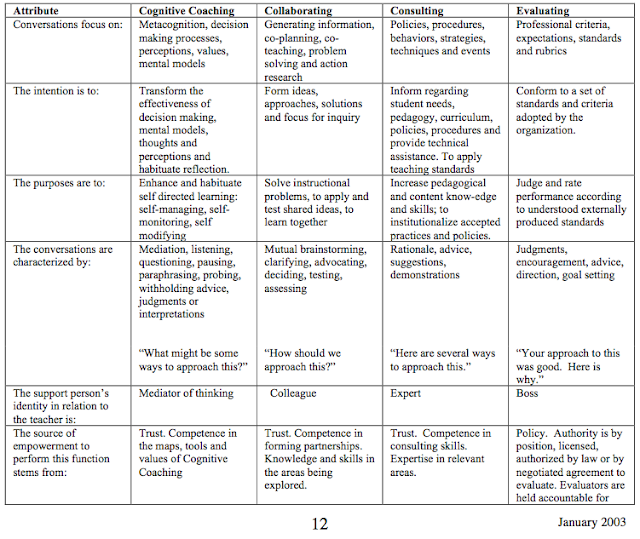
To learn more about Cognitive Coaching®, head over to the website where they have many resources. A great example of the work we did is this chart describing the differences between Cognitive Coaching®, Collaborating, Consulting and Evaluating found in the article "Cognitive Coaching® in Retrospect - Why It Persists."

http://www.thinkingcollaborative.com/wp-content/uploads/2012/08/CC-in-Retrospect-Why-Persists.pdf

Friday, June 5, 2015

First Year of Teaching in Review

By Kristen Gierman 

There is no doubt that one of the most powerful things I did to develop as an individual and educator in my first year at Elk Grove was connecting with others in the building.  Thankfully, the atmosphere that our ITF/DTCs created provided me the opportunity and space to build valuable networks to expand my ideas and teaching practice.

Partaking in collaboration did require an initial nudge, but it generated enormous value at practically no cost to me.  While I understand that time is one of our most precious resources as teachers, I would argue that the transmission of new ideas and perspectives that took place in moments of collaboration far outweighed my fear of “misusing my time” in that way.
In exchanging ideas and listening to the suggestions of others, I not only got to see my ideas improve but also received tangible evidence about how my thoughts could be put to use elsewhere in the school.

This year reaffirmed my belief that good ideas do not develop in isolation or in the confines of our own practice.  Rather, they come from a network of connections that are all around us at Elk Grove if we challenge our ways of thinking and recognize the potential that exists in connecting, learning, and sharing with others.  There is value in the unlikely interactions that occur when clusters of individuals with distinct skills and passions overlap.  It is these combinations that carry the potential to spark innovation and can drive us all forward.

As I wrap up my first year, I want to take the time to thank those who have given me the opportunity to work in conjunction with them and challenged me to grow.  You have served as a clear reminder of the reality that there is a small difference between doing something and doing nothing but the two have wildly different outcomes for our students and us!

On Making Mistakes & Learning in a 1:1 Classroom

By Kim Miklusak

This has been a year of uncharted territory for many of us.  Although I had worked with iPads and technology prior to this year, it was my first year teaching in a full 1:1 classroom.  I have to say I was nervous--especially working with people who had been in iPad pilot programs for a few years.  I was nervous that people would ask me questions that I may not immediately know the answer to.  I was nervous that I would try things out in my classroom and they wouldn't work.  I was nervous that I would take time to make something only to find a better way to do it later.

And you know what?  All of those things happened.  But because of the general support structure at  EGHS--and throughout the district as a whole--as well as the specific support structure of the CollabLab and my peers, I was able to learn and grow alongside those I was helping--and alongside my students!  I appreciate the willingness to share in our school, and I appreciate the instructional conversations we can have in our departments and across departments.  I've learned as much from teachers in other subjects as I have from teachers in my own!  Additionally I've learned so much from connecting with people on Twitter and at EdCamps.

I know the shift in instructional technology is a big one, and we are all in different places with it.  The mindset at our school is so important: move at a pace that is comfortable for you.  For some that means considering the SAMR model and working first with substitution as we digitize curricula.  For some that means trying out one thing such as doing entrance or exit slips on the iPad each day.  For others that could be doing one project on the iPad.  And still for others that means transforming as many pieces of the curriculum as possible.

The key is always, however, to realize that whatever we do for the first time, we may (we will!) find more effective and efficient ways to do it in the future--especially if we share our successes and missteps with others.  As long as our instructional focus comes first and technology comes second, the technology will be there to enhance as oppose to diminish what we do in our classrooms for our students.

Wednesday, May 27, 2015

Guest Post: Adding Value to People


By Joe Bush

In February of 2015, I was fortunate enough to attend the John Maxwell Team Leadership Certification Program.  It was the best professional development I ever experienced, and the knowledge I learned from that conference fundamentally altered they way in which I teach.  The most important pieces of information that I took away from the three-day conference are as follows: 1. The best leaders are those who have the greatest influence, 2. Leaders need to serve, 3. Leaders need to add value to people and 4. Expectations drive beliefs and beliefs drive behavior.

As a teacher, I have always considered myself a leader. However, for much of my career, I was a positional leader.  A positional leader is someone who leads because someone else gave them a position.  An example might be an NFL head coach who was handpicked by the owner, but is unable to influence the players.  That type of teacher rarely has success in the classroom because they use their position to hold it over students.  After hearing John Maxwell (The Number One Leadership Guru in the World) speak, I began to think differently about teaching.  If I were going to truly change the minds and hearts of students and educate them they way that I saw fit, I was going to need to serve them.  The second part was adding value to the lives of the students. 

I would like to explain more on the notion of serving others and adding value through an example.  This year I was blessed with the opportunity to teach a leadership through service course.  What I quickly realized was that my students had great ideas, were already influential in their own circles and they all loved to serve.  After hearing Maxwell speak I realized that instead of pushing my own leadership agenda at the beginning of the year I should have focused on helping each student become more influential using their own strengths.  For some it may have been through public speaking, others it was through organization and still others just needed encouragement.  After coming back from the conference, I quickly changed my agenda in time to help the students succeed in our St. Baldrick’s charity drive.  As I incorporated Maxwell’s ideas, I could quickly see how the students grew in an explosive fashion.  I helped my students enhance what they already did well. 

The final piece to the puzzle was the idea that expectations drive belief and belief drives behavior. Motivational speaker and entrepreneur Paul Martinelli talked about how he overcame stuttering and the fact that he was a high school dropout to build several million-dollar businesses.  Paul said that belief drives behavior.  Therefore, if we think we are stupid, our behaviors are stupid.  However, because expectations drive beliefs, as a teacher it is our job to set expectations for our students to live up to.   When we set those expectations, hold students accountable and provide supports to assist them, students achieve more.

What I found to be the best part of the Maxwell training was the fact that serving and adding value to others is something that can be done regardless of your position. Maxwell says, “Everything rises and falls on leadership.”  This is true because leadership is influence.  So, regardless of your position, you can always strive to be more influential, thus becoming a better leader.   Going forward, I will strive to add value to my students right from the start.  Each year will be different based on the different needs of students, but the lessons learned from that conference will forever change the way I think, lead and teach. 


Wednesday, April 22, 2015

Student Feedback and Notability

By Mark Heintz

A few weeks ago, Linda Ashida posted on Katie Owen's innovative idea of sharing Notability notes to students.  You can read her post here.  Lately, I have been using this practice to increase student engagement and feedback.   Also, as the school rapidly comes to a end, time is precious.  Using shared notes increases classroom time because students are not spending time copying information from one place to another.  Therefore, more time is spend in the analysis of student work and providing feedback.

I recently used this strategy through a list of topics/terms on the USSR and CCP.  I shared the note with the students, and I asked them to move the information to either category.  They could copy the terms to place under both groupings.  When they finished, students shared their work via AppleTV. This practice enabled the class to go through the answers and provide feedback on their selections.  The entire task took only a few minutes to create and a few minutes for the students to attempt.  The discussion that followed the assignment was rich. Since the activity only took a few minutes, there was time that allowed for students to ask questions on why a term was in a specific category.  At the end, some students had a list of terms they needed to look up for further review.  Next time I do this activity, I will ask the students to use the words to draw comparisons.


Another example of this practice comes from a first year teacher, Kristen Gierman.  To help students writing, Kristen created a note that contained elements of a paragraph.  She wrote one main idea statement that the students located and move to the top of the page.  Then, the students went through all of the other statements to determine which were the best support of the main idea.  The students simply erased the ones that were off topic and moved the ones in support to the order they belonged in the paragraph.


The students shared theirs versions of the paragraph and defended the placement of the statements to the class. It was great to see the students evaluating work and seeing their rationale. Many of the students understood the necessity for clarity in their writing and often cited that as a reason to exclude some pieces of evidence. At the conclusion of the activity, the students wrote their own paragraph.  The writings were some of the strongest I have seen students create in my nine years as a teacher.  It was great to see the students use the structure, clarity, and use of strong evidence from the example in their own writing.   


Friday, April 10, 2015

Energizing the Mid-Career Teacher

By Kim Miklusak

We have all perhaps seen a variation of this chart during our teaching career: phases of first-year teachers' attitude toward teaching.  It makes sense, and it makes new (and veteran!) teachers feel less isolated in their attitudes as the year goes on.  There is a natural progression to things, and it is something we can be conscious of and try to address and prevent.  See this image here:
Graphic from http://www.newteachercenter.org/


There has been a lot of talk in the past ten plus years--but again recently--about new teacher retention: its costs, its causes, its remedies.  I think it's vital to have these conversations about new teachers.  However, I think another conversation we need to be having is mid-career teacher retention--or, more specifically, mid-career teacher re-invigoration.

I wonder what the above chart looks like across the span of a career.  I'm sure there are many peaks and valleys for a variety of reasons both internal and external to each individual.  I wonder how we can support mid-career teachers as we do new teachers to help them connect to other educators, to continue to grow as experts in their field, and to help them find new avenues to learn.

One way is for teachers to make those connections on their own whether that be through Twitter, conferences, EdCamps, etc.  I think another way is for teachers to start finding ways to publish their own writing and reflection be that in journals, websites, or their own blog!  Another way is for schools to facilitate this re-invigoration.  This past week our school held Spark Sessions and a Mini-EdCamp at our first In-Service day in addition to the teacher-led sessions held at our Institute Days.  In addition, administrators both in-building and at the district are working with many mid-career and new teachers to branch out into new roles and help guide new and existing initiatives.  I hope that all schools follow this lead and spend their resources in some of these ways as well in order to connect to new and veteran teachers.  While it's true that teachers can hit a groove in mid-career and be left on their own, it's also a time to be sure to find ways to remain energized and constantly reflect and grow!

Tuesday, March 31, 2015

In-Service Day Preview: Spark Sessions & EdCamp

This Monday the CollabLab will help facilitate a portion of our school's In-Service Day focusing on instructional technology.

First, we will be offering a 45-minute session of "Spark" Presentations. A Spark Presentation is a 3-5 minute presentation of an educational technology strategy that teachers employ with their students. These are not formal presentations;  think of a "spark presentation" as a kind of "show and tell." For example, Gary Alperin will share how he uses the student-response app Kahoot and Dean Burrier Sanchis will share how he uses his Weebly Website. We are planning to have Spark Presentations by 8-10 staff members. We already have several teachers who have volunteered, but we want to open this opportunity up to everyone. 


After this we will move into a mini-EdCamp.  EdCamps are "un-camps," free professional development for teachers and by teachers.  There are EdCamps hosted in many areas around the world.  Our local one is EdCamp Chicago, and the next meeting will May 9, at Bednarcik Junior High School.  Elk Grove will host its first "mini-camp."

At the start of the event, teachers come up and suggest a session they are interested in.  This does not mean that you are running it or presenting it; it just means that you are heading there to start talking about it.  The idea is you vote with your feet.  If you go to one session, and it is not what you need, or if there is more than one session you want to see, you simply get up in the middle of the session, and go to another one! Another aspect of EdCamps is the sharing of information. There will be an open Google document available for each session to share out ideas with those in and out of the workshop time.

Check out this site next week for reflections from the day!

Tuesday, March 10, 2015

Cross-building Collaboration: Systems of Support

This afternoon the building Instructional Technology Facilitators (ITF) and Division Technology Coaches (DTC) from all of the schools in District 214 met at district offices for a collaboration meeting hosted by Dr. Steven Kellner.  This is the second meeting the full group has had this year.

The focus of this meeting was for each building to first report out on successes and areas of improvement for the year.  ITFs then rotated to different schools' DTC teams to ask questions and share out ideas.  The groups reconvened to reflect on how far they felt their schools have come on the SAMR model since the start of the year.  Finally, the teams again rotated to consider challenges and brainstorm ways to continue to energize our own teacher leaders as we move ahead into next year.  Superintendent Dr. David Schuler also stopped by to express his support and answer any questions the teams may have had.

This was an excellent opportunity for collaboration, sharing, and problem solving as the district closes out its first year in this ITF/DTC model.  So much of the district's success in rolling out such a large number of iPad pilots and focusing on instructional technology over the years comes because of the district's support--including sessions like the one today.