Showing posts with label student engagement. Show all posts

Wednesday, March 6, 2019

Changing the culture of traditional grading practices


By Mark Heintz

Last week, I celebrated my attempts to minimize the value placed on grades in order to focus on learning. In my previous post, I triumphed over my progress and stated, “So far, I have never felt better about finalized grades.  Some student anxiety has been alleviated and I don’t feel that I have as many students point-grubbing.  I feel that students are learning. The grade is an afterthought.  They know they can argue to make a change.  They know they have a voice in the process other than just the assessments I use.  It has become a partnership.  Something it should always be.”

I wish it was always this easy.

Minimizing grades is a process, and what I hope to do in writing these blog posts is to be as transparent as possible in hopes others see what I do and are willing to try it as well. I hope to not just present a perfect picture of the process of going to gradeless.  I have encountered many bumps in the road because it’s hard to move away from relying on coercive grading methods, which, if we were to be honest with ourselves, grades are.  It is even harder for students not to feel under the thumb of those practices. I firmly believe in order for me to make larger shifts in going gradeless it will require more people making the effort.  Joy Kirr has curated a lot of educators attempts and practices in going gradeless, and I hope to continue to contribute to that resource hub.


The day I posted that blog, I asked my students some additional questions.  As a class, writing is a focus, and I wanted more descriptive feedback.  In another Google form, I asked them how they felt they're doing and what they needed more help/time on in each of the following areas: making claims, using evidence, explaining that evidence, making connections between arguments, using prior knowledge to set the stage, and again what grade would they give themselves.


I am still incredibly happy with how this is going.  The feedback from the students was overall positive.  Their feedback was constructive and helpful for them and me.  However, I did receive a comment that is troubling me.  One of my students gave themselves an F and was very critical of themselves. I was confused by this reflection because the student has a clear voice, and they actively can do all of the things required of them.  They are a strong reader, and they naturally make connections between topics and disciplines.  If I were using traditional assessment metrics, this student would have an A.

When I conferenced with her, she said she needed the validation from me.  She wanted me to give her the grade.  She has been so accustomed to a teacher being the authority that without my grading her, she simply can’t do it.  I expressed my hope that she should know what she needs/wants, that “grading” yourself would lead to me helping where she need it.  I told her to go back and reevaluate what she put and why.  I got an email later that day asking me to give her a grade.  I again expressed my wishes, but I caved and said I would give her an A.  This was her response:

“You're the teacher. Ultimately, I have no say in what you do. Even with the illusion of us having a voice in anything, we don't. I'm sorry for challenging your beliefs about how you run your classroom, but it's justified by your control over the grade book”


This comment is hitting me in the reflection stomach.  Comments like these demonstrate just how much power a teacher has in determining grades.  Even as I am pushing the boundaries of what is possible in a school, I ultimately hold all of the power. As much as we’d like to think otherwise, using grades leads to a lack of motivation.  The kids are stripped of the agency that I want them to have--partially because I do have the authority, but also because these students are experiencing traditional grading practices throughout the rest of their day and have experienced this practice for most of their schooling.  I have spent this entire year minimizing grades, and I still get comments that reinforce traditional grading views.  Next year, this student will most likely go to classes that reinforce their beliefs.

The ultimate problem of having all of the authority is that students will learn less.  Grading causes a loss of intrinsic motivation.  Giving a grade lends to a mentality that there is an end to learning; The grade is more meaningful than the process and the outcome.  We use grades to get kids to be compliant, but we also see that they don’t take risks and often do required work to memorize what we are asking for the test and then forget it.  However, that is not what I want school to be.  I want them to have agency over their learning, and to do that, they need to have conditions that allow them to take risks, see that learning doesn’t have an end, and not feel threatened nor shamed to learn what we are asking them to learn.

I will continue to make shifts and share my journey in hopes that others do the same.


A special thanks to Kim Miklusak for feedback and edits on this post.  She continues to be the best English teacher I never had.

Tuesday, February 19, 2019

Learning: the struggle in going gradeless

by Mark Heintz

I struggle with grading.  Not keeping up with it, but rather assigning a grade as a measurement of learning.  Maybe the struggle comes from my own experience.  As a student, I was a grade manipulator.  I wasn’t a point-grubber, more of a...okay, I was a point-grubber.   In school, my goal was the grade.  As the teacher handed the syllabus to me on the first day of school, I combed through the categories to find out the most efficient way to get a 90.1%. I love a detailed syllabus. The more information the better.  It gave me the rules on how to earn the grade I wanted. The whole process became a game for me, and I enjoyed how to game the system.

Each teacher had their own rules, and my part to play was to earn points.  I played the game fairly well in high school, but things escalated beyond just manipulating a syllabus. Now, I could game the system even more because I could pick the teacher.  I asked, snooped, around to find out teacher reputations on their system before signing up for the class.  In this system, I knew the teacher held most of the power.  I know the teacher’s intention was for me to learn, but my objective was to get points.


Despite all of the manipulation, I loved to learn.  Grades and learning just didn’t go together for me.  That being said, I never tried to get out of anything. When I was assigned work, I would do it.  I just was efficient and completed it quickly in order to get to my interests.  One of the best parts of college was that the abundance of free time allowed me to explore what I wanted.  Each semester I read books, just not the ones in the syllabus.  I talked to people outside my major about their passions.  My utopia version of school would have been just going to different classes all day, simply talking to others and diving into things I was curious about.  I loved connecting with others and learning for the sake of learning. From that love, I became a teacher.

As a teacher

As a new teacher, and like most people new to a profession, I thought I would be different. I could make the grade book represent learning.  I knew the student tricks and throughout my first decade as a teacher, I changed grading practices in an attempt to have the grade book represent what a student had learned.  I tinkered with my categories, did grade replacement, allowed retakes, and only counted major exams  Ultimately though, I became part of the system I manipulated. No matter how much I shifted, I continued to create conditions just like my teachers had, that made me all-powerful in determining a student’s grade.  My ultimate power continued the trend of having most students playing a game to accumulate as many points as possible.  No matter how much I tinkered, I could only deemphasize the importance of the points, but it still remained the most important goal.  In the end, the goal wasn’t learning.

In my course, there was a mandatory curriculum.  To cover the material, I used a textbook.  Students struggled to understand what was important.  Some spent hours each night digesting the material and others gave up because the task was too daunting.  To help them I used reading guides, but then students copied each other or hunted for the information needed not really understand anything. For this course, I needed the students to get the information and what I was doing wasn’t working.  Either the kids gamed the system or it simply didn’t work for them.  I ditched the textbook.  I created videos and questions that students would complete after viewing.  I put these into Schoology checklists and made them required.  I emphasized that all students would need to complete each checklist. It was compulsory and efficient like my learning had been.  I told each student what they needed to know.  To ensure all kids would complete the work, each had to finish the checklist before they could take the exam. To move away from the point-grubbing, nothing went into the grade book if they completed it.  They simply got to take the test.  From this system, kids spent less time on their work, actually did it, and my scores improved.

Something's wrong

Yet, I knew something wasn’t right.  While the system worked for some, there were inherent flaws.  Some kids did all of the work the way it was intended and still struggled to pass. Others gamed the system by fast forwarding the videos and just taking the quizzes. I found that some of the kids who gamed the system earned the highest scores.  Neither one of those things should happen if the system was about learning.  Reflecting on the system I created, I realized that the system emphasized completion not learning.

Ultimately, having to assign a grade gets in the way of learning.  I understand that and the importance in the role a grade plays for a students future.  Despite that conflict, I continue to deemphasize the grade and have it be about the learning.   In that attempt, last year I made another change in order for the class to focus on learning.  I did this at the end of the year, before the final.  I made a simple Google form. There were three questions: What did you learn? What grade do you think you earned? Why do you think you earned it?  After reading through their responses, I only disagreed with a handful of students; Most of which judged themselves too harshly.  For the few others who I disagreed with, their reflection opened my mind to their experience.  Many students cited their effort as a validation of earning a grade, but others detailed how they collaborated, learned about themselves, changed habits, and just an overall changed in abilities. A lot of that reflection is difficult to easily compute into a grade or empirically assess with traditional metrics.  Asking them their thoughts allowed for their journey to be seen.

Students know their experience more than anyone.  The purpose of the class is for them.  As I continued to want the importance of the grade to drop, I realized I needed the students to be viewed as a partner in determining the grade.  I don’t want them to game the system as I had.  I wanted it to be a journey where they are learning, not just grabbing at points to get the A. The problem with last year: I did it at the end of the year.  It wasn’t a partnership.  It was an afterthought.  Even though I did value their responses, the students didn’t know how much I valued it.  I learned that I need to be transparent in the value I placed in their responses. The process can’t just be lip service; Another thing that they do, but ultimately has no influence.

The present

Which gets to this year.  I asked my students the same three questions every time I have had to formally submit a grade, with two additional ones: What are you proud of? What would you do differently if you could go back in time and redo the time that has passed in this semester?  Again, I learned about their journey.  The two additional questions revealed more about who they were. Anyone that I disagreed with or needed more information, I held a conference with them.  I got clarification on the points they made or what happened in class. After that, I submitted the grade.  So far, I have never felt better about finalized grades.  Some student anxiety has been alleviated and I don’t feel that I have as many students point-grubbing.  I feel that students are learning. The grade is an afterthought.  They know they can argue to make a change.  They know they have a voice in the process other than just the assessments I use.  It has become a partnership.  Something it should always be.


A special thanks to Kim Miklusak for feedback and edits on this post.  She is the best English teacher I never had.

Tuesday, May 8, 2018

Learning at Elk Grove: Intro to Engineering

By Patrick McGing, Merlyn Manoj, Kaelyn Rittle, and Mark Heintz


I was fortunate to visit Pat McGing's Intro to Engineering course a few weeks ago.  I asked him and a few of his students to document the learning that took place that lesson and what they hoped to learn in future ones.  From my outsider's perspective, there was a high level of student agency present.  The students were focused and working with purpose.  They rarely deviated from the task at hand and that was evident by the amount of time student spent on the task at hand.  

More importantly, the teacher and the students were all learners.  The teacher was learning right alongside the students.  Because the student projects were so different, it was impossible for the teacher to know the answers to all of their questions.  Rather than giving the students the answers or saying he did not know it, he worked with the students to come up with the solutions.  The equity in the partnership between students and the teachers reminds me that everyone is a learner and together we grow so much more than by ourselves.  Watch the short clip of student focus and the partnership between student and teacher.  Aftwerwards, be sure to read the reflections that follow.  


Teacher Perspective: Patrick McGing

What did learning look like in the lesson?

Learning looked like collaboration.

Students in this Introduction to Engineering Design section are at many different points in a project. Many students were working with their peers to solve problems, demonstrate, or just assist in a minor way to help a peer along. I could look around the classroom and see multiple students leaning over to their neighbor or getting out of their seat to assist a classmate. Therefore, the teaching did not come from me but from students peers.

  • Learning looked like students building skills in smaller areas of Autodesk Inventor with 3D modeling or 3D assemblies.
  • Learning looked like students building communication skills.
  • Learning looked like students building time management skills.
  • Learning looked like students recalling previous knowledge to aide in their current project.


What do you hope to do for the next time?

I hope for students to have a better grasp and understanding of assembling parts in Autodesk Inventor. Many of the students helping each other during the lesson were helping students assemble parts. Something I have tried in one of my other courses is having students develop a step by step “protocol” for troubleshooting specific problems. This helped students actually attempt troubleshooting a problem with already brainstormed solutions and gave them better success in solving a problem on their own. I would like to try this in my introductory course so that students could better persevere through problems.


Student: Merlyn Manoj

What did you learn this lesson?

During this project, I learned how to use my manage my time since we worked on our project independently. It was a bit hard though because if you were falling behind you would have to go to the lab outside of class to catch up with your peers. This project also gave me a lot of freedom since we had to create our own parts, and even though it was frustrating at times because you can’t just follow a plan right in front of you when things are going wrong, it was fun having that creative aspect in our project.

What do you hope to learn for the next time?

I want to learn more about Inventor rather than the basics of it. I think learning how to figure out a solution to a problem rather than just asking a friend or a teacher right away would be a great skill to have.


Student: Kaelyn Rittle 

What did you learn this lesson?

I’m not sure I can say I learned anything new from this unit because most of what we did included skills I learned in the past. However, this unit granted a lot of freedom as to what we were allowed to create, and I would say the design process was the most challenging for me. My project is slightly different in that I have two cranks whereas pretty much everyone else has only one which makes spacing everything just a little harder. I have 5 parts - three in the back and two in the front and measuring everything out so that they wouldn’t hit each other involved a lot of trial and error. This was difficult because whenever I’ve worked on Inventor in the past, I was either following a sheet with the dimensions given to me or I was physically measuring parts as I went along.

What do you hope to learn for the next time?

I think it would be fun to work with other features on Inventor that I haven’t used before. As far as I know, I’ve only used the very basics of it, and maybe exploring it more will help me further understand the program in case I were to ever use it in the future.

Tuesday, April 17, 2018

Reflections on Reading: What is our goal? What influences students?

By Kim Miklusak

Often we hear people bemoan a perceived or real decrease in sustained reading in our students.  Teachers express frustration that students don't read outside of class or are not reading at a level that teachers feel they should be at.

This year our Senior English students were doing independent reading choices for 20-60 minutes a week in class, and I know more classes have added this across all grades.  So as the Senior English teachers prepared for our Independent Reading Book Circles, I asked my students to do a brief journal entry on successes and barriers when it came to their reading.

In the words of Paulo Freire in Teachers as Cultural Workers: Letters to Those Who Dare to Teach, he says, "As a practical-theoretical context, the school cannot ignore the knowledge about what happens in the concrete contexts of its students and their families.  How can we understand students' difficulties during the process of becoming literate without knowing what happens in their experiences at home or how much contact they have with written words in their sociocultural context?"

I want to share some of their responses here.  They certainly caused me to step back and reflect as we set our goals and targets for our unit: was our goal a quiz at the end?  Was our goal just to finish a book?  Was our goal to inspire a love of reading?  In the end our goal was to have sustained dialogue about a reading both within one book circle and across books.


Wednesday, February 21, 2018

A Rewarding and Demanding Lesson

By Kristen Gierman

Historical documents are tricky.  They are full of baggage.  Historical context.  Higher level vocabulary.  Perspective.  Author’s purpose.  You name it, they are HARD to digest.  But that is no reason to shy away from them in the classroom.  In fact, I sit here writing this blog because challenging my students to break down arguably the most difficult document they have seen thus far culminated in one of the most demanding yet rewarding lessons of the school year.


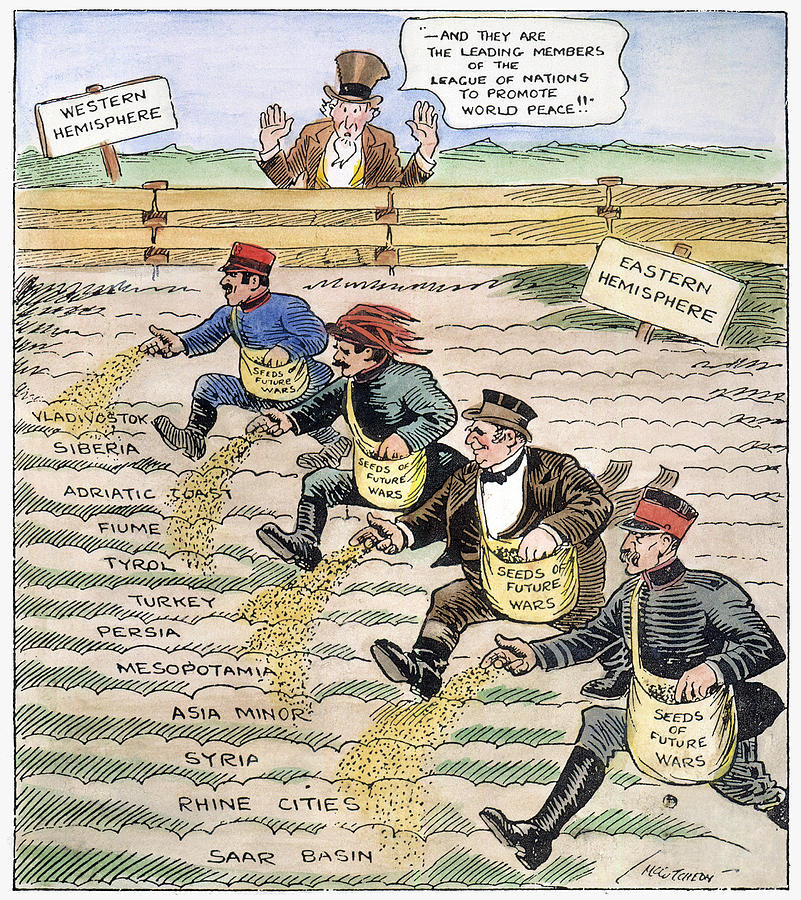
As my world history classes focus on the rise and fall of governments during the time period after World War I, we turned our attention to the Middle East.  What happened to the region after the Ottoman Empire came crashing down?  What role did the League of Nations play? How might this impact the region today?  These are all questions I wanted my students to consider, however, I did not want to simply answer that for them.  Instead, I wanted to release this responsibility of learning to the students.


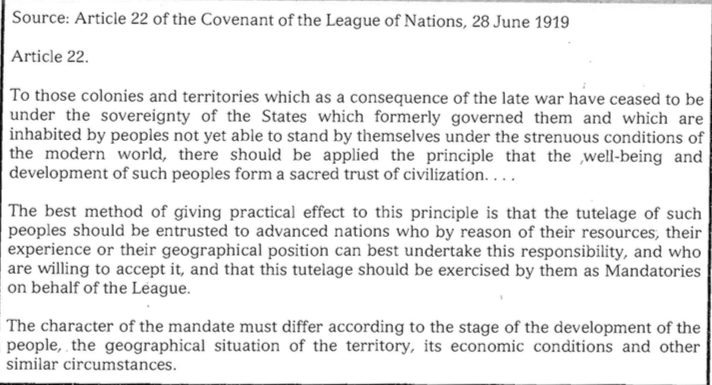
This took some careful planning and pre-reading strategies to make it all come together.  To start the lesson, students were teamed up and competed in a Quizlet Live that included eight “difficult” terms they might not know or might not have ever seen yet would encounter during the course of the period.  Words like sovereignty, tutelage, and mandate are no walk in the park for any sophomore.  However, allowing students to work together to gain some familiarity with the terms shifted the conversation from “I have no idea what these mean” to eventually building some confidence in what used to be unknown or unrecognizable.  

After creating a historical context for the lesson, the students worked to decipher the potential meaning of the political cartoon seen below.


The claims produced by the students echoed the criticisms of the League of Nations’ decisions and ultimately set the stage for the Big Kahuna of this entire lesson...analyzing and understanding the language of Article 22 of the Covenant of the League of Nations.  


For anyone, this would appear a daunting task but the students got after it!!  After modeling some word substitution thanks to the help of the Quizlet, the students worked with their partners to take each sentence and put it in words they could understand.  Not only did they strive to complete this challenge but I found them more engaged in the process and seeking my feedback to confirm their understanding of the text.  

I even laughed a bit as students, who regularly do not want to do work, busted it to prove to me that they were “Ivy League” material….only to conclude class by announcing their future attendance at Stanford University. :)

All jokes aside, it was rewarding to see the students grapple with their understanding of a document that was arguably “out of their reach.”  I am confident that they can make an argument as to why the mandates were created in the Middle East by the League of Nations and I look forward to the next step of the process where they connect these concepts to the rise of independence movements in the region.

Tuesday, December 5, 2017

The Lost Art of Field-Tripping

        
The best field trip I experienced was when I took my first group of students to see Much Ado About Nothing at Chicago Shakespeare Theater over twenty years ago.  The students, who had never seen live theater, were fascinated with the lighting, scenery, the physical comedy of the actors, and the entire sensory experience.  The play jumped off the page and turned into something entirely different in the theater space. 

 AP students? Far from it. These were lower level students, some of the weakest readers in the building.  Why did it work so well?


Create barriers, but not financial ones.

This is a privilege, a delightful treat, not a march. We built a barrier (study guide, quiz mastery, lunchtime discussion/preparation) that allowed students who were interested and intrigued to join us, but left behind those who were not yet ready.

We made a point to take students who came from disadvantaged backgrounds. Despite living thirty minutes from world-class museums, these students had never entered the doors of these institutions.

Anticipate where your students may struggle.
 
What will intimidate your students?  When will they feel uncertain or uncomfortable? Directly teach behaviors.  Before I took my lower level class to see Shakespeare, we talked about what to do if they found it boring, had to go to the bathroom, or got hungry. We discussed the difference between applause and yelling out.  Students worry about getting lost, what to wear, and when they will get to eat. Openly address those fears. 

Let students design the trip.

A few years ago, we were studying the novel Things Fall Apart, and a student wondered what some of the African cultural references actually looked like. A few weeks later, the students walked into the African Art wing at the Art Institute of Chicago and exploded with awe when they saw what was at the entrance – the towering dramatic costumes of the mysterious edwugwu.  Suddenly, the students understood the power of these intimidating demi-gods.

Prepare yourself and prepare your hosts.

We use the education departments at these institutions.  When my students went to the Art Institute in conjunction with our reading of Things Fall Apart, the volunteer docents took the time to read the novel themselves the week before our trip so they could be better prepared to help students find those cultural connections.


Friday, October 13, 2017

Using Google Slides Q&A Interactive Feature

By Kim Miklusak

I had a presentation in my grad school class last night, and while preparing for it, I actually Googled "How to make Google Slides more interesting"...and that's how I got here.  Did you know that you can turn on an interactive Q&A option when you're presenting in Google Slides?

Here's are quick steps:
Step 1: The option to turn it on is found in 2 places: either under "present" or when you're already presenting, in the toolbar screen on the bottom.
Step 1, Option 1
Step 1, Option 2


Step 2
Step 2: a small box will pop up on your screen.  From there you will see "audience tool" and "speaker notes" in addition to the running timer, a pause option, and a of your slides.  From this screen you will press "start new" OR, and this is really cool, if you've presented before, it will show you the option to click on the notes from other recent times you've given this presentation.  This is a nice feature because it will allow you to address any questions ahead of time if you feel you need to.


Step 3
Step 3: You will now have the option to select the audience.  Mine defaulted to our district; however, you can turn on so that anyone with the URL can respond.  This is a nice feature because you can choose to toggle this off or own depending on your presentation and what you need.  Once you press this button, the screen will remain like this unless you have audience members writing questions or making comments.  If this happens, a notification will pop up on "audience tools."  Otherwise, you can remain on "speaker notes," if you have them, to continue your presentation.


Step 4
Step 4: One of the nice features about this is that the audience is able to see each other's comments (anonymously or by name).  Therefore, people have the ability to "like" a comment, allowing the presenter to see a popular question.  Additionally, the presenter can click on the "present" button under a comment.  This results in the comment overriding the presentation slide and showing up as its own slide.  This way the presenter can show the comment/question to the whole audience and address it.

HOW this went in my class: My screen in class wasn't letting me show only the "presenter view," so my whole class was able to see my notes.  This wasn't a problem in the setting I was in, but it would have been a problem if I were given a formal presentation.  I would expand the usage with this from just Q&A and also allow for comments.  I can see many uses for this--especially in classes that are lecture-heavy.

Leave us a comment below if you have other suggestions, uses, or experiences in your class!