The We Are EG Podcast S1E2
The second episode in our We Are EG Podcast series features a student from Syria talking about her experiences. She not only discusses the obstacles she has faced, but also the ways in which the Newcomer Center and Elk Grove High School have inspired her to attain her dreams.
The episode is sure to inspire you. We hope you'll take a listen.

Tuesday, October 3, 2017

Thursday, September 28, 2017
One Year in AP: Moving On (Week Six)
By Mark Heintz
Context
I have two main focuses as I write this weekly blog. Two driving questions that I have in my mind while making decisions. They are:
Week Six: Answer the Question
My content instructional goal this week was centered around how empires grew and rose to power.

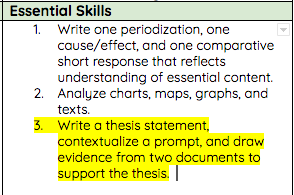
My skill instructional goal was centered around the document based question.
 Cite Specific Evidence
This week was a little short because of the religious observation of Rosh Hashanah. I started the week on a positive note. To do this, and review content at the same time, I had the students play Classical Era pictionary. It's fun and sets a good mood for the week. All of the pictionary words were technologies invented in Classical China or before. For instance one of the words is paper. The activity gives memory cues for the students to add to their essays later on. Furthermore, it builds foundational content knowledge about Han China.
On to the skills. I was so proud of their ability to pull evidence from readings this week. They were able to correctly identify key pieces of evidence to support claims.


I also threw in content checks every day. One of checks was a twelve card puzzle on the methods of political control. The students had to sort which method of political control went with each empire. It was incredibly hard at first, but watching the students work through the content and hearing their dialogue with group members allowed me to gauge how much they knew. Slowly, they are start putting together the ones they know and then the puzzle comes together.
To explain the activity a little more, each of the edge pieces had a fact that were outside of the time period. So Mali, Inca, Hagia Sophia, and Muhammad were edge pieces because I haven't covered it yet. I quickly saw which students needed direction because they were pairing Hagia Sophia with Qin and Han. But over all, they were very impressive and proved their content knowledge.

Explanation of the Evidence
Worlds better (pun intended (it's a world history class))! Their ability to add context improving daily. The sentence starter I used helped them address the skill. From the practice and peer to peer editing, they have a greater understanding of what the purpose of context is. Doing it everyday solidified the skill and provided a basis for what they need to improve. There is still a lot of work needed in this area. But overall, they are doing well and I am impressed with them for as early as it is in the school year.
There were numerous checks for understanding on their content. I felt they are still some gaps and I need to address those next week. They are having trouble understanding the trade routes and their connection to the growth of empires. Other than that, the students are demonstrating an impressive depth of content knowledge of the classical era.
Now to the thesis. That was a low point last week. I gave them similar conditions this week and tested what they could do. It was so much BETTER! There are some errors still occurring. Some kids need some one on one attention. Others made simple mistakes such as forgetting the time period. But it was a lot better. I uploaded three examples for you to sample.


Reflection and Impact
My biggest takeaway: I need to spend the time where it is needed. I know that sounds simple. But it is hard on the day to day to remember that. I can manage the macro scale when looking at the whole year, but it is hard for me to stay focused when it feels I "covered" it or am spending significant time on something. I know they need more work on thesis statements, so I need to spend the time on writing thesis statements. Writing is over 50% of the AP exam and it is a skill that will transcend the course. I need to address my instruction on the biggest needs. Those biggest needs come from the feedback the students giving me. That feedback is telling me to spend more time on writing.
Read week seven here.
Context
I have two main focuses as I write this weekly blog. Two driving questions that I have in my mind while making decisions. They are:
- How do I know if my students know?
- How do I get them to know if they know?
Week Six: Answer the Question
My content instructional goal this week was centered around how empires grew and rose to power.

My skill instructional goal was centered around the document based question.
This week was a little short because of the religious observation of Rosh Hashanah. I started the week on a positive note. To do this, and review content at the same time, I had the students play Classical Era pictionary. It's fun and sets a good mood for the week. All of the pictionary words were technologies invented in Classical China or before. For instance one of the words is paper. The activity gives memory cues for the students to add to their essays later on. Furthermore, it builds foundational content knowledge about Han China.
On to the skills. I was so proud of their ability to pull evidence from readings this week. They were able to correctly identify key pieces of evidence to support claims.

The students wrote contextualization statements nearly everyday this week. In addition to their statements, they analyzed primary sourced documents and pulled evidence to support claims.

Again, they practiced writing thesis statements everyday. This was based on the feedback from last week's setback.

To explain the activity a little more, each of the edge pieces had a fact that were outside of the time period. So Mali, Inca, Hagia Sophia, and Muhammad were edge pieces because I haven't covered it yet. I quickly saw which students needed direction because they were pairing Hagia Sophia with Qin and Han. But over all, they were very impressive and proved their content knowledge.

Worlds better (pun intended (it's a world history class))! Their ability to add context improving daily. The sentence starter I used helped them address the skill. From the practice and peer to peer editing, they have a greater understanding of what the purpose of context is. Doing it everyday solidified the skill and provided a basis for what they need to improve. There is still a lot of work needed in this area. But overall, they are doing well and I am impressed with them for as early as it is in the school year.
There were numerous checks for understanding on their content. I felt they are still some gaps and I need to address those next week. They are having trouble understanding the trade routes and their connection to the growth of empires. Other than that, the students are demonstrating an impressive depth of content knowledge of the classical era.
Now to the thesis. That was a low point last week. I gave them similar conditions this week and tested what they could do. It was so much BETTER! There are some errors still occurring. Some kids need some one on one attention. Others made simple mistakes such as forgetting the time period. But it was a lot better. I uploaded three examples for you to sample.


Reflection and Impact
My biggest takeaway: I need to spend the time where it is needed. I know that sounds simple. But it is hard on the day to day to remember that. I can manage the macro scale when looking at the whole year, but it is hard for me to stay focused when it feels I "covered" it or am spending significant time on something. I know they need more work on thesis statements, so I need to spend the time on writing thesis statements. Writing is over 50% of the AP exam and it is a skill that will transcend the course. I need to address my instruction on the biggest needs. Those biggest needs come from the feedback the students giving me. That feedback is telling me to spend more time on writing.
Read week seven here.
Wednesday, September 27, 2017
When Conversation Becomes Difficult . . . How do We Facilitate Better Communication?
By Linda Ashida
A recap of a Team on Tuesday conversation facilitated by Kim Miklusak.
Sometimes controversial topics are embedded in our course curriculum. Sometimes controversial topics come up due to an unforseen comment by a student, or due to issues in the news.
Whether planned or unplanned, teachers can find it challenging to facilitate conversation around controversial issues in order to allow for differing viewpoints to be expressed in a way that allows all voices to be heard, and in a way that facilitates understanding and empathy.
An idea:
After Kim Miklusak connected with valuable resources to support teachers in facilitating difficult conversations, she wanted to share them with colleagues and create a forum for teachers to exchange resources and strategies of their own.
A Plan:
The Collab Lab's Team on Tuesday served as a perfect vehicle to do this. Kim sent an invitation to all staff at EG. Kim also wanted to include colleagues from Rolling Meadows High School, who shared interest in this topic. Google Hangout would make that possible!
The Result:
15 staff from Elk Grove and Rolling Meadows, from across disciplines (Science, Math, World Language, English and Fine Arts) connected and shared their questions and ideas to facilitate better conversations when controversy can undermine communication. Teachers shared examples of situations they found challenging. They offered specific strategies and resources to respond in ways that foster an atmosphere where differing viewpoints can be expressed and listened to with respect, and questions are asked respectfully to clarify and build understanding and common ground.


To get a better ideas of the conversatoin, check out this link to the Google Doc we used to take notes and curate resources.
Do you have ideas, resources or questions? We'd love to hear from you! Leave us a comment below!
A recap of a Team on Tuesday conversation facilitated by Kim Miklusak.
Sometimes controversial topics are embedded in our course curriculum. Sometimes controversial topics come up due to an unforseen comment by a student, or due to issues in the news.
Whether planned or unplanned, teachers can find it challenging to facilitate conversation around controversial issues in order to allow for differing viewpoints to be expressed in a way that allows all voices to be heard, and in a way that facilitates understanding and empathy.
An idea:
After Kim Miklusak connected with valuable resources to support teachers in facilitating difficult conversations, she wanted to share them with colleagues and create a forum for teachers to exchange resources and strategies of their own.
A Plan:
The Collab Lab's Team on Tuesday served as a perfect vehicle to do this. Kim sent an invitation to all staff at EG. Kim also wanted to include colleagues from Rolling Meadows High School, who shared interest in this topic. Google Hangout would make that possible!
The Result:
15 staff from Elk Grove and Rolling Meadows, from across disciplines (Science, Math, World Language, English and Fine Arts) connected and shared their questions and ideas to facilitate better conversations when controversy can undermine communication. Teachers shared examples of situations they found challenging. They offered specific strategies and resources to respond in ways that foster an atmosphere where differing viewpoints can be expressed and listened to with respect, and questions are asked respectfully to clarify and build understanding and common ground.


To get a better ideas of the conversatoin, check out this link to the Google Doc we used to take notes and curate resources.
Do you have ideas, resources or questions? We'd love to hear from you! Leave us a comment below!
Tuesday, September 26, 2017
Student Involvement in Assessment (Part 2)
By: Rachel Barry
This is the second post in a series focusing on involving students in the assessment process. For the first post, click here.


I loved this activity, and I'd rather not call it an assessment. I feel that the students learned so much from being given a "second chance." The struggle that I have is that I am obligated to report something in the gradebook. This year, I am only reporting summative unit test scores towards students grades, so all quizzes are going in the formative assessment category in the gradebook (a 0% category). Because of this, I had some flexibility on how to report this to be as informative as I wanted. For the score, I averaged the two scores, and in the comments section, I reported both the original score and their edited score (as seen to the right). I LOVE the comments section!
This is the second post in a series focusing on involving students in the assessment process. For the first post, click here.
In continuing to include students in the assessment process, I am exploring methods of self-reflection and peer editing, as well as open to suggestions that I hope other educators will share with me. For our second quiz, I had my regular Algebra II students edit their own quizzes. First, I had them take the quiz as they normally would, and I made marks (in blue) only if the problem was incorrect. I gave no scores. Then, the next day I handed back the quizzes, along with a green pen, to each student. Students corrected the problems that they got wrong in the green pen.


The conversations were awesome! The topic is simplifying radicals, so it is common for students to make silly mistakes or make the same mistake throughout all problems. Many students quickly realized what they did incorrectly and were able to make the necessary adjustments to their work. For the students who struggled on this topic more than others, I was able to give them more one-on-one instruction to better understand this topic.
I loved this activity, and I'd rather not call it an assessment. I feel that the students learned so much from being given a "second chance." The struggle that I have is that I am obligated to report something in the gradebook. This year, I am only reporting summative unit test scores towards students grades, so all quizzes are going in the formative assessment category in the gradebook (a 0% category). Because of this, I had some flexibility on how to report this to be as informative as I wanted. For the score, I averaged the two scores, and in the comments section, I reported both the original score and their edited score (as seen to the right). I LOVE the comments section!
I'm continuing to explore new methods to build a positive learning experience and student self-reflection from the assessment process. I would love to hear any ideas that you have as well, so comment here, tweet at me, or stop down in the Collab Lab!
Thursday, September 21, 2017
One Year in AP: failure (Week Five)
By Mark Heintz
Context
I have two main focuses as I write this weekly blog. Two driving questions that I have in my mind while making decisions. They are:
Week Five: Answer the Question
My content instructional goal this week was centered around how empires grew and rose to power.
My skill instructional goal was centered around the document based question. Also, I tested the students on last weeks skills, just the thesis and contextualization to see the retention of their abilities.
 Cite Specific Evidence
Throughout the week, the students analyzed documents and more documents. And more documents. By the end of the week, they were able to pull evidence from a document and connect it to their thesis.
It was great! The students dove into the documents and were able to write out their understandings. Check out the video below!
On the content side of things, there were numerous checks for understanding on the content. I know and the students know what they know and don't know. These checks were crucial.


Explanation of the Evidence
Well, I know the content checks are working. They are acing the checks for understanding. There are a few students that need to go back to review previous knowledge, but overall they have made strides in knowing what they don't know, and articulating it to others. I notice this in their peer-to-peer feedback conversations and their conversations with me. In the past, it was a quagmire trying to figure out what students need to work on. This year, some of my revised and varied formative checks for understanding have allowed me to better point my students directly to what they need work on to help them master the content. From the checks I did this week, I figured out that many of them had the same gaps in knowledge and I was able to to address those common gaps to the whole class.
The students were amazing with they beginning document work! However, I don't believe they have any idea what they are doing. Sure, they can analyze the document and link it to a thesis statement when I am present and walking them through the steps. But I don't think they can do it alone nor do I believe they actually know where these scaffolded steps fit in the big picture. That was a big pause for me. I realized that I kept having them go through the steps, but I never had them pause to reflect on what and why they were doing it. It was as if I was driving it, and they were on the path of learning with me, but they couldn't get to the destination on their own yet.
The final one really knocked me off my feet. The previous week's instruction told me they were ready to move on. The feedback they gave me, told me they were ready to move on. However, the results did not match this feeling. When it mattered, on their own, they couldn't preform. I need to go back and look at what I did, and maybe try a different strategy.
Reflection and Impact
I need to have more moments in the class where they are given the opportunity to respond and demonstrate their learning without support, in much the same way that they will have to do under the conditions of the AP test in May. I need to give them more moments where they are given a prompt they have never seen before and are working through it. The reflection is going great, but I need them to reflect more on how they did under the specific conditions of the assessment.
Read week six here.
Context
I have two main focuses as I write this weekly blog. Two driving questions that I have in my mind while making decisions. They are:
- How do I know if my students know?
- How do I get them to know if they know?
Week Five: Answer the Question
My content instructional goal this week was centered around how empires grew and rose to power.
My skill instructional goal was centered around the document based question. Also, I tested the students on last weeks skills, just the thesis and contextualization to see the retention of their abilities.
Throughout the week, the students analyzed documents and more documents. And more documents. By the end of the week, they were able to pull evidence from a document and connect it to their thesis.
It was great! The students dove into the documents and were able to write out their understandings. Check out the video below!
On the content side of things, there were numerous checks for understanding on the content. I know and the students know what they know and don't know. These checks were crucial.

Additionally, I did a thesis skill check to monitor progress from the week before in order to see if they had retained mastery. I gave the students and unannounced prompt to see if students could still write a strong thesis independently without support in the same way they will need to do on the AP exam. This thesis check proved my instruction and their reflection from last week were inadequate. Many students did not master the thesis and contextualization skills. Their responses demonstrated that they were not at the level I thought they had achieved. nor at the level they thought they had attained, based on last week's progress. Some responses were not clear, revealing potential confusion. Other responses were missing components or were contradictory.

Explanation of the Evidence
Well, I know the content checks are working. They are acing the checks for understanding. There are a few students that need to go back to review previous knowledge, but overall they have made strides in knowing what they don't know, and articulating it to others. I notice this in their peer-to-peer feedback conversations and their conversations with me. In the past, it was a quagmire trying to figure out what students need to work on. This year, some of my revised and varied formative checks for understanding have allowed me to better point my students directly to what they need work on to help them master the content. From the checks I did this week, I figured out that many of them had the same gaps in knowledge and I was able to to address those common gaps to the whole class.
The students were amazing with they beginning document work! However, I don't believe they have any idea what they are doing. Sure, they can analyze the document and link it to a thesis statement when I am present and walking them through the steps. But I don't think they can do it alone nor do I believe they actually know where these scaffolded steps fit in the big picture. That was a big pause for me. I realized that I kept having them go through the steps, but I never had them pause to reflect on what and why they were doing it. It was as if I was driving it, and they were on the path of learning with me, but they couldn't get to the destination on their own yet.
The final one really knocked me off my feet. The previous week's instruction told me they were ready to move on. The feedback they gave me, told me they were ready to move on. However, the results did not match this feeling. When it mattered, on their own, they couldn't preform. I need to go back and look at what I did, and maybe try a different strategy.
Reflection and Impact
I need to have more moments in the class where they are given the opportunity to respond and demonstrate their learning without support, in much the same way that they will have to do under the conditions of the AP test in May. I need to give them more moments where they are given a prompt they have never seen before and are working through it. The reflection is going great, but I need them to reflect more on how they did under the specific conditions of the assessment.
Read week six here.
Wednesday, September 20, 2017
Learning Celebration Reflections: Part Deux (It's not just for AP!)
by Dan Saken
Last week I wrote a blog about how I've changed "test days" into "Learning Celebrations" and how I reflect on them with students, specifically in my AP Psychology classes. I received a comment to my post asking if perhaps my experiences and results would be different in non-AP classes that might not be as cumulative or "academic." Thankful for the feedback, I wrote the following reply about how I've implemented the same procedures and ideology in mainstream classes I teach as I have to my AP classes. Similar to the AP classes, these mainstream classes have experienced positive outcomes in terms of assessment results and a change in overall classroom culture and student mindsets.
My Reply
Thanks for the questions! I also taught mainstream US History classes last year and now a Criminal Law class this year that are not AP level. I used the "Learning Celebration" concept with those classes as well with the same success in terms of developing a positive culture in the classroom and improved results on assessments from previous years. I take a day after the Learning Celebration to reflect in those classes too using team tests, individual test corrections, self-reflections, or other activities to be able to identify what they knew and what they didn't.
The pictures below are of my most recent Learning Celebration Reflection Day in my Criminal Law classes where students worked to not just identify what questions they answer incorrectly, but why. By doing this kind of reflection, students would better understand what they need to work on for the next Learning Celebration: Did they get the wrong answer because they misread the question? Didn't read all the answer choices? Didn't study that content? Etc. I got this idea from a colleague (Mark Heintz, AP World History and Human Geo teacher) to get students to not just care about the score they received, but the thinking process involved in recalling information and answering those questions.

While those classes are not as cumulative as an AP class (though they will need to know the content for the Final Learning Celebration at the end of each semester), I still want to stress the importance of filling in the gaps of knowledge so they won't get wider over time. I always like to make connections to previously learned material as I go through the course, so if the students never learned that content in the first place and didn't get a chance to realize that through our reflection, then it hurts their ability to learn the new information later on as well.

Finally, more than any other year I have taught before, I took a great deal of class time in the first week of school to hammer home the idea of the Growth Mindset with all of my classes, both AP and mainstream. I have a bunch of posters in my room dedicated to the idea that failure is not an end result, but rather every time you fail is simply an opportunity to learn. I refer to Thomas Edison "learning" 1000 different ways of how NOT to make a light bulb before his final success. I talk about the importance of simply trying your best, being willing to try and be wrong, and when all else fails, just keep trying. That an error does not become a mistake unless you refuse to correct it. That you never fail until you stop trying. That you shouldn't do something until you get it right, you should do something until you can't get it wrong (I use a basketball analogy for that one). That "whether you think you can or think you can't, you're right." I refer to these concepts constantly throughout the year as reminders as we go. It's not just a one-day, "rah-rah" kind of thing in our class...it's about building a positive culture and mindset throughout the school year.

It definitely is difficult to convince teenagers to care more about and focus more on the process than the end result (grade), but just getting them to think a little bit differently about the importance of the process is extraordinarily helpful. I've seen a TED Talk about how the greatest predictor of success is Grit and read articles about how failure can be our best teacher. I communicate those ideas so that when students do hit a road block in their learning or don't do well on an assessment, they are ready, willing, and able to continue on and just keep trying.

I hope this helps you think about how it can apply to other classes. Obviously the "Statistics" part of the reflection I do with my AP Psych is more specific because it connects with content we learn, but I still look at the averages and most missed with my mainstream classes on our reflection days. Thanks again for your questions and good luck with your classes!
by Dan Saken
Last week I wrote a blog about how I've changed "test days" into "Learning Celebrations" and how I reflect on them with students, specifically in my AP Psychology classes. I received a comment to my post asking if perhaps my experiences and results would be different in non-AP classes that might not be as cumulative or "academic." Thankful for the feedback, I wrote the following reply about how I've implemented the same procedures and ideology in mainstream classes I teach as I have to my AP classes. Similar to the AP classes, these mainstream classes have experienced positive outcomes in terms of assessment results and a change in overall classroom culture and student mindsets.
My Reply
Thanks for the questions! I also taught mainstream US History classes last year and now a Criminal Law class this year that are not AP level. I used the "Learning Celebration" concept with those classes as well with the same success in terms of developing a positive culture in the classroom and improved results on assessments from previous years. I take a day after the Learning Celebration to reflect in those classes too using team tests, individual test corrections, self-reflections, or other activities to be able to identify what they knew and what they didn't.
The pictures below are of my most recent Learning Celebration Reflection Day in my Criminal Law classes where students worked to not just identify what questions they answer incorrectly, but why. By doing this kind of reflection, students would better understand what they need to work on for the next Learning Celebration: Did they get the wrong answer because they misread the question? Didn't read all the answer choices? Didn't study that content? Etc. I got this idea from a colleague (Mark Heintz, AP World History and Human Geo teacher) to get students to not just care about the score they received, but the thinking process involved in recalling information and answering those questions.

While those classes are not as cumulative as an AP class (though they will need to know the content for the Final Learning Celebration at the end of each semester), I still want to stress the importance of filling in the gaps of knowledge so they won't get wider over time. I always like to make connections to previously learned material as I go through the course, so if the students never learned that content in the first place and didn't get a chance to realize that through our reflection, then it hurts their ability to learn the new information later on as well.

Finally, more than any other year I have taught before, I took a great deal of class time in the first week of school to hammer home the idea of the Growth Mindset with all of my classes, both AP and mainstream. I have a bunch of posters in my room dedicated to the idea that failure is not an end result, but rather every time you fail is simply an opportunity to learn. I refer to Thomas Edison "learning" 1000 different ways of how NOT to make a light bulb before his final success. I talk about the importance of simply trying your best, being willing to try and be wrong, and when all else fails, just keep trying. That an error does not become a mistake unless you refuse to correct it. That you never fail until you stop trying. That you shouldn't do something until you get it right, you should do something until you can't get it wrong (I use a basketball analogy for that one). That "whether you think you can or think you can't, you're right." I refer to these concepts constantly throughout the year as reminders as we go. It's not just a one-day, "rah-rah" kind of thing in our class...it's about building a positive culture and mindset throughout the school year.


I hope this helps you think about how it can apply to other classes. Obviously the "Statistics" part of the reflection I do with my AP Psych is more specific because it connects with content we learn, but I still look at the averages and most missed with my mainstream classes on our reflection days. Thanks again for your questions and good luck with your classes!
Tuesday, September 19, 2017
You Made Me a Better Teacher: S1E1 We Are EG Podcast
We are excited to announce our first We Are EG Podcast!
Elk Grove High School English teacher Rita Thompson tells the story of a student who changed her life. In teaching this student how to read, she also learned a little bit about herself.
Elk Grove High School English teacher Rita Thompson tells the story of a student who changed her life. In teaching this student how to read, she also learned a little bit about herself.
Subscribe to:
Posts (Atom)