By Kim Miklusak
This year my co-worker Matt Snow and I decided to try something different when it comes to how we attack the different essay types in AP English Language. We wanted the students to see the bigger picture, how each essay type was related rather than seeing them as three different essays. The planning and instruction didn't change for us that much, thankfully, but the payoffs, we believe, are going to be huge.
We have grouped our first few texts under a common theme of knowing one's self--specifically learning to read and write alongside identity. For this we used three excerpts from the textbook 50 Essays, which included Sherman Alexie's "Superman and Me" and Frederick Douglass's and Malcolm X's "Learning to Read and Write" from their autobiographies. For each text, students worked with individual writing skills alongside comprehension and active reading strategies. For example, we worked with thesis writing, paragraph-level evidence and analysis practice, as well as ethos/pathos/logos from our textbook Everything's an Argument. Additionally students have practiced paragraph-level and verbal argumentation practice using professional, self, and peer samples.
Now we were ready to put all of the practice together. The students brainstormed and planned an argumentative writing prompt on the value and function of grades in schools when it comes to learning (building from a summer reading excerpt from Zen and the Art of Motorcycle Maintenance). Students used the dry erase tables to plan their thoughts and then walked around to give each other feedback. We then worked to plan out argumentative thesis statements, brainstorm evidence, and plan out outlines--not 5-paragraph papers, but the best way to convince someone in the argument.
After writing their essays, students then set them aside, which was strange to them. This week we began a rhetorical analysis prompt on the same topic. In fact, most of the prompt was word-for-word the same as the argumentation prompt. We used Rebecca Schuman's article "I Give Up, You're All Exceptional" and analyzed her writing for strategies and purpose. Again, students brainstormed and outlined together and then wrote a draft on their own.
Next week we will put the essays side-by-side. Students will look at the similarities and differences in argumentative and analytical writing and what specific elements change for which task. We also are challenging the students to look at themselves as writers: what did the author do in her writing that they could try in theirs? They will then peer edit and revise both essays before submitting.
The last task will be a synthesis/DBQ prompt in 2 week using all of the texts we have dealt with this quarter--so, again, on the same topic. I will report back after that with how it all went!
Showing posts with label peer editing. Show all posts
Thursday, October 13, 2016
Tuesday, October 4, 2016
Writing for an Authentic Audience (without the internet)
By Kim Miklusak
This week my English 100 students are working on argumentative paragraphs. They read and annotated an article on Colin Kaepernick from Kelly Gallagher's Article of the Week site, and then they wrote a summary of the article to demonstrate comprehension.
Another teacher on our team, Emily M., pulled a handful of statements from the article to debate. On a giant sticky note I wrote out four of them and separated the paper into "Agree/Disagree/Qualify."
The statements read:
1. Not standing for the anthem is disrespectful to our troops.
2. We should be always be able to protest against our government in peaceful ways.
3. A celebrity should always be a good role model.
4. People should stand up for what they believe in no matter if it goes against what others say.
At each table students used small sticky notes to brain storm as many pieces of evidence or arguments as they could for all of the sticky notes. They walked around the room and stuck them to the paper. They then walked around to look at all of the responses. This produced, as you can imagine, some excellent discussions. Students discussed modern and historical angles, brought in outside information, challenged each other, and so on--all respectfully.
The next step was for students to choose which topic and which stance they wanted to argue. They used our dry erase tables to brain storm and then to anonymously hand write their paragraph. The next day I hung the paragraphs up around the room. Each group had a feedback chart using the elements of a good argumentative paragraph that we had discussed. My 5th period evaluated my 7th period's paragraphs and awarded up to three points to the best response. Then my 7th period did the same for 5th. The last step will be to review the feedback given by the other class and revise. This is all the final step before students start writing their own argumentative paragraphs on a new topic next week.

Not only did the competitive nature of this assignment have students up, walking around, and engaged, but knowing that their peers would be reviewing it--even anonymously--was enough motivate more of them to do their best! It was a great experience that I look forward to doing more as the year goes on!
This week my English 100 students are working on argumentative paragraphs. They read and annotated an article on Colin Kaepernick from Kelly Gallagher's Article of the Week site, and then they wrote a summary of the article to demonstrate comprehension.
The statements read:
2. We should be always be able to protest against our government in peaceful ways.
3. A celebrity should always be a good role model.
4. People should stand up for what they believe in no matter if it goes against what others say.
At each table students used small sticky notes to brain storm as many pieces of evidence or arguments as they could for all of the sticky notes. They walked around the room and stuck them to the paper. They then walked around to look at all of the responses. This produced, as you can imagine, some excellent discussions. Students discussed modern and historical angles, brought in outside information, challenged each other, and so on--all respectfully.
The next step was for students to choose which topic and which stance they wanted to argue. They used our dry erase tables to brain storm and then to anonymously hand write their paragraph. The next day I hung the paragraphs up around the room. Each group had a feedback chart using the elements of a good argumentative paragraph that we had discussed. My 5th period evaluated my 7th period's paragraphs and awarded up to three points to the best response. Then my 7th period did the same for 5th. The last step will be to review the feedback given by the other class and revise. This is all the final step before students start writing their own argumentative paragraphs on a new topic next week.
Not only did the competitive nature of this assignment have students up, walking around, and engaged, but knowing that their peers would be reviewing it--even anonymously--was enough motivate more of them to do their best! It was a great experience that I look forward to doing more as the year goes on!
Thursday, September 15, 2016
Hey, Did You Hear?
One of our goals in the Collab Lab is sharing our practices by getting into classrooms and seeing student learning in action. Here are some highlights!
1. Peer Editing using Whiteboard Tables
In Kim Miklusak's class, students were put into groups based on general teacher feedback on an area for improvement: organization, evidence & depth, or counter claims & analysis. Each group sat with a table leader, a student who was successful on this first essay, and the table leader guided the group in self-analysis of their essay. Students used the white board tables to chart evidence and counter claims or to organize and re-organize their main ideas. While this could have been done on paper, the act of writing, rewriting, and seeing each other's work in progress helped students collaborate on similar skill areas with the guidance of a peer.
2. Student-Created Videos
In Dave Johnson's PreCalculus class, students are learning how to manipulate literal equations. To reinforce their learning, he had students record videos using the app called ShowMe. Students were able to work in pairs or alone to talk through the process of solving a literal equation.
3. Building Cause & Effect Charts
Students read five key documents and for each document wrote the causes and the effects of the event described. Students wrote the causes and effects on the white board table. The students were able to walk from table to table to provide feedback to one another.
4. Student-Created Study Guides
In Ami Heng's Honors Advanced Algebra class, students reviewed for their test by making study guides on the whiteboard tables in the room. Students worked in groups to come up with definitions and properties, as well as provide examples of the different types of numbers.
5. ...while having 1-on-1 conferences!
When students were working in their groups to build study guides (#4), Ami Heng had individual conferences with students. This allowed her to go over their beginning of the year benchmark test scores and discuss their progress in class so far this year.
1. Peer Editing using Whiteboard Tables
In Kim Miklusak's class, students were put into groups based on general teacher feedback on an area for improvement: organization, evidence & depth, or counter claims & analysis. Each group sat with a table leader, a student who was successful on this first essay, and the table leader guided the group in self-analysis of their essay. Students used the white board tables to chart evidence and counter claims or to organize and re-organize their main ideas. While this could have been done on paper, the act of writing, rewriting, and seeing each other's work in progress helped students collaborate on similar skill areas with the guidance of a peer.
2. Student-Created Videos
In Dave Johnson's PreCalculus class, students are learning how to manipulate literal equations. To reinforce their learning, he had students record videos using the app called ShowMe. Students were able to work in pairs or alone to talk through the process of solving a literal equation.
![]() |
| Click here to listen to this student's video. |
3. Building Cause & Effect Charts
Students read five key documents and for each document wrote the causes and the effects of the event described. Students wrote the causes and effects on the white board table. The students were able to walk from table to table to provide feedback to one another.
4. Student-Created Study Guides
In Ami Heng's Honors Advanced Algebra class, students reviewed for their test by making study guides on the whiteboard tables in the room. Students worked in groups to come up with definitions and properties, as well as provide examples of the different types of numbers.
5. ...while having 1-on-1 conferences!
Monday, May 16, 2016
Peer Editing: When You Don't Know What You Don't Know
By Kim Miklusak
A few weeks ago, as my students were heavily working on
sample analysis, writing, and peer analysis in preparation for our AP English
exam, I was listening to an episode of This
American Life. The topic was “In Defense of Ignorance."
One of the acts focused on what is called the Dunning-Kruger Effect,
a cognitive bias that says that someone with low skills frequently mistakenly over-evaluates themselves in certain areas (which is basically all of us at some time). Conversely, people with high skills frequently under-evaluate themselves because they assume they can't be that much stronger than everyone else.
This made me think about how my students were doing in their
peer- and self-evaluations. Peer
editing circles, for example, are sometimes only as effective as the peers’ ability to
provide reliable, valuable, specific, skills-based feedback. Each year my students focus on using rubric skills to give this feedback to their peers.
As the year comes to a close and we look at more AP holistic scoring
guide anchor papers, I ask them to put a 1-9 score on the top of the peer’s
page, so each student will have 3 scores.
I then ask them to score their own paper: either by circling the
score they agree with or by disagreeing with their peers and writing their own
scores. I also ask them to resolve
among their group any essay for which a score differs by more than 2 points,
asking them to return to the anchor papers as their guide.
But that got me thinking: there will always be those of us
who don’t know what we don’t know.
In this setting, in addition to what we already do, how can we refine our instruction or provide different experiences to help all students more accurately self-assess
and then take clear steps to improve,
reflecting upon how and why they did so, so they can write a better paper next
time. I know, million dollar teacher
question, right?
As it turns out, when you’re in the CollabLab, these are
things your peers either jump in to help discuss with you, or, in this case, were
already working through as well! In the next couple of days we share Quinn’s pen-and-paper take on it in Biology and Mark Heintz’s digital ideas via
Schoology
Please share any ideas you have in how to have students be better at self-assessing their skill ability level!
Thursday, January 28, 2016
Peer editing to improve writing
by Kirsten Fletcher, Anna Izzo, Carmen Ruiz-Bergman
Want to know how great teachers encourage great writing? I've encountered some amazing examples in my own department of how to front load instruction and use peer editing to improve students' writing. Check out the different ways you can apply peer editing to your own classes!
Anna Izzo - AP Italian
I overheard Anna Izzo talking about how she was preparing her students to tackle the interpersonal writing section of the AP Italian test. She not only graciously invited me into her class to observe this engaging lesson, but she also wrote the following explanation of her process.
There is a section of the AP test in which students need to write a formal email response. I decided to take a day for 'email bootcamp;' we started by dissecting the AP rubric and underlining key words. Then we read the email prompt for the 2013 test and 3 student submissions. We read the student who received a 5 together and discussed why he or she earned a 5. Then I gave students 2 more student submissions they had to grade and prove why. That lead to a great discussion. The next step was now to write their own with a different prompt.
The next day we began reviewing some concepts from yesterday. Then students switched emails with a peer to grade. In front of them, they each had out the AP rubric and a check list from me. The checklist is something I've used before; it's simple. They just have to check for the different parts of the email response that must be included. For example, is there a formal greeting- yes or no. After completing the checklist, they then have to give their peer a grade on the AP scale and defend why.
Carmen Ruiz-Bergman - AP Spanish
Carmen just presented this idea as a Spark Session at our Teacher-Led Institute Day. (Click here for our blog post containing information and resources from all the Spark Sessions.) She then followed up by leading a Learning Lab. I was impressed with how much time she spent familiarizing her students with the rubric and teaching students to self- and peer-assess prior to ever having them write a formal essay. She said that by front-loading her instruction this way, the end result was a high quality essay that kids were confident about writing.
Carmen credits the idea and some of the resources for her work to another Spanish teacher, Señora B, whose blog has an amazing amount of resources for World Language teachers.
The first thing she did was to have students evaluate a writing sample from a past AP Spanish test. She gave students a modified version of the AP rubric, had them read an essay, then try to determine what grade it had received. The discussion surrounding this activity familiarized students with the language of the rubric and with how is should be applied to writing.
Next, Carmen gave students a practice essay and had them write in class. When finished, before she ever graded the essays, Carmen gave her students a self-assessment worksheet. It contained the same language as the AP rubric, only it was presented in checklist format to make it more user-friendly. First, students assessed their own work. Then they got into groups. On the back of the self-assessment worksheet was a similar checklist, broken into different skills for peer assessment. Students passed their essay to a classmate who evaluated it for only ONE part of the rubric (i.e. task completion, sentence structure, use of texts, etc.) The essay then traveled around the group. Each time, a different student assessed it for a separate skill. In the end, each student received feedback from at least 3 peers. At this point, the teacher had not yet graded a thing, but students had already received meaningful feedback!
Carmen did give her students personalized feedback before they wrote their summative essay. However, she just gave them a checklist with what they needed to improve since they had already received meaningful, descriptive feedback from their peers. On the day of the summative writing assessment, students were allowed to refer to their practice assessment and feedback. The advantages of this approach are many. Students not only reflected on their own work, they also had to think about how the rubric applies to writing. By having multiple peers grade each essay, every student was likely to get at least one set of really quality feedback. Carmen reports that the time spent teaching students to self- and peer-assess was worth it because the essays that she received were much stronger than the previous year.
Want to know how great teachers encourage great writing? I've encountered some amazing examples in my own department of how to front load instruction and use peer editing to improve students' writing. Check out the different ways you can apply peer editing to your own classes!
Anna Izzo - AP Italian
I overheard Anna Izzo talking about how she was preparing her students to tackle the interpersonal writing section of the AP Italian test. She not only graciously invited me into her class to observe this engaging lesson, but she also wrote the following explanation of her process.
| First, students became familiar with the AP rubric. |
There is a section of the AP test in which students need to write a formal email response. I decided to take a day for 'email bootcamp;' we started by dissecting the AP rubric and underlining key words. Then we read the email prompt for the 2013 test and 3 student submissions. We read the student who received a 5 together and discussed why he or she earned a 5. Then I gave students 2 more student submissions they had to grade and prove why. That lead to a great discussion. The next step was now to write their own with a different prompt.
| Students evaluate peer writing |
The next day we began reviewing some concepts from yesterday. Then students switched emails with a peer to grade. In front of them, they each had out the AP rubric and a check list from me. The checklist is something I've used before; it's simple. They just have to check for the different parts of the email response that must be included. For example, is there a formal greeting- yes or no. After completing the checklist, they then have to give their peer a grade on the AP scale and defend why.
Carmen Ruiz-Bergman - AP Spanish
Carmen just presented this idea as a Spark Session at our Teacher-Led Institute Day. (Click here for our blog post containing information and resources from all the Spark Sessions.) She then followed up by leading a Learning Lab. I was impressed with how much time she spent familiarizing her students with the rubric and teaching students to self- and peer-assess prior to ever having them write a formal essay. She said that by front-loading her instruction this way, the end result was a high quality essay that kids were confident about writing.
Carmen credits the idea and some of the resources for her work to another Spanish teacher, Señora B, whose blog has an amazing amount of resources for World Language teachers.
The first thing she did was to have students evaluate a writing sample from a past AP Spanish test. She gave students a modified version of the AP rubric, had them read an essay, then try to determine what grade it had received. The discussion surrounding this activity familiarized students with the language of the rubric and with how is should be applied to writing.
![]() |
| AP Rubric rewritten as a checklist |
![]() |
| Peer assessment form |
Carmen did give her students personalized feedback before they wrote their summative essay. However, she just gave them a checklist with what they needed to improve since they had already received meaningful, descriptive feedback from their peers. On the day of the summative writing assessment, students were allowed to refer to their practice assessment and feedback. The advantages of this approach are many. Students not only reflected on their own work, they also had to think about how the rubric applies to writing. By having multiple peers grade each essay, every student was likely to get at least one set of really quality feedback. Carmen reports that the time spent teaching students to self- and peer-assess was worth it because the essays that she received were much stronger than the previous year.
Monday, January 25, 2016
Classkick
By Mark Heintz
Game changer! I have heard this term used in education twice. The first time was from Persida Bujdei. She came into a peer observation group and was ecstatic about the power of AirPlay. She was right on the implications and power of AirPlay. AirPlay continues to be a game changer!
The second was from Rachel Barry. She came in after using Classkick for the first time. Game changer was all she said. After using it, I cannot say enough on how much of gamer changer Classkick is. Click here for the website. The website automatically plays an overview video that provides functionality of Classkick.
It is an amazing tool! The user can upload any pdf or image into Classkick. Classkick also connects with Google Drive. Any images or pdf already in Drive can be selected. Once uploaded, the user easily can select any part of a pdf.
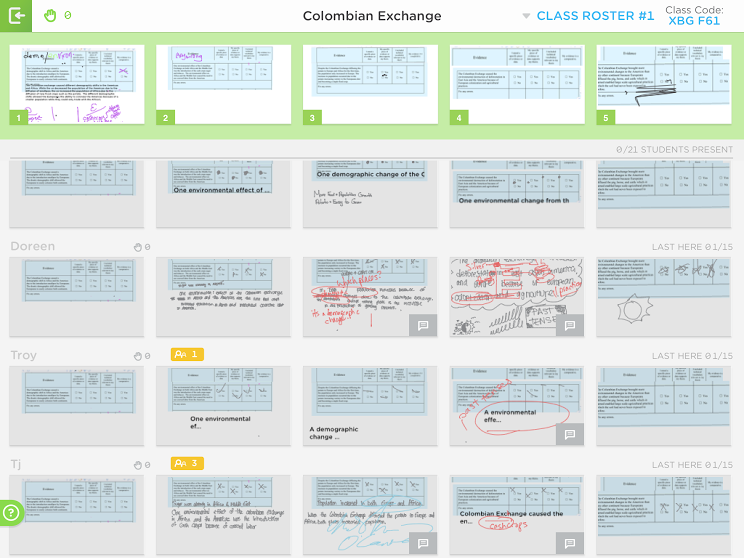
From Rachel's remark, I quickly created a lesson using Classkick. The lesson focused on the analysis of evidence and student writing. The power of Classkick lies in the instant feedback it grants to the students and teacher. The teacher can select any student and view their work in real time. The teacher can comment on the information and the student receives the feedback in real time. IN REAL TIME!
Since it is in real time, the feedback is immediate. In the above image, the student wrote, "In both places." I circled which places, and then they inserted Europe and Africa. The whole process took less than thirty seconds. Since it was so fast, the student's learning progressed quicker than ever before, because they received almost instant feedback while in the writing process.
The above image is the teacher's view. The teacher can easily see the progress of all students. The teacher can click any square for a zoomed in view and the ability to provide feedback. A great part of this view is just watching students think and express themselves in real time. You don't have to be right next to the student, which allows students a degree of normalcy when writing. Furthermore, the teacher can display any work via AirPlay. Therefore, if a student writes something that is worthy of showing to the whole class, the teacher can easily display the work. The great thing, the teacher can display multiple student examples very quickly because of the central location of the work.
Game changer! I have heard this term used in education twice. The first time was from Persida Bujdei. She came into a peer observation group and was ecstatic about the power of AirPlay. She was right on the implications and power of AirPlay. AirPlay continues to be a game changer!
The second was from Rachel Barry. She came in after using Classkick for the first time. Game changer was all she said. After using it, I cannot say enough on how much of gamer changer Classkick is. Click here for the website. The website automatically plays an overview video that provides functionality of Classkick.
It is an amazing tool! The user can upload any pdf or image into Classkick. Classkick also connects with Google Drive. Any images or pdf already in Drive can be selected. Once uploaded, the user easily can select any part of a pdf.
From Rachel's remark, I quickly created a lesson using Classkick. The lesson focused on the analysis of evidence and student writing. The power of Classkick lies in the instant feedback it grants to the students and teacher. The teacher can select any student and view their work in real time. The teacher can comment on the information and the student receives the feedback in real time. IN REAL TIME!
Since it is in real time, the feedback is immediate. In the above image, the student wrote, "In both places." I circled which places, and then they inserted Europe and Africa. The whole process took less than thirty seconds. Since it was so fast, the student's learning progressed quicker than ever before, because they received almost instant feedback while in the writing process.
The student's work above shows their writing in purple and the teacher's feedback in red. The black is another student's feedback. That's right, the teacher can enable student to student feedback. And the student to student interaction occurs in real time! The student can click on the hand icon in the upper left hand of the screen. Once raised, teachers and students can help the person with the raised hand. Students can only help another student if the hand is raised. They can then comment. The primary user can always delete any comments written by the teacher or another student.
Students can work ahead if needed. Also, students can work on the task after the class ended. The last bonus I will raise, is the work is saved for later use.
Wednesday, October 28, 2015
Peer Observation: Round 2 (Post 2/4)
Colleen Mullaney's regular junior math class worked on a self-reflection document before the end of the quarter. On the front side of the reflection, students filled in their grades for each of the assessments of first quarter. Then on the back, they answered these four questions:
1) The quarter is ending on Friday. What are your thoughts about your grade where it is now?
2) What has gotten you to the grade that you have now? Is it the homework? The time spent in class?
3) Are all your assessments complete? Meaning have you taken them all? Or do you have a redo or missing?
4) What are you going to do to either maintain the grade you have or improve your grade before the semester ends?
1) The quarter is ending on Friday. What are your thoughts about your grade where it is now?
2) What has gotten you to the grade that you have now? Is it the homework? The time spent in class?
3) Are all your assessments complete? Meaning have you taken them all? Or do you have a redo or missing?
4) What are you going to do to either maintain the grade you have or improve your grade before the semester ends?
Anna Izzo's AP Italian class was peer editing a two-paragraph DBQ essay. Since this was the first one of the year, Ms. Izzo had students focus on writing an introduction and thesis statement. Then their peers were given a checklist with specific criteria to make sure they included the necessary information and supporting evidence from the article.
Subscribe to:
Posts (Atom)