Showing posts with label ACT prep. Show all posts

Thursday, November 3, 2016

Critical Thinking to Prepare for the SAT

By: Rachel Barry

In Illinois, we switched from the ACT to the SAT as our standardized test.  The math department's digital curricula were originally developed based on the ACT College Readiness Standards, however, we made some changes this summer to also prepare our students for the ACT.  You can read more about these changes here.  

One of the document templates of our regular math courses was an ACT10.  We have one of these documents developed for each skill that we teach our students.  The front side of the template presents students with approximately 5 ways that the ACT would question students on the current skill they were learning in class.  The back side of the template gives students a mix of 5 ACT-type questions of topics that students have already learned to reenforce their understanding.  Here is a sample of an ACT10 that was used in my regular level Algebra I class.  

These documents can still be used as warm-up problems and to help students gain an understanding of ACT-style questions, however, the SAT questions are set-up much differently.  The ACT focuses on one mathematical skill per question, while the SAT merges multiple skills into a question.  Therefore, we need to strengthen our students' critical thinking skills in order to perform better on the SAT.

Therefore, I started brainstorming and came up with a new template.  We have been doing a lot of work at Elk Grove High School to find commonalities throughout content areas, so I thought it was fitting to model this template after a science lab report.  Students are already accustomed to the process of writing a lab reports, and this format would help break down the SAT question for students.

Here is a sample of this SAT template:


This document helps in two ways: 1) forces students to slow down when solving the problem and 2) gives students who may be lost a place to start.  Students who benefit the most from the first way are those that know what to do, but make silly mistakes.  The conclusion part of checking their work helps force these students to double check their answers.  The students who benefit from the second way are those who defeat themselves before they start the problem.  These students may read the problem and immediately give up because they don't know what to do.  This step-by-step process helps students to break down the problem to show them that they may know how to do part of the problem.  Then, if they can find confidence in understanding part of the problem, they can try to critically solve the rest of it.  

Monday, February 22, 2016

Using Class Olympics to Motivate Students in ACT Practice

By: Rachel Barry

First off, I love the Olympics.  I believe that the Olympics motivates and unites people of various backgrounds in a common goal.  I enjoy the multitude of events, the rivalry and comradery of athletes, the interactions of people from multiple countries...I could go on and on.    So I thought, "Why not bring this to my classroom?"  

Now, I should preface this by noting that I have already tried implementing the Olympics in my classroom four years ago.  The first time around, I will be honest, I bit off more than I can chew.  I gave too many ways for students to win medals, I switched groups too often, and it became very cumbersome to keep up with.  

This year, I decided to develop the Winter Olympic Games focused around our weekly 10 ACT questions.  As part of our curriculum, we have created one set of 10 standardized-test questions for each of our skills.  Throughout first semester, students completed these either on paper or the Socrative app, but I could sense that students were getting bored by these methods.  This is why I chose to develop the Winter Games around these ACT questions, to re-engage my students when heading into the ACT.

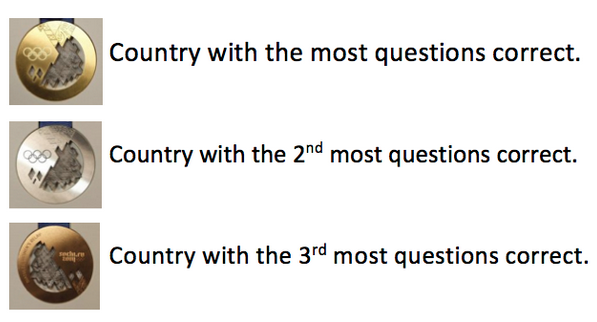
For the Games, I placed students into groups based on EPAS scores, so that the groups are balanced in ability.  Each group chose a country that they would be representing.  For the competition, students would work individually on the ACT questions for 8 minutes, and then have 3 minutes to discuss with their group members.  Upon completion of the 11 minutes, each country would submit one final set of answers.  The medals (gold, silver, broze) are awarded as such:

To add motivation each week, the team that gets a gold medal chooses candy from my candy bucket.  


The weekly medals get converted into points:

Gold = 3 points
Silver = 2 points
Bronze = 1 point

I'm keeping track of all of these scores in a GoogleDoc that is shared with my students on Schoology.  

In the end, the winning country gets to pick from a grab bag of items!


In the early stages of the Winter Olympics, I have found students taking these questions more seriously. I don't necessarily know whether this is due to the ACT date coming up in April, the ability to discuss with peers, or the rewards of candy and grab bag items, but I like that they seem to have a resurgence of motivation. I also find the conversations to be intriguing. Students are defending their opinions as to why they believe a question is correct, some students are explaining to others how to answer a problem, and some are just feeling more confident in their own abilities without second-guessing themselves. It is always really exciting to witness students helping one another out and fighting over correct answers in math problems!

Tuesday, March 3, 2015

Individualized ACT Math Prep

By Rachel Barry

In light of Illinois state testing this week, I decided to use this blog post to reflect on our ACT test prep course.  Four years ago, my coworker Ami Heng and I took over the math portion of the ACT prep course at our school.  We wanted to develop a course that was more individualized and technology-based for our students.  Our modes of providing resources to students have changed over time, as we originally had students using a Google Site on desktop computers and now students have a Schoology course on their own iPad, however, the process is very similar.  

Before I dive into our course, I would like to provide you with a little background information.  The ACT math test is based on eight pillars of topics in mathematics:


Ami and I read through numerous retired ACT tests to see which of these topics showed up the most often and analyzed data from prior junior classes to see which standards students struggled with the most.  Of the 126 standards, we chose to focus on a core of 62 standards.  As needed we have added some additional standards over the past couple years.

Our course is split into four days of math.  We paired the skills based on topic and number of standards under each category:

The BOA standards were covered in daily exit slips because students constantly struggle with word problems and the ACT is inconsistent with the types of questions asked in this category.

Each day, students would take a pre-assessment on a specific CRS band of skills, one question per standard.  Following the warm-up quiz, students would identify all of the topics that they got wrong.  This is where the individualization came into play; students would begin working on their own skills of weakness instead of going over topics that only some of the class needed help with.  

For each incorrect standard, there was a folder on Schoology.  In each folder, students would have four to five items, depending upon if there was a graphing calculator component to the standard.  Here is the folder for GRE 504: Midpoint of a Line Segment:


First, the students would watch a video, recorded using the Educreations app, talking them through the problem that they got wrong on the pre-assessment.  Then, they would watch a short lecture video on the topic (a notes sheet is provided).  The calculator video is optional, as it walks students through the steps to solve these types of problems using the graphing calculator.  Next, students download a set of 3-5 practice problems into their Notability app.  Upon completion, they type their answers into the Practice Quiz to see how they performed.  


This process would be repeated for all questions that they had answered incorrectly.  As mentioned before, the benefit to this model was that students were each addressing their individual weaknesses.  I observed increased engagement in students because the material was meaningful to them and their time was preserved.  With approximately every three new skills that a student masters, their ACT math score will go up a point.  With their weaknesses addressed in this course, students are provided with a targeted approach to success.

Another benefit is that the use of technology allows for students to continue to work on these topics outside of our meeting time.  I see Schoology notifications at all hours that tell me that students are working on this course.  Students can e-mail me outside of class if they are struggling with some of the practice problems.  Overall, I feel that students have been able to improve their scores with this individualized method of ACT prep.

Thursday, February 12, 2015

Socrative for Formative Assessment


Formative assessment is crucial for teachers to understand each student’s strengths and weaknesses as well as providing feedback prior to a summative assessment.  We have already discussed some tools for formative assessment in Mark Heintz's prior blog post, which discusses the use of Moodle and Schoology assessments to increase student motivation. I have also found that the data features of Socrative make it a great technology tool to foster immediate feedback to students while also providing teachers with a detailed report of both individual student and whole class performance.  

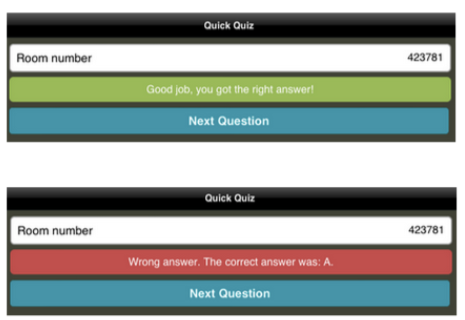
My PLT has created a worksheet of ten PLAN or ACT multiple choice questions per topic.  Socrative has been a great tool to convert these ten questions into an interactive tool while also providing students with immediate feedback:
Screen Shot 2015-02-05 at 2.05.38 PM.png


I find that this feedback fosters more questions with my students of how to get the correct answer. Students go back to look at what they did wrong, instead of just accepting their score out of ten.  The comments of “Oh I thought that was the right answer!”,  “Oh, I forget the negative sign!” or something of the sort are a regular occurrence.  The immediate feedback provides students with a quick reflection piece before moving on to the next question.

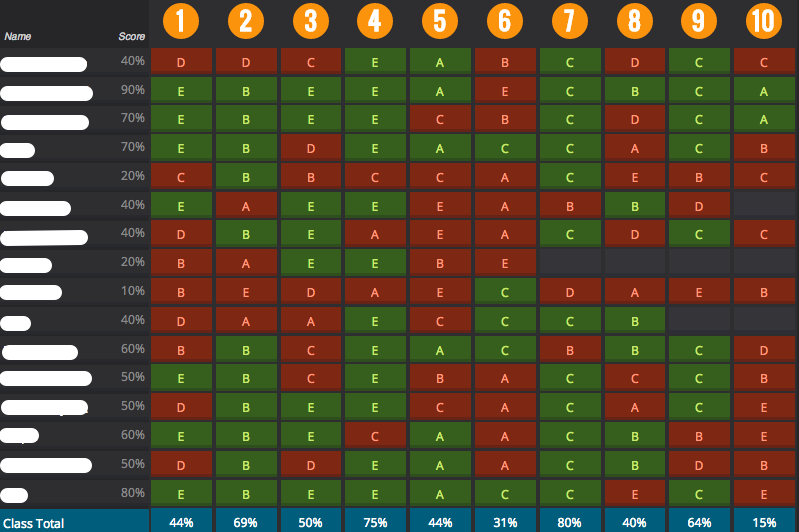
The live teacher report provides me with both individual and group information.  

Screen Shot 2015-02-09 at 2.32.56 PM.png

First, I am able to track my students’ paces. (Are they moving too quickly through the questions?  Should I have a conversation of time management with a student who spends too much time on one problem?) Next, I am able to target specific class needs, using the percentages of student success marked at the bottom. I use these percentages to determine which question(s) to go over with the whole class following completion of the activity as well as identify which skills I need to spiral back into the curriculum.  I also address individual student needs, especially in terms of multiple choice test-taking strategies.  Lastly, these reports are saved to your account, so I look back prior to unit tests, final exams, or when working over the summer on the course curriculum to target common mistakes with our population of students.